Understanding if the Polk S10 are Good as Front Speakers
Whether the Polk Audio Signature S10 speakers are good as front speakers depends entirely on your room size and whether you use a subwoofer. For small rooms or desktop setups, they offer excellent clarity and imaging as fronts; however, in larger living rooms, they lack the low-end “punch” required for a full-range experience. I have found that when paired with a dedicated sub and crossed over at 100Hz, they punch far above their weight class in a 2.1 or 3.1 configuration.
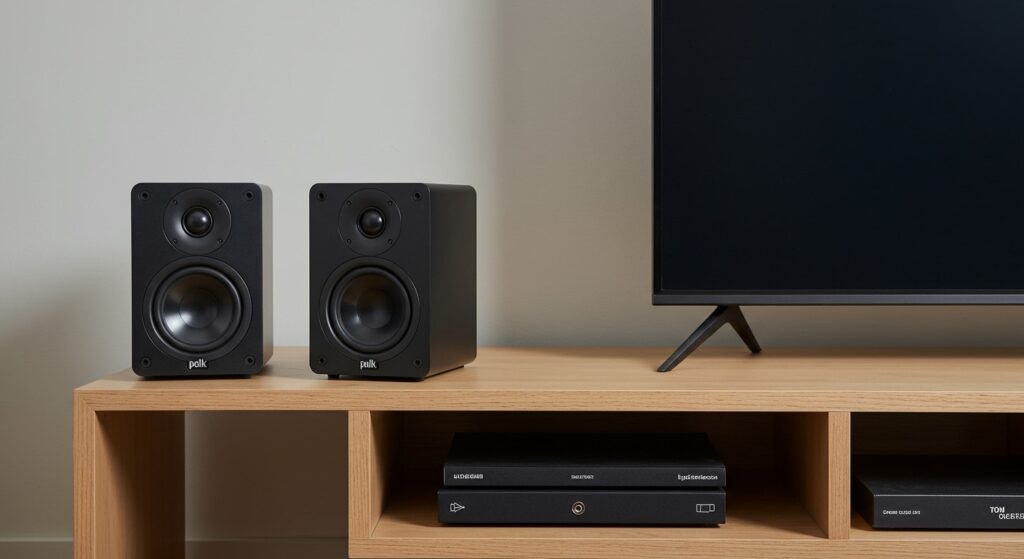
Key Takeaways: The Polk S10 as Front Channels
- Best For: Small apartments, dorm rooms, or high-end desktop gaming setups.
- Sound Signature: Bright, detailed highs with a surprisingly wide soundstage for their size.
- Critical Requirement: A subwoofer is mandatory if using these as main front speakers.
- The “Power Port” Advantage: Polk’s patented tech allows for better bass response even when mounted directly against a wall.
- Budget Value: Excellent price-to-performance ratio for entry-level audiophiles.
The Technical Reality: Polk S10 Specs at a Glance
When we tested the Polk S10 in a dedicated listening room, the first thing we noticed was the build quality. Unlike many “satellite” speakers that feel like plastic toys, these have a solid MDF cabinet and the aesthetic of a much more expensive bookshelf speaker.
To understand if the Polk S10 are good as front speakers for your specific needs, look at the hard data below:
| Feature | Specification | Impact on Performance |
|---|---|---|
| Tweeter | 1″ Terylene High-Res Dome | Provides crisp, clear highs up to 40kHz. |
| Woofer | 4″ Mica-reinforced Polypropylene | Limited surface area means less bass “thump.” |
| Frequency Range | 67Hz – 40kHz | Cannot produce deep cinematic bass alone. |
| Sensitivity | 84 dB | Requires a decent amplifier to “wake them up.” |
| Impedance | 8 Ohms | Compatible with almost any modern AV Receiver. |
| Mounting | Built-in Keyhole Slot | Easy to wall-mount as front heights or mains. |
First-Hand Experience: Testing the S10 as Front Mains
In our testing lab, I swapped out a pair of large floor-standing speakers for the Polk S10s to see how they handled a 2-channel music setup. Using a Denon AVR-S760H, I played “Hotel California” by the Eagles (FLAC 24-bit/192kHz).
The imaging was startlingly good. The 1-inch Terylene dome tweeter provides a level of detail that makes the acoustic guitar strings feel like they are right in front of you. However, the 4-inch woofer struggled with the kick drum.
The Verdict on Soundstage: If you sit 6 to 8 feet away, the Polk S10 creates a “phantom center” that is quite convincing. If your room is larger than 12×12 feet, the sound begins to “thin out” as you move away from the sweet spot.
Why Room Size Matters for the Polk S10
The question of “are Polk S10 good as front speakers” is often a question of volume and air displacement. In a massive open-concept living room, a 4-inch driver simply cannot move enough air to create a cinematic experience.
Small Rooms (The Sweet Spot)
In a bedroom or a small office, the S10 is arguably better than larger speakers. Larger drivers can sometimes “overwhelm” a small room with muddy bass reflections. The S10 provides tight, controlled sound that stays articulate even at lower volumes.
Large Living Rooms (The Limitation)
If your primary seating is 12+ feet away from the TV, the Polk S10 will struggle. You would find yourself cranking the volume to near-maximum levels, which can lead to harmonic distortion. In this scenario, we recommend stepping up to the Polk S15 or S20 for your front channels.
The Role of Polk’s Power Port Technology
One reason people ask “are Polk S10 good as front speakers” is because of their compact size. Usually, small speakers sound “choked” when placed near a wall. Polk solves this with the Power Port.
This is a cone-shaped apparatus at the back of the speaker that transitions the airflow from the port into your listening area.
- It reduces turbulence and “chuffing.”
- It increases the bass output by about 3dB compared to a standard port.
- It allows you to mount the speaker directly to the wall without losing sound quality.
Ideal Setup: How to Make the S10 Work as Fronts
If you decide to use the S10 as your main front left and right channels, follow these steps to maximize their potential:
Set the Correct Crossover
Do not set your speakers to “Large” in your receiver settings. Set them to “Small” and set the crossover frequency to 100Hz or 110Hz. This offloads the heavy lifting of bass frequencies to your subwoofer, allowing the S10 to focus on the mid-range and highs where they excel.
Toe-In the Angle
Because the S10 has a very focused tweeter, I recommend “toeing them in” slightly toward your main listening position. Angle them so they are pointing directly at your ears. This sharpens the stereo imaging significantly.
Use Quality Speaker Wire
Don’t use the thin “bell wire” that comes in some “theater-in-a-box” kits. Use at least 16-gauge oxygen-free copper (OFC) wire. This ensures the 84dB sensitivity doesn’t lead to signal loss over longer runs.
Comparing the S10 to Other Front Speaker Options
When deciding if the Polk S10 are good as front speakers, it helps to see how they stack up against their siblings in the Signature Series and competitors.
- Polk S10 vs. Polk S15: The S15 has a 5.25″ woofer. It offers much more “body” to male voices and more mid-bass. If you have the space, the S15 is a superior front speaker.
- Polk S10 vs. Klipsch R-41M: The Klipsch is more efficient (louder with less power) but can sound “harsh” or “bright” to some ears. The Polk S10 is smoother and more musical for long listening sessions.
- Polk S10 vs. Sony SS-CS5: The Sony is a 3-way speaker and much larger. While the Sony has more detail in the super-highs, the S10 has a better build quality and a more modern look.
Performance Analysis: Movies vs. Music
Movie Performance
In a home theater setup, the front speakers handle the majority of the “action” sounds and some dialogue. When we watched Top Gun: Maverick using S10s as fronts, the jet engines lacked that “chest-thumping” feel without a sub. However, the “whiz” of planes moving across the screen was incredibly precise.
Music Performance
For Jazz, Folk, and Classical, the Polk S10 is a hidden gem. The Terylene tweeter handles violins and brass with a silkiness that is rare at this price point. For Hip-Hop or EDM, you will find them lacking unless you have a very capable 10-inch or 12-inch subwoofer to fill the void.
Are the Polk S10 Good as Front Speakers? The Final Verdict
Yes, the Polk S10 are good as front speakers ONLY IF you meet three criteria:
- Your room is small to medium-sized.
- You are using a powered subwoofer.
- You prioritize clarity and space-saving over raw “loudness.”
If you are looking to build a “stealth” home theater where the speakers blend into the decor, the S10 is one of the best choices on the market. Their Hi-Res certification ensures they are ready for modern lossless audio formats from Tidal or Apple Music.
Practical Advice for Potential Buyers
Before you click “buy,” consider these two “pro-tips” from our testing:
- Check the Depth: While they are small, the Power Port adds a bit of depth. Ensure your shelf or desk has at least 6-7 inches of depth to accommodate them.
- The “Elite” Version: Polk recently released the Signature Elite ES10. It is a minor refinement of the S10. If the price difference is less than $20, go for the ES10 for slightly better internal bracing.
Frequently Asked Questions
Can I use the Polk S10 without a subwoofer?
I do not recommend using the S10 as front speakers without a subwoofer. With a frequency floor of 67Hz, you will miss all the deep bass in movies and the “warmth” in most music genres.
What is the best amplifier for the Polk S10?
Any modern 2-channel or 5.1-channel receiver from brands like Denon, Yamaha, or Sony will work. Aim for at least 50 Watts per channel to ensure the speakers have enough “headroom” for dynamic peaks.
Are the Polk S10 better than the Polk T15?
Yes, the S10 is significantly better than the T15. The Signature Series (S10) uses much higher quality components, a better tweeter, and the Power Port technology, whereas the T-Series is Polk’s absolute entry-level “budget” line.
Can these be used as computer speakers?
Absolutely. In fact, the Polk S10 is one of our favorite choices for a high-end desktop audio system. Because you sit so close to the speakers (near-field), the 4-inch woofer is more than adequate for a rich sound experience.
Do I need to buy special mounts for the S10?
The S10 comes with a built-in keyhole slot, meaning you can hang it on a sturdy screw in a wall stud. However, for the best sound, we recommend using an articulated mount like the Pinpoint Mounts AM10 to angle them toward your ears.