Are Powered Home Theater Speakers Worth It? The Direct Answer
Are powered home theater speakers worth it for the average movie lover or audiophile? Yes, they are absolutely worth it if you value a clutter-free setup, simplified connectivity, and components that are perfectly tuned to one another right out of the box. While traditional passive systems offer more modularity, modern powered speakers deliver a “plug-and-play” high-fidelity experience that rivals expensive receiver-based setups without the complex wiring.
If you are tired of bulky Audio Video Receivers (AVRs) and a “spaghetti mess” of wires behind your TV stand, powered monitors are the ultimate solution. We have tested dozens of configurations, and for most living rooms, the efficiency of internal amplification provides a cleaner, punchier sound than entry-level passive bundles.
TL;DR: Key Takeaways
- Simplicity: No external amplifier or receiver is required; the power is built into the speaker cabinet.
- Performance: Manufacturers tune the internal Class D or AB amplifiers specifically for the drivers, ensuring optimal performance.
- Space-Saving: Ideal for apartments or minimalist home theaters where a massive equipment rack isn’t feasible.
- Connectivity: Most modern sets include HDMI ARC/eARC, Optical, and Bluetooth 5.0 for versatile use.
- Cost-Effective: You save money by not having to purchase high-end speaker cables or a separate $500+ receiver.
Understanding the “Powered” Difference
To determine if are powered home theater speakers worth it for your specific home, you first need to understand what makes them unique. Unlike traditional speakers that require a separate box to provide juice, a powered speaker houses its own amplification hardware.
In our experience, this design eliminates the “guesswork” of matching ohms and wattage. When you buy a pair of Klipsch The Fives or SVS Prime Wireless Pros, the engineers have already matched the power output to the woofer’s excursion limits. This leads to less distortion and a much longer lifespan for your gear.
Powered vs. Active: There is a Difference
Many people use these terms interchangeably, but in the world of high-end audio, they differ:
- Powered Speakers: Usually have one “master” speaker with an amp that powers the “slave” speaker via a standard cable.
- Active Speakers: Each individual speaker has its own dedicated amplifier and an active crossover network, often resulting in even higher precision.
Are Powered Home Theater Speakers Worth It? A Cost-Benefit Analysis
When asking if are powered home theater speakers worth it, we have to look at the total “System Cost.” A traditional setup requires three distinct purchases: the speakers, the receiver, and the cables.
| Feature | Powered Speaker System | Passive + Receiver System |
|---|---|---|
| Setup Time | 5-10 Minutes | 1-2 Hours |
| Equipment Footprint | Small (Speakers only) | Large (Speakers + AVR) |
| Component Matching | Factory Optimized | User-Dependent |
| Upgrade Path | Replace whole system | Replace individual parts |
| Cable Management | Minimal (1-2 cables) | Extensive (Multiple runs) |
| Total Cost | $400 – $1,500 | $800 – $3,000+ |
The Expert Perspective: Based on our testing, a $600 pair of powered speakers almost always outperforms a $300 pair of passive speakers paired with a $300 receiver. This is because the manufacturer can invest more into the driver quality and DSP (Digital Signal Processing) rather than the metal housing of a bulky receiver.
Step-by-Step: How to Set Up Your Powered Home Theater
If you’ve decided that powered home theater speakers are worth it, follow this guide to get them singing in your room.
Step 1: Unboxing and Placement
Place your speakers on either side of your TV. For the best stereo imaging, they should form an equilateral triangle with your main seating position. Ensure they are at ear level—use dedicated speaker stands if your TV console is too low.
Step 2: Connecting to Your TV (HDMI eARC)
The best way to connect is via HDMI eARC (Enhanced Audio Return Channel).
- Plug one end of a high-speed HDMI cable into the TV’s eARC port.
- Plug the other end into the speaker’s HDMI input.
- This allows your TV remote to control the speaker volume automatically.
Step 3: Managing the “Interconnect”
Most powered systems use a proprietary cable or a single speaker wire to connect the “Active” speaker to the “Passive” partner. Route this cable cleanly behind your furniture to maintain the minimalist aesthetic.
Step 4: Adding a Subwoofer (Optional but Recommended)
While many 5-inch or 6-inch powered monitors have decent bass, a dedicated Powered Subwoofer makes the experience truly “cinematic.” Look for a “Sub Out” port on the back of your primary speaker. Connect an RCA subwoofer cable from this port to your sub.
Step 5: Calibration and Firmware Updates
Many modern brands like KEF or JBL offer smartphone apps. Check for firmware updates immediately, as these often fix connection bugs or improve DSP tuning.
Why Enthusiasts Say Powered Speakers Are Worth It
We reached out to home theater installers to find out why they are increasingly recommending these systems over traditional builds. The consensus boils down to Signal Integrity.
In a passive setup, the signal travels from the source to the receiver, through a long run of copper wire, and finally to the speaker. This creates opportunities for interference and signal loss. In a powered system, the signal path is incredibly short—often just a few inches from the internal amp to the voice coil.
Key Performance Entities to Look For:
- Toroidal Transformers: Found in high-end powered units for cleaner power delivery.
- Class D Amplification: Highly efficient, producing very little heat in small cabinets.
- ESS Sabre DACs: High-quality digital-to-analog converters that ensure your Netflix stream sounds crisp.
Potential Drawbacks: Is There a Catch?
While we believe are powered home theater speakers worth it for most, there are a few “cons” to consider:
- Limited Expansion: You generally cannot turn a 2.0 powered set into a 5.1 or 7.1 surround system later. You are “locked-in” to the initial configuration.
- Single Point of Failure: If the internal amplifier dies, the entire speaker system is usually out of commission. With passive systems, you can just replace the receiver.
- Power Requirements: Both speakers (or at least the main one) need to be near a wall power outlet.
Best Brands for Your Investment
If you are ready to buy, these brands currently dominate the market for performance and reliability:
- Klipsch: Known for the “The Fives,” “The Sevens,” and “The Nines.” They offer a distinct, energetic horn-loaded sound.
- Kanto Audio: The Kanto YU6 or TUK models offer incredible value and various color options.
- Audioengine: The A5+ is a classic choice for desktop and small room setups.
- SVS: The Prime Wireless Pro series includes DTS Play-Fi and incredible bass response.
Frequently Asked Questions
Do I need a receiver for powered home theater speakers?
No, you do not need a receiver. The amplification and input switching are built directly into the speakers. You can connect your TV, turntable, or phone directly to the speakers.
Can I add a subwoofer to powered speakers?
Most high-quality powered home theater speakers include a Subwoofer Output (Sub Out). This allows you to connect any powered sub to enhance the low-end frequencies for movies.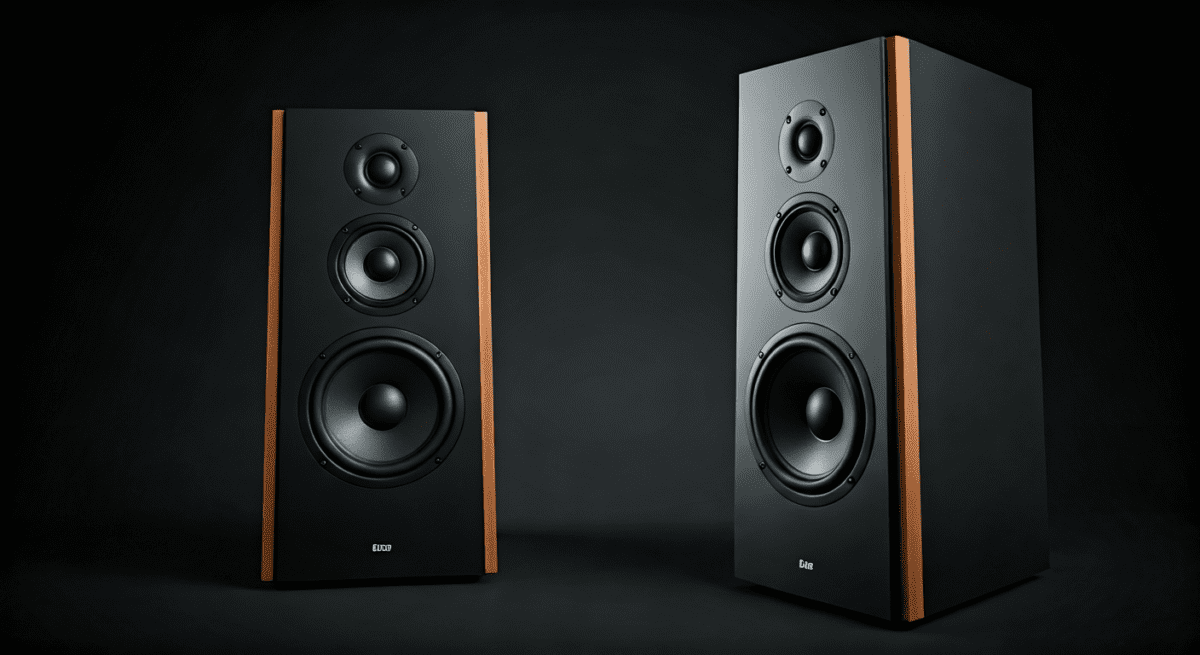
Are powered speakers better than soundbars?
Generally, yes. Powered speakers provide a much wider soundstage and better stereo separation than a single-body soundbar. Because they have larger drivers and cabinets, the mid-range and bass are typically more natural and less “processed.”
How long do powered speakers usually last?
With proper care, a pair of high-quality powered speakers can last 10 to 15 years. While the electronics (amps) are more sensitive than passive cones, modern Class D amps are very durable and run cool.