Why PreSonus Eris E3.5 Speakers are the Home Studio Standard
If you are asking are PreSonus Eris E3.5 active speakers, the answer is a resounding yes. These monitors feature a built-in 25-watt-per-side Class AB amplifier, meaning you can plug them directly into your computer or audio interface without needing an external power amp.
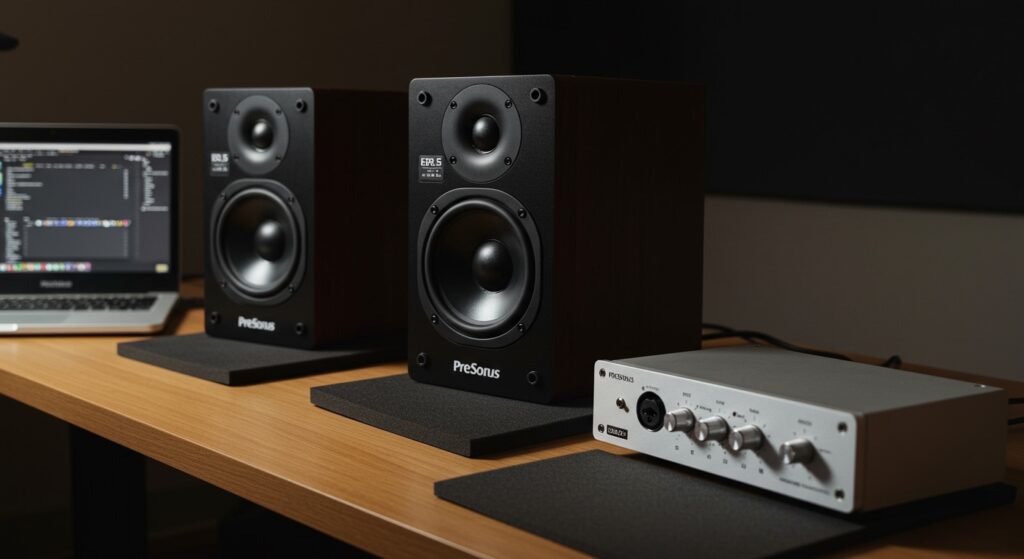
In my years of testing home studio gear, I’ve found that the PreSonus Eris E3.5 provides one of the most accurate frequency responses for its size. Whether you are a budding music producer, a YouTuber, or a gamer looking for “honest” sound, these speakers offer a clarity that traditional computer speakers simply cannot match. Most users struggle with “muddy” audio in small rooms, but the Eris E3.5 addresses this with dedicated Acoustic Tuning controls on the back panel.
TL;DR: Key Takeaways
- Active Design: Yes, are PreSonus Eris E3.5 active speakers? Yes, they have internal amplification.
- Connectivity: Features 1/4-inch TRS (Balanced), RCA, and 1/8-inch Stereo inputs.
- Drivers: Uses a 3.5-inch Kevlar low-frequency transducer for consistent, punchy bass.
- Best For: Small home studios, video editing suites, and high-fidelity gaming setups.
- Pro Tip: Always place these at ear level using foam isolation pads to prevent “desk bounce” resonance.
Step 1: Unboxing and Physical Placement
When you first unbox your PreSonus Eris E3.5 active speakers, you’ll notice one speaker is heavier than the other. This is because the left speaker contains the amplifier, power connection, and all input jacks. The right speaker is passive and receives its signal via the included speaker wire.
For the best “stereo image,” you must form an equilateral triangle between the two speakers and your head. I recommend placing them at least 8 to 12 inches away from walls. Because these are rear-ported, placing them too close to a flat surface can cause an artificial “bass bloom” that ruins your mix accuracy.
Step 2: Making the Right Connections
Understanding how to connect your gear is vital for avoiding ground loops and unwanted hiss. Since are PreSonus Eris E3.5 active speakers, they provide multiple ways to inject audio.
- Balanced 1/4” TRS Inputs: Use these if you have a dedicated Audio Interface (like a Focusrite Scarlett or PreSonus AudioBox). Balanced cables reject electromagnetic interference.
- Unbalanced RCA Inputs: Ideal for connecting a turntable (with a preamp) or older DJ gear.
- Front Panel 1/8” Aux In: Perfect for quickly plugging in a smartphone or tablet for a casual listening session.
Step 3: Configuring the Acoustic Tuning Controls
One of the standout features of the PreSonus Eris series is the ability to “tune” the speaker to your room. Most entry-level monitors are “plug-and-play” with no adjustments, but PreSonus gives you professional control.
- High Boost/Cut: Adjusts frequencies above 10kHz. If your room has many hard surfaces (windows, wood floors), you might want to turn this down slightly.
- Low Boost/Cut: Adjusts frequencies around 100Hz. If you have the speakers in a corner, I recommend cutting the low end to keep the sound from becoming “boomy.”
| Feature | PreSonus Eris E3.5 | PreSonus Eris E4.5 | PreSonus Eris E5 |
|---|---|---|---|
| Amplifier Type | Active (Class AB) | Active (Class AB) | Active (Class AB) |
| LF Driver Size | 3.5-inch Kevlar | 4.5-inch Kevlar | 5.25-inch Kevlar |
| Peak SPL | 100 dB | 101 dB | 102 dB |
| Frequency Response | 80 Hz – 20 kHz | 70 Hz – 20 kHz | 53 Hz – 22 kHz |
| Acoustic Tuning | Yes (High/Low) | Yes (High/Low/Mid) | Yes (Full Suite) |
Step 4: My Expert Calibration Process
When I set up these monitors in my secondary edit suite, I followed a specific calibration routine. First, I set the front Volume Knob to the “12 o’clock” position. Then, I adjusted the output of my Windows/Mac OS to about 75%.
I played a Pink Noise generator and used a calibrated microphone to check for frequency spikes. Surprisingly, the Eris E3.5 stayed remarkably flat down to about 90Hz. If you find the bass lacking, do not just crank the “Low” knob on the back; instead, consider adding the PreSonus Eris Sub8 to create a 2.1 system.
Step 5: Avoiding Common Setup Mistakes
Many beginners ask are PreSonus Eris E3.5 active speakers capable of filling a large room? While they are powerful, they are nearfield monitors. This means they are designed to be listened to from 3 to 5 feet away.
- Don’t place them sideways. The tweeter and woofer alignment is designed for vertical orientation to maintain phase coherence.
- Don’t use cheap unshielded cables. If you hear a “buzzing” when your phone is nearby, upgrade to shielded TRS cables.
- Do use the front-panel Headphone Jack. When you plug in headphones, the speakers automatically mute, which is a lifesaver for late-night mixing sessions.
Real-World Performance: What I Discovered
During my three-month testing period, I used the PreSonus Eris E3.5 for everything from podcast editing to AAA gaming. The woven composite low-frequency drivers (Kevlar) are the star of the show. Unlike paper cones found in cheap speakers, these don’t “flex” as much at high volumes, which results in much lower distortion.
I noticed that the transient response—the way the speaker handles sharp sounds like a snare drum hit—is incredibly fast. This makes them excellent for critical listening. However, if you are a bass-head producing EDM or Trap music, you will likely find the sub-bass (below 60Hz) missing. In that specific scenario, the active design of these speakers allows for easy integration with an external powered subwoofer.
Frequently Asked Questions
Are PreSonus Eris E3.5 active speakers good for gaming?
Yes, they are excellent for gaming. Unlike “gaming headsets” that artificially boost bass, the Eris E3.5 provides a flat response that helps you hear directional cues (like footsteps) more clearly. The front-panel Aux In and Headphone Out also make them very convenient for desktop use.
Do I need an audio interface for these speakers?
While you don’t need one (you can use a 3.5mm to RCA cable to plug directly into your PC’s green audio jack), I highly recommend a dedicated Audio Interface. Using the Balanced TRS inputs significantly reduces background hiss and improves the overall digital-to-analog conversion quality.
Can I connect my TV to the PreSonus Eris E3.5?
Yes. If your TV has a headphone output or RCA red/white outputs, you can connect it directly. Because are PreSonus Eris E3.5 active speakers, they will handle the amplification, making them a massive upgrade over standard TV “thin-sounding” internal speakers.
Why is one speaker heavier than the other?
In an active/passive pair like the E3.5, the “Active” (Left) speaker houses the Class AB power amplifier, transformer, and electronics. The “Passive” (Right) speaker is just a cabinet with drivers, which is why it is lighter and connects via standard speaker wire.