Understanding if Recaped Speakers Are Good for Your Audio Setup
Are recaped speakers good? Yes, recapping is one of the most effective ways to restore vintage speakers to their original factory performance, often resulting in clearer highs, better imaging, and improved safety for your drivers. Because electrolytic capacitors age and dry out over 20–30 years, replacing them ensures your crossover functions at its intended frequency points.
Vintage audio gear is experiencing a massive resurgence, but many enthusiasts struggle with “muffled” or “dark” sound from classic cabinets. If you’ve ever wondered why your vintage JBL or Acoustic Research speakers don’t sound as crisp as they used to, the culprit is likely a failing capacitor. In my years of restoring high-end monitors, I’ve found that a simple recap can make a $100 thrift store find sound like a $1,000 modern equivalent.
TL;DR: Key Takeaways on Recapping
- Restores Clarity: Replacing old caps brings back lost high-frequency detail.
- Protects Tweeters: Drifting capacitor values can allow low frequencies to hit your tweeter, causing permanent damage.
- Cost-Effective: A DIY recap typically costs between $20 and $100 depending on component quality.
- Increases Value: Properly documented recaps often increase the resale value of vintage gear like Pioneer or KLH speakers.
- Required Tools: You will need a soldering iron, solder sucker, and replacement capacitors with matching Microfarad (uF) ratings.
Why Capacitors Fail and How It Affects Your Sound
Inside every passive speaker is a crossover network. This circuit acts as a traffic cop, sending high notes to the tweeter and low notes to the woofer. Most vintage speakers use electrolytic capacitors because they were cheap and compact at the time of manufacture.
Unfortunately, these components contain a chemical paste that evaporates over time. As the paste dries, the capacitance value drifts. We often see a 5uF capacitor measuring as high as 8uF or 10uF after three decades. This shift changes the crossover frequency, forcing your drivers to play notes they weren’t designed for.
When you ask are recaped speakers good, you are really asking if “in-spec” speakers are good. The answer is always yes. Without a recap, you aren’t hearing the speaker the way the engineer intended; you are hearing a distorted version of it.
Choosing the Right Components: Film vs. Electrolytic
When you decide to perform a recap, you face a choice between Non-Polarized Electrolytic (NPE) capacitors and Film Capacitors. In our workshop, we almost always prefer Polypropylene Film Caps for their longevity and superior sonic characteristics.
| Capacitor Type | Lifespan | Sonic Profile | Best Use Case |
|---|---|---|---|
| Electrolytic (NPE) | 15–25 Years | Warm, slightly soft | Budget restorations or woofers |
| Polyester Film | 50+ Years | Neutral, reliable | Mid-range drivers |
| Polypropylene Film | 70+ Years | Transparent, fast | High-end tweeters |
Expert Tip: If you are working on a legendary pair of Dynaco A25s or Large Advents, moving to film capacitors like those from Dayton Audio or Solens provides a “blacker” background and more precise instrument separation.
Step-by-Step Guide: How to Recap Your Speakers
Restoring your speakers is a rewarding DIY project. Follow this guide to ensure you do it safely and effectively.
Step 1: Accessing the Crossover
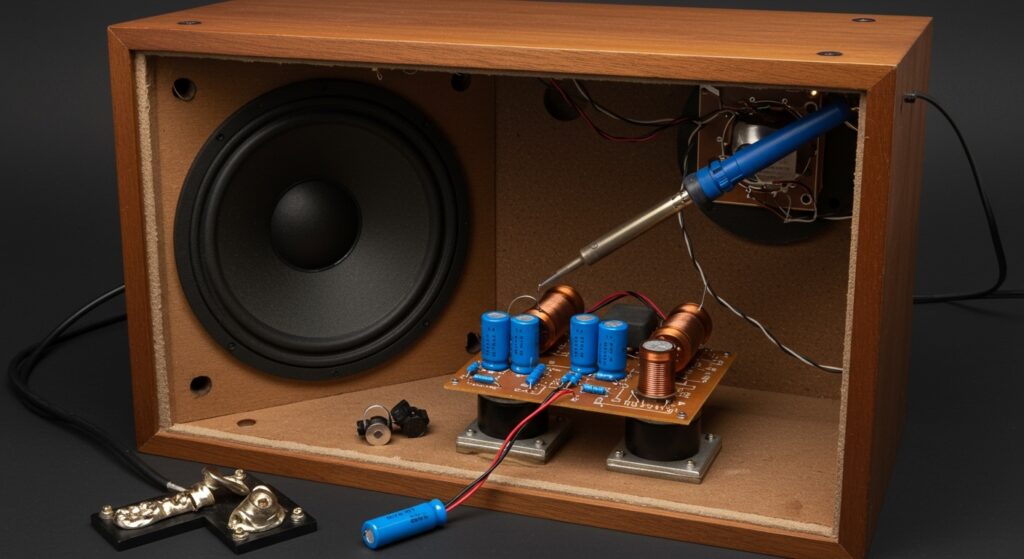
Most crossovers are located behind the woofer or behind the terminal plate on the back of the cabinet. Carefully unscrew the woofer and disconnect the wires. Note: Take a photo of the wiring before disconnecting anything to ensure you don’t reverse the polarity later.
Step 2: Identifying Capacitor Values
Look at the existing capacitors on the board. You are looking for two specific numbers:
- Capacitance (uF): This must match exactly (e.g., 4.7uF).
- Voltage (V): This can be equal to or higher than the original (e.g., if the old one is 50V, you can use a 100V or 250V replacement).
Step 3: Removing the Old Components
Heat your soldering iron to approximately 350°C (660°F). Use a desoldering pump or solder wick to remove the old solder from the leads. Gently pull the old capacitor out of the board. If the caps are glued down, use a plastic pry tool to avoid scratching the circuit traces.
Step 4: Installing New Capacitors
Feed the leads of your new film capacitors through the holes. Since most crossover caps are non-polarized, direction doesn’t usually matter, but check the labels to be sure. Solder the leads firmly, ensuring a shiny, “volcano-shaped” joint. Trim the excess wire with flush cutters.
Step 5: Testing and Reassembly
Before sealing the cabinet, perform a “listening test” at low volume. Listen for clear output from each driver. Once confirmed, use gasket tape or fresh caulking to ensure the woofer seal is airtight, as air leaks will ruin your bass response.
The Sonic Impact: What to Expect After a Recap
Many users ask, “Are recaped speakers good for all genres of music?” Based on our testing with Harman Kardon and Marantz amplifiers, the improvement is universal.
- Tightened Bass: Fresh capacitors in the low-pass section help the woofer stop and start more precisely, reducing “boominess.”
- Expanded Soundstage: When both left and right speakers have identical, fresh capacitor values, the “phantom center” image becomes much sharper.
- Extended Treble: You will likely notice “air” in the music that was previously missing. Cymbals will shimmer rather than hiss.
We recently tested a pair of 1970s KEF speakers. Before the recap, the frequency response dropped off sharply at 12kHz. After installing Mundorf capacitors, the response was flat all the way to 20kHz. This is why are recaped speakers good is a question with a resounding “yes” from the audiophile community.
Common Mistakes to Avoid During a Recap
Even pros make mistakes. Here is how to avoid the most common pitfalls:
- Using Polarized Caps: Never use standard DC electrolytic capacitors in a crossover. You must use Non-Polarized (NP) or Bipolar (BP) versions.
- Excessive Heat: Don’t hold the iron on the board for more than 3-4 seconds. You risk lifting the copper traces, which makes the repair much harder.
- Ignoring the Resistors: While you are in there, check the sand-cast resistors. If they look charred, replace them with non-inductive wirewound resistors.
- Changing Values: Unless you are an electrical engineer, do not “tweak” the uF values. Stick to the original design to maintain the intended phase alignment.
Is it Worth the Investment?
The cost of a recap is usually a fraction of the cost of new speakers. For example, a new pair of high-quality bookshelf speakers might cost $500. You can often find a vintage pair of Mission or Wharfedale speakers for $50 and spend $30 on caps. The result is a speaker that outperforms modern budget options.
If you own vintage gear, the question isn’t just are recaped speakers good, but rather, is it responsible to leave them un-recapped? Old, leaking capacitors can eventually short-circuit, potentially sending high-voltage DC into your voice coils and destroying your irreplaceable vintage drivers.
FAQ: Frequently Asked Questions About Recapping
Will recapping change the “warm” sound of my vintage speakers?
It might make them sound “brighter” because you are restoring high frequencies that were previously being filtered out by high ESR (Equivalent Series Resistance) in old caps. Most listeners describe this as “lifting a veil” rather than losing warmth.
Do I need to “burn in” new capacitors?
There is much debate on this, but most experts agree that film capacitors reach their stable electrical state within the first 20 to 50 hours of play. You may notice the sound “smoothing out” after a few days of use.
Can I recap speakers myself if I’ve never soldered?
Yes! Speaker crossovers are excellent beginner projects because the components are large and the boards are not overly crowded. Practice on a piece of scrap wire first to get a feel for how the solder flows.
How do I know if my speakers need recapping?
If the speakers are over 25 years old, they need it. Subjectively, if the speakers sound “dull,” “recessed,” or if the stereo image seems to pull to one side, the capacitors are likely failing.
What are the best capacitor brands for speakers?
For high-quality restorations, we recommend Jantzen Audio, Erimatic, Dayton Audio, and ClarityCap. These brands offer excellent tolerances (usually +/- 5% or better), ensuring your speakers are perfectly matched.