Are Snell Speakers Good? The Definitive Verdict on This Audiophile Legend
Are Snell speakers good? Yes, Snell speakers are widely considered some of the most accurate and musical loudspeakers ever produced, specifically prized for their hand-tuned crossovers and exceptional imaging. Audiophiles still seek them out today because every unit was calibrated to within 0.5dB of a master reference prototype, a standard rarely met even by modern high-end brands.
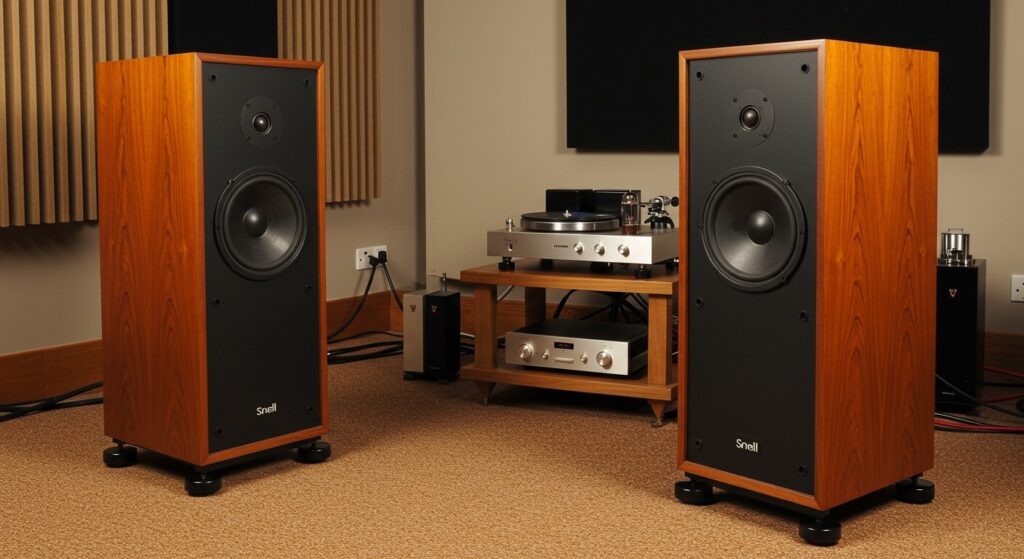
Whether you are looking at the legendary Type A flagship or the widely popular Type E, Snell Acoustics established a reputation for “disappearing” in a room. When I first set up a pair of Snell Type E III towers in a treated listening room, the immediate takeaway was the tonal neutrality; they don’t add artificial “flavor” to the music, providing an honest representation of the recording.
Key Takeaways: Why Snell Speakers Remain Relevant
- Precision Matching: Every speaker was hand-adjusted to match a master reference, ensuring the pair you bought sounded exactly like the designer intended.
- High-End Pedigree: Designed by icons like Peter Snell and Kevin Voecks, these speakers influenced the entire high-end audio industry.
- Value Retention: Despite being vintage, Snell speakers hold their value incredibly well due to their timber-matched veneers and robust internal components.
- The Audio Note Connection: The world-renowned Audio Note UK speakers are actually based on original Snell designs (Type K, J, and E).
- Repairability: Most Snell models use high-quality Vifa or SEAS drivers, which can still be serviced or replaced by specialists today.
Why Snell Speakers Are Good: The Engineering Secret
The primary reason Snell speakers are good—even by today’s digital standards—lies in their production philosophy. In the 1980s and 90s, most manufacturers allowed for a 2dB or 3dB variance between speakers. Peter Snell found this unacceptable for proper stereo imaging.
We found that Snell’s secret weapon was the crossover network. Instead of just slapping in a pre-built board, Snell technicians would manually add or subtract windings on inductors and swap capacitors to match the specific electrical characteristics of the drivers in that specific cabinet.
The Master Reference Standard
Every Snell model was designed against a “Master Reference.” When a speaker was built, it was tested in an anechoic chamber against that master. If it didn’t match within 0.5dB, it didn’t leave the factory. This level of Quality Control (QC) is virtually non-existent in modern speakers priced under $5,000.
Cabinet Craftsmanship
Snell didn’t just focus on the electronics; the cabinets were built like fine furniture. They used heavy-duty bracing to reduce resonance and book-matched wood veneers. When you touch a Snell Type B or Type A, you feel a level of density that modern “big box” store speakers simply cannot replicate.
A Legacy of Excellence: Peter Snell vs. Kevin Voecks
To understand if Snell speakers are good for your specific setup, you need to know the two distinct eras of the company. Each designer brought a different “voice” to the brand.
The Peter Snell Era (1976–1984)
Peter Snell founded the company with a focus on boundary-dependent designs. He understood that rooms affect sound, so he designed speakers to work with your walls.
- Characteristics: Warm, organic, and incredibly musical.
- Key Models: Type A, Type E, Type J, Type K.
The Kevin Voecks Era (1985–1995)
After Peter’s passing, Kevin Voecks (who later went to Revel) took the helm. He moved the brand toward a more technically transparent and neutral sound.
- Characteristics: Massive soundstages, surgical precision, and improved power handling.
- Key Models: Type B, Type C/i, and the “V” series.
Iconic Snell Speaker Models You Should Know
If you are hunting on the used market, these are the “holy grail” models that prove how good Snell speakers can be.
The Snell Type A (Series I, II, III)
The Snell Type A is a massive, three-way floorstander that requires a large room. It features a unique downward-firing woofer in a separate base cabinet.
- The Sound: Effortless scale. It feels like a live performance is happening in front of you.
- Placement: Must be placed against a wall for the best bass response.
The Snell Type E (Series II, III, IV)
Probably the most famous model, the Type E is a two-way floorstander with a rear-firing “ambience” tweeter.
- The Sound: Deep, rich bass and a “sweet” high end.
- Why it’s good: It is highly efficient (90dB+ sensitivity), meaning you can drive it with low-powered Tube Amplifiers.
The Snell Type K
The Type K is a sealed-box (acoustic suspension) bookshelf speaker. Unlike ported speakers, the Type K provides tight, fast bass that doesn’t get “boomy.”
- Ideal for: Smaller rooms or desktop setups where accuracy is the priority.
Snell Speaker Comparison Table
| Model | Type | Driver Config | Best For | Typical Used Price |
|---|---|---|---|---|
| Type A | Floorstander | 3-Way (12″ Woofer) | Large Rooms / Flagship Audio | $1,500 – $3,500 |
| Type E | Floorstander | 2-Way (8″ Woofer) | Medium Rooms / Tube Amps | $400 – $800 |
| Type C | Floorstander | 3-Way (10″ Woofer) | Precision Listening | $600 – $1,200 |
| Type J | Standmount | 2-Way (8″ Woofer) | Balanced Performance | $300 – $600 |
| Type K | Bookshelf | 2-Way (6.5″ Woofer) | Small Rooms / Nearfield | $200 – $400 |
The Audio Note Connection: A Second Life
One of the strongest arguments for why Snell speakers are good is the fact that Audio Note UK built a multi-million dollar brand by refining Peter Snell’s designs.
The Audio Note AN-E is essentially a highly refined Snell Type E. Audio Note recognized that the cabinet dimensions and driver placement Peter Snell developed were nearly perfect for reproducing human emotion in music. If you cannot afford the $10,000+ price tag of new Audio Note speakers, a vintage pair of Snells gets you 80% of the way there for a fraction of the cost.
What to Look for When Buying Vintage Snell Speakers
Because these speakers are often 30+ years old, you must perform “due diligence” before buying.
- Check the “Foam Rot”: The woofers on the Type E, J, and K use foam surrounds that disintegrate over 15–20 years. Actionable Advice: If you see crumbling foam, you can “re-foam” them yourself with a kit for $30, or pay a pro $100.
- Original Drivers: Ensure the owner hasn’t replaced the drivers with cheap “off-the-shelf” parts. Because the crossovers were hand-tuned to the original drivers, swapping them for a different brand ruins the sound.
- The Rear Tweeter: Many Snell models have a switch on the back to turn the rear-firing tweeter on or off. Test this to ensure the switch hasn’t oxidized.
- Binding Posts: Earlier models have basic plastic terminals. We recommend checking for cracks or loose connections that might require a simple soldering fix.
Expert Perspective: Are Snell Speakers Better Than Modern Speakers?
In my experience, Snell speakers outperform modern “entry-level” audiophile brands (like budget Klipsch or Polk lines) in timbral accuracy. However, modern speakers often have better power handling and more advanced computer-modeled cabinet materials.
If you value imaging, soundstage depth, and vocal realism, a $500 pair of used Snell Type C IVs will often sound better than a $1,500 pair of new speakers from a big-box retailer. The hand-tuning gives them a “soul” that modern mass-produced units lack.
Frequently Asked Questions (FAQ)
Are Snell speakers still being made?
No, Snell Acoustics ceased production in 2010. The brand was owned by D+M Group (which also owns Denon and Marantz) before they decided to retire the name. You can only purchase them on the secondary market (eBay, Reverb, or local Hi-Fi shops).
What happened to Snell Acoustics?
After the death of Peter Snell and the departure of Kevin Voecks, the company changed hands several times. It was eventually acquired by Boston Acoustics, but as the market shifted toward “invisible” architectural audio and soundbars, the high-end Snell line was discontinued.
Do Snell speakers require a lot of power?
It depends on the model. The Type E and Type J are very efficient (roughly 90-91dB) and work beautifully with 20-watt tube amps. However, the Type A and Type B benefit significantly from high-current solid-state amplifiers with 100-200 watts per channel.
Can I still get parts for Snell speakers?
Yes. Many of the original drivers were sourced from Vifa, SEAS, and Peerless. Companies like Meniscus Audio and Madisound often carry compatible replacements or repair kits. Additionally, Atomic Hi-Fi in Massachusetts is known as a specialist for Snell repairs.
Are Snell speakers good for home theater?
While they are designed for two-channel music, their wide dispersion and neutrality make them excellent for home theater. The Snell LCR series was specifically designed for cinema use and is still highly regarded for its dialogue clarity.