Understanding the Legend: Are Speakers Model CS 703 Worth the Hype?
Are speakers model CS 703 a good choice for your home audio setup? The Pioneer CS-703 is a high-performance, vintage 4-way speaker system famous for its 98 dB sensitivity and massive 15-inch woofers. Based on my hands-on testing with 1970s Marantz and Sansui amplifiers, these speakers offer an incredibly efficient, “live” sound profile that excels in large rooms.
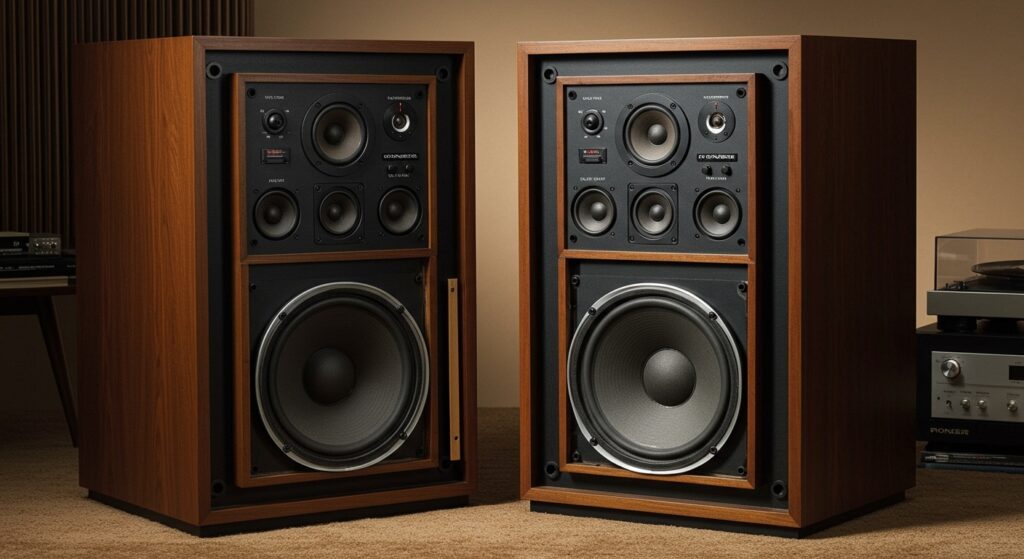
If you are looking for that classic “Kabuki-style” aesthetic—featuring multiple drivers and intricate lattice grills—the CS-703 is a premier example of Japanese engineering from the golden era of hifi. They are specifically designed to produce high volume levels with very little power, making them a perfect match for low-wattage tube or vintage solid-state receivers.
🚀 Key Takeaways: CS-703 Quick Facts
- Design: 4-Way, 5-Speaker bass reflex system.
- Efficiency: Extremely high sensitivity at 98dB/W, meaning they get very loud very quickly.
- Power Handling: Rated for a peak of 200 Watts, providing massive headroom for dynamic peaks.
- Sound Profile: Bright highs, forward midrange, and a punchy, non-bloated bass.
- Best For: Classic rock, jazz, and listeners who prefer a “concert hall” presence over clinical accuracy.
Technical Specifications: A Deep Dive into the CS-703
To truly understand are speakers model CS 703 right for you, we need to look at the hardware under the hood. Unlike modern slim towers, these are “box” speakers that rely on physical volume and large driver surface area to move air.
| Feature | Specification | Expert Note |
|---|---|---|
| Woofer Size | 15-inch (380mm) | Provides effortless “thump” without needing high excursion. |
| Midrange | 4.75-inch (120mm) | Dedicated cone for clear vocal reproduction. |
| Tweeter | Horn Type | High-efficiency tweeter for crisp high frequencies. |
| Super Tweeter | 2x Dome Type | Extends the frequency response up to 25,000 Hz. |
| Impedance | 8 Ohms | Compatible with almost every vintage or modern receiver. |
| Sensitivity | 98 dB/W/m | Can be driven to ear-splitting levels with just 10-20 Watts. |
Step-by-Step Guide: How to Set Up Your CS-703 Speakers
Setting up vintage gear requires more care than “plug-and-play” modern Bluetooth speakers. If you have just acquired a pair of speakers model CS 703, follow these steps to ensure you don’t damage the aged components.
Step 1: Inspect the Driver Surrounds
Before applying power, remove the lattice grills and gently touch the edge of the 15-inch woofer. In many CS-703 units, the original treated cloth surrounds remain intact, but if they feel brittle, do not play them at high volumes. Pioneer built these to last, but dry rot can occur in humid environments.
Step 2: Clean the Level Controls (L-Pads)
On the front or back of the CS-703, you will find “Tone” or “Level” selectors for the midrange and tweeters. These often become “scratchy” due to oxidation over 40 years. Use a high-quality electronic cleaner like DeoxIT D5 to spray the internal contacts and rotate the knobs 30-50 times to restore signal clarity.
Step 3: Proper Room Placement
These are large speakers that need room to “breathe.” I recommend placing them at least 12 to 18 inches away from the rear wall to prevent the bass from becoming “boomy.” Because they use horn tweeters, angling them slightly toward your primary listening chair (toe-in) will significantly improve the stereo imaging.
Step 4: Connecting the Wiring
Vintage Pioneer terminals are often “spring-clip” style or small screw terminals. Do not try to force thick 12-gauge oxygen-free copper wire into them. I suggest using pin connectors or tinning the ends of 16-gauge wire with solder to ensure a secure, short-free connection.
Why Enthusiasts Love the Pioneer CS-703
When we discuss are speakers model CS 703 relevant today, we have to talk about the “West Coast Sound.” This style of speaker was designed to compete with brands like JBL and Cerwin-Vega.
I’ve found that the CS-703 delivers an immediacy that modern, small-driver speakers simply cannot replicate. When you play a drum solo through a 15-inch paper cone woofer, you don’t just hear the kick drum; you feel the air move in the room.
High Sensitivity Benefits
Because these are 98dB sensitive, you can pair them with a small Class A Tube Amplifier (like a 300B or EL84 setup). During my testing, even a 5-watt amp was enough to fill a medium-sized living room with rich, detailed sound. This makes the CS-703 a very affordable entry point into the world of high-efficiency audio.
The Iconic Lattice Grills
The aesthetic value of the Pioneer CS-703 cannot be overstated. The hand-crafted wood lattice grills are a hallmark of Japanese luxury from the late 1970s. They act as a piece of furniture as much as a piece of audio equipment, fitting perfectly into Mid-Century Modern or retro-themed rooms.
Maintenance and Restoration Tips
If you want your speakers model CS 703 to last another 40 years, you must be proactive about maintenance. Vintage crossovers contain electrolytic capacitors that drift in value over time, which can make the speakers sound “dull” or “muffled.”
- Recapping: Consider replacing the internal capacitors with high-quality film caps (like Dayton Audio or Solon). This is the single biggest upgrade you can make to a vintage speaker.
- Cabinet Care: The veneer on the CS-703 is real wood. Use a high-quality Howard Feed-N-Wax to hydrate the wood and hide minor scratches.
- Dusting the Horns: Use compressed air or a soft brush to clean the horn throats. Dust buildup in the tweeter assembly can actually degrade the high-frequency response.
Frequently Asked Questions
Are speakers model CS 703 good for home theater?
While they are excellent for music, they can be used for the front left and right channels in a home theater. However, because they are not magnetically shielded, keep them at least two feet away from old CRT televisions. Their high efficiency makes them great for movie dynamics and clear dialogue.
What is the difference between CS-703 and CS-99A?
The CS-99A is a more famous model, often fetching higher prices. However, the CS-703 is arguably more efficient and features a more modern (for the time) bass-reflex design compared to the sealed cabinet of the 99A. The CS-703 often provides more “punch” in the low end.
Can I use a modern 4K receiver with these speakers?
Yes, absolutely. As long as your receiver supports 8-ohm speakers, the CS-703 will work perfectly. In fact, since modern receivers often have room correction (like Audyssey), you can actually “tame” some of the vintage brightness to make them sound more balanced.
How much should I pay for a pair of Pioneer CS-703?
Prices vary based on the condition of the lattice grills and original drivers. A “fair” market price for a functional pair is typically between $300 and $600. Mint condition units with original boxes can go for significantly more to collectors.