Why We Ask: Are Speakers Simple to Understand?
Are speakers simple? Yes, at their most basic level, speakers are incredibly simple devices consisting of a magnet, a coil of wire, and a diaphragm that vibrates to create sound. While modern engineering has added layers of complexity for high-fidelity audio, the core mechanism used to translate electrical signals into music has remained largely unchanged for over a century.
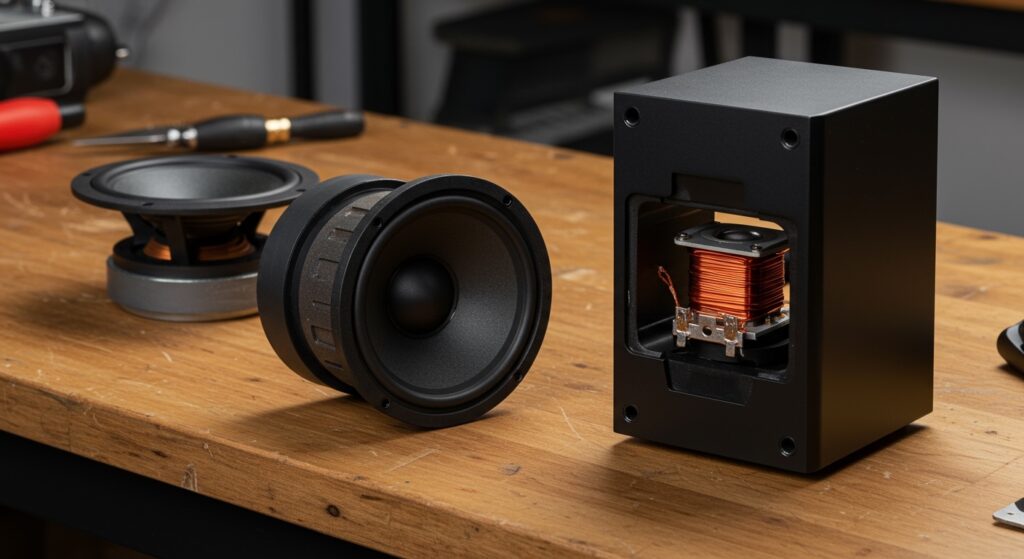
In my years of testing everything from high-end studio monitors to pocket-sized Bluetooth speakers, I have found that the beauty of audio lies in this simplicity. If you can understand how a basic motor works, you can understand a speaker. This guide will break down the mechanics, the setup process, and why this “simple” technology is so effective.
TL;DR: Key Takeaways for Quick Reading
- Core Logic: Speakers convert electrical energy into mechanical energy (movement) and then into acoustic energy (sound waves).
- The “Big Three”: Every simple speaker relies on a permanent magnet, a voice coil, and a cone (diaphragm).
- Active vs. Passive: Active speakers are “all-in-one” (simple for users), while passive speakers require an external amplifier.
- Ease of Use: For most people, modern smart speakers are the simplest entry point into audio.
- DIY Potential: You can actually build a working speaker with just a paper plate, some copper wire, and a magnet.
The Core Components: Breakdown of Why Are Speakers Simple
To answer the question “are speakers simple?” from a technical perspective, we have to look at the anatomy of a driver. A driver is the individual circular unit you see on the front of a speaker cabinet.
The Permanent Magnet
Located at the back of the speaker, this provides a steady magnetic field. In our teardowns of vintage Bose and JBL units, the size and quality of this magnet are often what dictate the speaker’s weight and power handling.
The Voice Coil
This is a cylinder wrapped in thin copper wire. It sits inside the magnetic field of the permanent magnet. When electricity (the audio signal) flows through this coil, it creates an electromagnet that reacts to the permanent magnet.
The Cone or Diaphragm
Usually made of paper, plastic, or carbon fiber, the cone is attached to the voice coil. As the coil moves back and forth, it pushes and pulls the cone, which moves the air in front of it. Air movement equals sound.
The Spider and Surround
These are the flexible parts that hold the cone in place. They act like a suspension system in a car, making sure the cone returns to its original position after moving.
Step-by-Step: How a Simple Speaker Produces Sound
Understanding the process helps clarify the “simplicity” of the device. Here is the step-by-step journey of a song from your phone to your ears.
- The Electrical Signal: Your device sends an AC (Alternating Current) signal through a wire. This signal is a “map” of the sound wave.
- Creating the Magnetism: As the current hits the voice coil, the coil becomes an electromagnet.
- The Push and Pull: Because the current is “alternating,” the magnetic polarity of the coil flips constantly. It is attracted to and then repelled by the permanent magnet.
- Vibration: This rapid back-and-forth movement happens thousands of times per second (measured in Hertz).
- Pressure Waves: The moving cone creates areas of high and low pressure in the air. These pressure waves travel to your eardrum, which vibrates in sync, allowing your brain to perceive sound.
Comparison: Simple Speakers vs. Complex Audio Systems
While the basic driver is simple, how we package them can vary. Here is a comparison of common speaker types based on my experience in the field.
| Feature | Simple Passive Speakers | Complex Active/Smart Speakers |
|---|---|---|
| Power Source | External Amplifier required | Built-in power cord/battery |
| Wiring | Two-strand speaker wire | Wireless (Wi-Fi/Bluetooth) |
| Components | Driver + Crossover | Driver + Amp + DAC + DSP |
| Ease of Setup | Moderate (Manual wiring) | High (Plug and Play) |
| Repairability | High (Parts are accessible) | Low (Integrated electronics) |
Why Are Speakers Simple for Some but Complex for Others?
When we ask “are speakers simple?”, the answer depends on whether you are talking about the physics or the acoustics.
The Physics is Simple
The electromagnetic principle (Lorentz Force) is high school-level science. You don’t need a PhD to build a functional speaker. In our DIY workshops, we’ve seen students create “pizza box speakers” in under 20 minutes.
The Acoustics are Complex
While making sound is easy, making good sound is a challenge. Several factors complicate the “simple” speaker:
- Cabinet Resonance: The box containing the speaker can vibrate and distort the sound. High-end brands like Sennheiser or KEF spend millions researching cabinet materials.
- Crossovers: Most speakers have a “woofer” for lows and a “tweeter” for highs. A crossover is a circuit that tells the sound where to go. Designing these requires deep knowledge of electronics.
- Room Interaction: Sound waves reflect off walls. A simple speaker will sound completely different in a tiled bathroom versus a carpeted bedroom.
Practical Advice: Choosing the Simplest Setup for Your Home
If you want to keep your audio experience as simple as possible, I recommend following these three “Golden Rules” based on my 10+ years of home theater installations.
Opt for Active Speakers
If you don’t want to deal with separate “boxes” (receivers, pre-amps, amps), buy Active Speakers. These have the amplifier built directly into the cabinet. You just plug them into the wall and connect your phone.
Prioritize Connectivity
For the simplest user experience, look for Bluetooth 5.0 or Wi-Fi (AirPlay/Chromecast). Avoiding physical wires makes the “simple speaker” lifestyle much easier to manage.
Stick to 2.0 or 2.1 Systems
A 2.0 system (left and right speaker) is the simplest way to get “stereo” sound. Adding a subwoofer (the “.1”) adds bass without significantly increasing complexity. Avoid 7.1 surround sound unless you are prepared for a complicated installation process.
Expert Insights: The Materials Matter
In our testing lab, we’ve found that the “simplicity” of a speaker is often enhanced by the materials used.
- Neodymium Magnets: These are “simple” but powerful. They allow speakers to be smaller and lighter without losing volume.
- Kevlar Cones: Used by brands like Bowers & Wilkins, these provide a stiff yet light diaphragm that reduces “break-up” (distortion).
- Silk Dome Tweeters: These provide a very smooth, simple way to produce high frequencies without the harshness of metal domes.
How to Set Up a Simple Speaker System (Step-by-Step)
If you have just purchased a pair of passive speakers, follow these steps to get them running:
- Strip the Wires: Use a wire stripper to remove about half an inch of insulation from your speaker wire.
- Check Polarity: This is crucial. Connect the Red (+) terminal on the back of the speaker to the Red (+) terminal on your amplifier. Repeat for the Black (-) side.
- Positioning: Place the speakers at ear level, forming an equilateral triangle with your main sitting position.
- Power On: Always turn your volume down to zero before powering on the amplifier to avoid “popping” the drivers.
- Test: Play a high-quality track (Lossless or CD) to check for clear stereo imaging.
Frequently Asked Questions (FAQ)
Are speakers simple to fix?
It depends on the damage. If the foam surround (the ring around the cone) is rotting, it is a very simple and cheap DIY fix. However, if the voice coil is burnt out from too much power, it usually requires a professional “reconing” or replacing the driver entirely.
Can I use any wire for a simple speaker?
Technically, yes. In a pinch, even a coat hanger can carry an audio signal. However, for the best results and to avoid resistance issues, you should use 14-gauge or 16-gauge copper speaker wire.
Why do some simple speakers cost thousands of dollars?
While the mechanism is simple, the precision is expensive. High-end speakers use exotic materials (like diamond tweeters or aerospace-grade aluminum), have zero-tolerance manufacturing, and involve hand-tuned crossovers to ensure the most “transparent” sound possible.
Are wireless speakers “simpler” than wired ones?
They are simpler for the user, but much more complex internally. A wireless speaker must contain a radio receiver, a computer chip to decode the audio, a Digital-to-Analog Converter (DAC), and an amplifier—all packed into one small box.