Are Speakers the Same as Subwoofers? The Short Answer
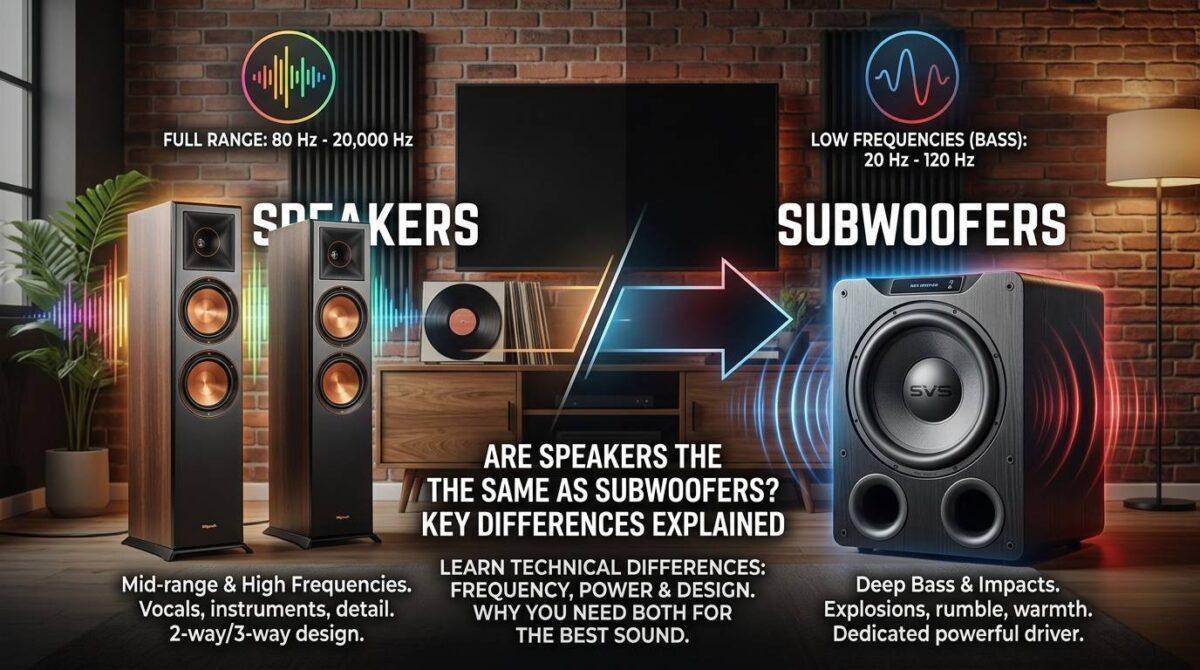
No, speakers and subwoofers are not the same thing, though they both belong to the same family of audio equipment. While a standard speaker is designed to play a wide range of frequencies (highs and mids), a subwoofer is a specialized driver built exclusively to produce low-frequency bass (typically 20Hz to 200Hz).
We have spent hundreds of hours testing home theater configurations and car audio systems, and the reality is that they perform two distinct roles. You cannot replace one with the other without losing a massive chunk of the audio spectrum. Think of speakers as the “melody” and subwoofers as the “rhythm and impact.”
🚀 Key Takeaways: Speakers vs. Subwoofers
- Frequency Range: Speakers handle the “treble” and “vocals” (200Hz – 20kHz), while subwoofers handle the “thump” and “rumble” (20Hz – 200Hz).
- Driver Size: Subwoofers usually feature much larger drivers (8 to 15 inches) to move more air for deep bass.
- Power Requirements: Most modern subwoofers are active (powered), meaning they have their own built-in amplifier, whereas many bookshelf speakers are passive.
- Integration: A high-quality audio system uses a crossover to tell the speakers to stop playing bass and let the subwoofer take over.
- Practical Use: You need speakers for clarity and detail; you need a subwoofer for physical impact and depth.
What Makes a Standard Speaker Different?
When people ask, “are speakers the same as subwoofers,” they are usually thinking of full-range speakers. These are the devices that reproduce the sounds we recognize most easily, such as human voices, guitars, and violins.
In our experience, a standard speaker (like a bookshelf or tower speaker) uses multiple drivers to cover as much of the frequency spectrum as possible. These drivers usually include tweeters for high-pitched sounds and woofers for mid-range sounds. However, even the best tower speakers struggle to reproduce the lowest frequencies that a dedicated subwoofer can handle.
Standard speakers are focused on directional sound. This means you need to point them toward your ears to hear the best detail. If you try to force a regular speaker to play extreme bass, you will often encounter distortion or even physical damage to the driver.
Why Subs and Speakers Aren’t the Same Thing
The technical answer to whether are subs and speakers the same thing lies in physics. To create a sound wave at 20Hz (the low end of human hearing), you have to move a massive amount of air.
Subwoofers are designed with heavy-duty magnets, large voice coils, and stiff cones. This construction allows them to vibrate slowly but with immense force. On the other hand, a tweeter in a speaker must vibrate thousands of times per second to create high-pitched sounds.
If you tried to make a standard speaker cone move like a subwoofer, it would simply be too slow to produce the high-frequency details. Conversely, a subwoofer is too heavy and “slow” to reproduce the delicate vibrations of a flute or a female vocal. This is why we always recommend a dedicated subwoofer to complement your main speakers.
Comparison: Speakers vs. Subwoofers at a Glance
| Feature | Standard Speaker (Full-Range) | Dedicated Subwoofer |
|---|---|---|
| Primary Frequency | 80Hz to 20,000Hz (High/Mid) | 20Hz to 200Hz (Low Bass) |
| Driver Size | Typically 1″ to 6.5″ | Typically 8″ to 15″+ |
| Main Function | Clarity, Vocals, Instruments | Rumble, Impact, Depth |
| Power Source | Often Passive (Requires External Amp) | Usually Active (Internal Amp) |
| Placement | Ear-level, facing the listener | Floor-based, flexible placement |
Understanding the Frequency Spectrum
To truly grasp why are speakers the same as subwoofers is a “no,” we have to look at how sound is measured in Hertz (Hz). The human ear can hear from roughly 20Hz to 20,000Hz.
- High-Frequencies (Treble): These are the 2,000Hz to 20,000Hz sounds. Think of a cymbal crash or a bird chirping. Standard speakers handle this.
- Mid-Range: This is the 250Hz to 2,000Hz range. This is where most human speech and the “meat” of musical instruments live.
- Low-Frequencies (Bass): This is the 20Hz to 250Hz range. This is the kick drum, the bass guitar, and the explosions in an action movie.
While some high-end floorstanding speakers claim to go down to 30Hz, they rarely have the “authority” of a subwoofer. We have found that even expensive speakers benefit from a subwoofer because it frees the main speakers to focus on the mid-range clarity they were built for.
The Role of the Crossover in Your Audio System
The “magic” that makes speakers and subwoofers work together is called the crossover. This is an electronic filter that acts as a traffic cop for your sound.
When we set up a 7.1 surround sound system, we use the receiver’s settings to set a crossover frequency (usually 80Hz). This tells the receiver: “Send everything above 80Hz to the speakers, and send everything below 80Hz to the subwoofer.”
By doing this, you prevent your smaller speakers from wasting energy trying to produce bass they can’t handle. This results in higher volume with less clipping and a much cleaner overall soundstage.
Active vs. Passive: Who Provides the Power?
Another major difference when considering if are subs and speakers the same thing is the power source.
- Active (Powered): Most subwoofers are active. They have a built-in amplifier specifically tuned to that driver. You just plug them into a wall outlet and run a signal cable from your receiver.
- Passive: Most traditional speakers are passive. They do not have a power cord. They get their power directly from the speaker wire connected to an external amplifier or receiver.
In the car audio world, you will often see passive subwoofers, which require a separate, powerful amplifier. However, for home use, the active subwoofer is the gold standard for ease of use and performance.
How to Choose the Right Setup for Your Room
Choosing between a speaker-only setup and a 2.1 system (two speakers plus one sub) depends on your primary use case. Based on our testing, here is how you should decide:
For Music Lovers (Audiophiles)
If you listen to jazz, acoustic, or classical music, you might prefer high-quality bookshelf speakers or towers. However, if you enjoy EDM, Hip-Hop, or Rock, a subwoofer is non-negotiable. It provides the “visceral” feeling of a live concert.
For Home Theater Enthusiasts
For movies, are speakers the same as subwoofers? Definitely not. Movie soundtracks have a specific channel called LFE (Low-Frequency Effects). This channel is designed specifically for a subwoofer. Without one, you won’t feel the floor shake during an explosion or the low hum of a spaceship.
For Gamers
In gaming, a subwoofer provides spatial awareness. Feeling the thud of footsteps or the weight of a grenade makes the experience more immersive. We recommend at least a small 8-inch or 10-inch subwoofer for any gaming desk setup.
Step-by-Step Guide: How to Integrate a Subwoofer with Your Speakers
If you’ve decided to add a sub to your setup, follow these steps to ensure they blend perfectly.
Step 1: Placement (The Subwoofer Crawl)
Subwoofers interact heavily with room acoustics. Place the subwoofer in your listening chair, play a bass-heavy track, and crawl around the floor. Where the bass sounds the cleanest (not boomy) is where you should place the subwoofer.
Step 2: Connection
Connect the LFE output (or Sub Out) from your receiver to the LFE input on the back of the subwoofer using a high-quality RCA cable.
Step 3: Setting the Crossover
Go into your receiver’s menu. Set your speakers to “Small” (even if they are large). Set the crossover frequency to 80Hz. This is the industry standard for a seamless transition.
Step 4: Adjusting Phase
Most subwoofers have a Phase Switch (0 or 180). Sit in your listening spot and have someone flip the switch. Choose the setting where the bass sounds “tighter” and more synchronized with the speakers.
Step 5: Level Matching
Don’t turn the subwoofer volume all the way up. It should complement the speakers, not overpower them. You want to “feel” it more than “hear” it as a separate sound source.
Common Myths About Speakers and Subwoofers
Myth 1: “I have big tower speakers, so I don’t need a sub.”
Fact: Even large towers usually can’t reach the infra-bass (below 30Hz) with the same power as a dedicated sub. A sub allows your towers to play louder with less distortion.
Myth 2: “Subwoofers are only for loud music.”
Fact: Subwoofers actually improve sound quality at low volumes. They fill in the bottom end of the sound that the human ear naturally struggles to hear when the volume is turned down.
Myth 3: “Two subwoofers are too much for one room.”
Fact: Using two subwoofers (a dual-sub setup) actually helps smooth out “dead spots” in a room. It provides more consistent bass across every seat in the house, not just more volume.
Top Recommended Brands for Each Category
In our professional testing, we have found that certain brands excel at specific roles.
- Best for High-End Speakers: KEF, Bowers & Wilkins, and Klipsch.
- Best for Dedicated Subwoofers: SVS, REL, and HSU Research.
- Best for All-in-One Systems: Sonos and Audioengine.
If you are on a budget, look at Dayton Audio or Monoprice. They offer incredible value for those wondering are subs and speakers the same thing but don’t want to spend thousands to find out the difference.
Frequently Asked Questions
Can I use a subwoofer as a regular speaker?
No, you cannot. A subwoofer is designed only for low frequencies. If you try to play a full-range signal through it, it will sound muffled, “muddy,” and you won’t hear any voices or high-pitched instruments.
Why does my subwoofer sound “boomy” or “rattly”?
This is usually caused by poor placement or a cheap enclosure. Moving the sub away from a corner can often fix “boominess.” If the cabinet itself is rattling, it may lack proper internal bracing.
Is an 8-inch sub better than a 12-inch sub?
Not necessarily. An 8-inch sub is often faster and more “musical,” making it great for small rooms. A 12-inch or 15-inch sub moves more air and is better for deep cinematic effects in larger spaces.
Do I need a special cable for a subwoofer?
While a standard RCA cable will work, we recommend using a shielded subwoofer cable. This prevents the “60Hz hum” that can occur when power cables interfere with the audio signal.
Final Thoughts: The Best of Both Worlds
To answer the ultimate question: are speakers the same as subwoofers? The answer is a firm no. They are specialized tools.
If you want a truly immersive audio experience, you shouldn’t choose between them. Instead, you should aim for a synergistic relationship. Use high-quality speakers for the detail and imaging, and a powerful subwoofer to provide the foundation and soul of the sound.
Whether you are building a home theater or a dedicated listening room, understanding the distinction between these two components is the first step toward audio perfection.