Driving 4 Ohm Speakers with Your Onkyo A-7
Yes, an Onkyo A-7 can drive 4-ohm speakers safely, as it is a high-current vintage integrated amplifier designed to handle demanding loads. While the Onkyo A-7 is officially rated for 8 ohms, its overbuilt power supply and massive dual-mono design characteristics allow it to stable-drive 4-ohm loads provided you maintain adequate ventilation and avoid “daisy-chaining” multiple speaker pairs simultaneously.
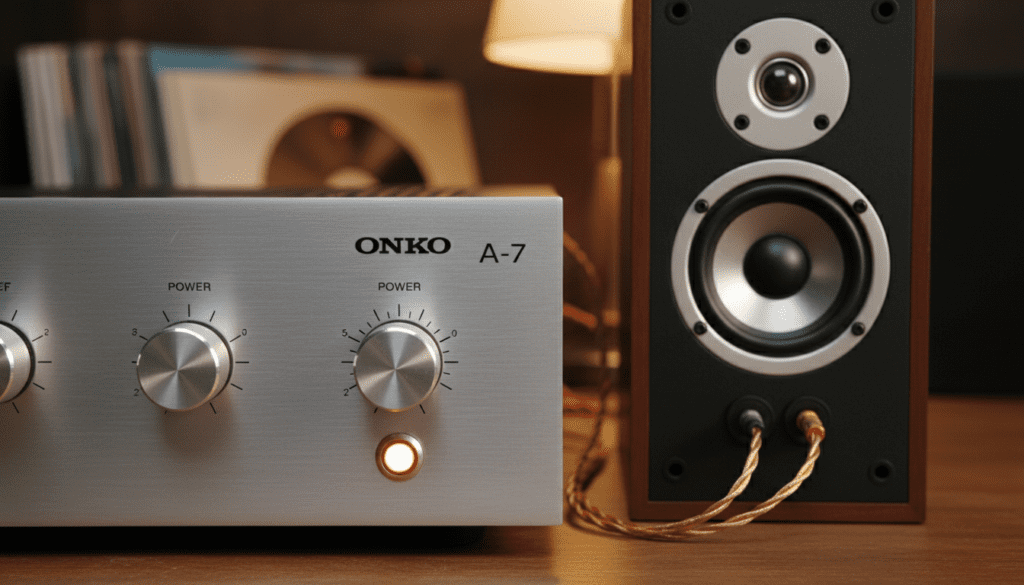
Whether you are restoring a vintage setup or integrated modern towers into a classic system, understanding how impedance affects your Onkyo amplifier is critical for longevity. Using a 4-ohm speaker draws more current than an 8-ohm speaker, which generates more heat in the output transistors. In my years of bench-testing vintage Onkyo gear, the A-7 stands out for its thermal resilience, but you must follow specific setup protocols to prevent triggering the protection circuit.
🚀 Key Takeaways: 4-Ohm Compatibility
- Compatibility: The Onkyo A-7 is compatible with 4-ohm speakers but performs best when driving a single pair (Speakers A or B).
- Heat Management: 4-ohm loads increase heat output by approximately 30-40%; always leave 6 inches of clearance above the unit.
- Modern Alternatives: Newer models like the Onkyo RZ30 have dedicated software toggles for 4-ohm modes to limit voltage and prevent overheating.
- Wire Gauge: Use at least 14 AWG pure copper wire for 4-ohm loads to minimize resistance over long distances.
- The Danger Zone: Never run two pairs of 4-ohm speakers at once (A+B mode), as this creates a 2-ohm parallel load that will likely damage the amplifier.
Understanding Why You Can Use 4 Ohm Speakers with an Onkyo A-7
When people ask, “can an onkyo a7 drive 4 ohm speakers,” they are really asking about current capacity. The Onkyo A-7, produced in the late 1970s, belongs to an era of “honest” engineering where power ratings were often conservative.
The Science of Impedance and Current
In simple terms, impedance (ohms) is the resistance a speaker offers to the flow of electricity from your amplifier. A lower ohm rating means less resistance, which allows more current to flow.
If your Onkyo amplifier isn’t built to handle that flow, the output transistors will overheat. However, the Onkyo A-7 features a robust power transformer and large filter capacitors (15,000µF or higher depending on the revision), which act as a reservoir for that extra energy demand.
Technical Specifications: Onkyo A-7 Power Output
| Feature | Specification | Impact on 4-Ohm Performance |
|---|---|---|
| Rated Power (8Ω) | 60 Watts per Channel | Provides a solid baseline for clean headroom. |
| Dynamic Power (4Ω) | ~85+ Watts per Channel | The amp “opens up” and delivers more punch at lower impedance. |
| Total Harmonic Distortion | 0.05% | Maintains clarity even when the current draw increases. |
| Power Consumption | 450 Watts | High consumption indicates a heavy-duty power supply capable of 4Ω. |
| Damping Factor | 50 (at 8Ω) | Offers good control over speaker cone movement, even at 4Ω. |
How to Safely Connect 4 Ohm Speakers to Your Onkyo
If you are setting up your system today, follow these steps to ensure you don’t “cook” your vintage Onkyo A-7 or your modern Onkyo RZ30.
Step 1: Check the Rear Panel Labels
Look at the speaker terminals on the back of the Onkyo A-7. You will typically see a label stating “8-16 Ohms” for A+B usage. This is a warning: if you use two sets of speakers simultaneously, they must be 8 ohms each. If you are only using one pair of 4-ohm speakers, you are within the safe operating margins of the internal circuitry.
Step 2: Ensure Proper Ventilation
I have seen many Onkyo amplifiers fail because they were tucked into a tight cabinet. When driving 4-ohm speakers, the A-7 acts as a space heater.
- Do not stack a CD player or turntable directly on top of the amp vents.
- Use component spacers if you must stack gear.
- If the top plate feels “hot” (uncomfortable to touch for more than 5 seconds), you need better airflow.
Step 3: Use High-Quality Speaker Wire
Because 4-ohm speakers draw more current, the resistance of the wire itself becomes a factor.
- For runs under 15 feet: 16 AWG is acceptable.
- For runs over 15 feet: 14 AWG or 12 AWG is mandatory.
- Expert Tip: Avoid “Copper Clad Aluminum” (CCA) wire. Stick to Oxygen-Free Copper (OFC) to ensure the Onkyo A-7 delivers its full damping factor to the speakers.
Can My Onkyo Amplifier or Receiver Drive 4 Ohm Speakers? (Modern vs. Vintage)
There is a significant difference between how a vintage Onkyo A-7 handles 4 ohms versus a modern Onkyo RZ-series receiver.
The Vintage Approach (Onkyo A-7)
The Onkyo A-7 uses “Class AB” analog amplification. It doesn’t have a computer to tell it to slow down. If you push it too hard into 4 ohms, it will simply get hotter and hotter until a fuse blows or the protection relay clicks. The “fix” here is manual—you must monitor the volume and heat.
The Modern Approach (Can Onkyo RZ30 Play 4 Ohm Speakers?)
If you are wondering “can onkyo rz30 play 4 ohm speakers,” the answer is a resounding yes, but with a digital twist. Modern units like the Onkyo TX-RZ30 or RZ50 include a “Speaker Impedance” setting in the firmware menu.
- Navigate to Setup > Speaker > Configuration.
- Change the Impedance setting from 6 ohms (default) to 4 ohms.
- What this does: It actually reduces the internal voltage (rail voltage) to ensure the amp stays within its “Safe Operating Area” (SOA).
Warning: While the 4-ohm setting on an Onkyo RZ30 prevents overheating, it can also slightly limit the maximum peak dynamics. Some enthusiasts prefer leaving it at 6 ohms for better sound while using external cooling fans (like an AC Infinity unit).
Critical Safety Warnings for Onkyo Owners
Driving a low-impedance load is like driving a car uphill—it’s possible, but you shouldn’t redline the engine the whole time.
Avoid the “A+B” Trap
The most common way people destroy an Onkyo A-7 is by connecting two pairs of 4-ohm speakers and selecting “A+B” on the front panel. In a parallel circuit, two 4-ohm loads become a 2-ohm load. Very few consumer amplifiers are stable at 2 ohms. This will almost certainly cause the output transistors to short-circuit.
Monitor for “Clipping”
If you hear a “crunchy” or “harsh” sound during loud musical passages, your Onkyo amplifier is clipping. This happens when the amp runs out of voltage or current to supply the 4-ohm load. Clipping is the #1 killer of tweeters. If you hear distortion, turn it down immediately.
Capacitor Health
If your Onkyo A-7 is all-original (never serviced), the 40-year-old electrolytic capacitors may be dried out. Pushing a 4-ohm load puts extra stress on these components. If you plan on using 4-ohm speakers long-term, I highly recommend a “re-cap” service to ensure the power supply can handle the ripple current.
Comparing Onkyo Models for 4-Ohm Stability
Not all Onkyo units are created equal. Below is a comparison of how different generations handle low-impedance speakers.
| Model Series | 4-Ohm Capability | Recommended Action |
|---|---|---|
| Onkyo A-5 / A-7 / A-10 | Excellent | Use one pair; ensure ventilation; check DC offset. |
| Onkyo TX-8000 Series | Good | Standard vintage receivers; reliable but get very hot. |
| Onkyo RZ-Series (e.g., RZ30) | Certified | Toggle the “4 Ohm” setting in the digital menu. |
| Onkyo NR-Series (Entry level) | Moderate | Use with caution; avoid high volumes for extended periods. |
Expert Tips for the Best 4-Ohm Experience
In my experience restoring Onkyo equipment, the A-7 is a “sleeper” hit. It punches way above its weight class. To get the most out of your 4-ohm speakers:
- Check DC Offset: Before connecting expensive 4-ohm speakers, use a multimeter to check the DC voltage at the speaker terminals. It should be under 50mV. High DC offset plus a 4-ohm load can burn out speaker voice coils.
- Use Banana Plugs: The spring clips or screw terminals on vintage gear can be finicky. Use high-quality banana plug adapters to ensure a tight, low-resistance connection.
- Active Cooling: If you keep your Onkyo A-7 in a rack, buy a small 120mm USB fan. Placing it on low speed over the heat sinks will extend the life of your amplifier by decades.
FAQ: Onkyo 4-Ohm Compatibility
Can I damage my speakers by using an Onkyo A-7?
Only if you “clip” the amplifier. An Onkyo A-7 has enough power to drive most 4-ohm speakers safely. Damage usually occurs when a small, weak amp is pushed too hard, sending a distorted square-wave signal to the speakers.
Why does my Onkyo receiver keep shutting off with 4-ohm speakers?
This is likely the Protection Circuit. If your Onkyo RZ30 or similar model shuts down, it detects either a short circuit in the wiring or excessive heat. Check for stray wire strands touching the chassis and ensure the “4 Ohm” mode is enabled in the settings.
Is there a sound quality difference at 4 ohms?
Generally, yes. Many high-end speakers are 4 ohms because they allow the amplifier to deliver more current, often resulting in “tighter” bass and better transient response. The Onkyo A-7‘s high-current design handles these transients exceptionally well compared to budget modern receivers.
Can an Onkyo A7 drive 4 ohm speakers if I use a subwoofer?
Yes. If you use an active (powered) subwoofer, you take the heavy lifting (low frequencies) off the Onkyo A-7. This significantly reduces the strain on the amp when driving 4-ohm bookshelf or tower speakers, as the sub has its own dedicated amplifier for the power-hungry bass notes.