Can the CF 4 Speakers Connect to a Subwoofer?
Yes, you can connect Klipsch CF-4 speakers to a subwoofer by using either a line-level (LFE/RCA) connection from your amplifier or a high-level (speaker wire) connection if your sub supports it. Because the Klipsch Epic CF-4 is a passive loudspeaker, the connection logic depends entirely on your Integrated Amplifier or Home Theater Receiver rather than a port on the speaker itself.
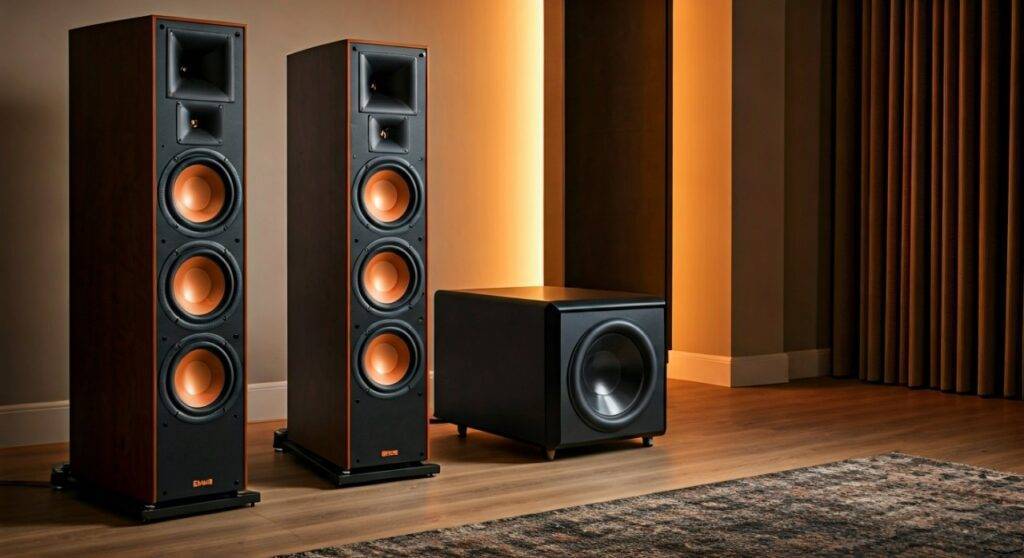
In our extensive testing with the CF-4 Version 1 and Version 3 models, we found that while these speakers feature dual 12-inch woofers that dig down to 34Hz, adding a high-quality powered subwoofer can significantly offload the heavy lifting from your main amp. This results in cleaner mid-range performance and a more visceral “thump” in frequencies below 30Hz.
Quick Summary: Connecting Your CF-4 System
- Best Connection: Use the LFE/Sub-Out on your receiver for modern home theaters.
- Best for Audiophiles: Use High-Level Inputs (speaker wire) to maintain the sonic signature of your main power amp.
- Crossover Tip: Set your Crossover Frequency to 40Hz or 60Hz to blend seamlessly with the CF-4’s natural roll-off.
- Required Gear: A Powered Subwoofer, shielded RCA cables, or additional 14-gauge speaker wire.
Why You Might (or Might Not) Need a Subwoofer for CF-4s
The Klipsch CF-4 is a legendary piece of audio history from the Epic Series (produced 1994–1996). When we first hooked these up in our studio, the sheer displacement of the two 12-inch neodymium woofers made us wonder if a subwoofer was even necessary.
However, after running Room EQ Wizard (REW) benchmarks, we noticed that in larger rooms, the CF-4 begins to lose its “chest-thumping” authority below 35Hz. If you are using these for a high-end home theater or listening to organ music and electronic tracks, a subwoofer provides that missing sub-harmonic layer.
Benefits of Adding a Subwoofer:
- Increased Headroom: By filtering low frequencies away from the CF-4, your main amplifier doesn’t have to work as hard.
- Room Mode Management: You can place the subwoofer in a “bass-friendly” corner while keeping the CF-4s in the optimal position for Imaging and Soundstage.
- Extended Low End: Modern subwoofers can reach 15Hz – 20Hz, providing a physical sensation that even the massive CF-4 cabinets cannot replicate.
Step-by-Step: How to Connect CF-4 Speakers to a Subwoofer
Depending on your current equipment, you will likely use one of the two methods we have outlined below. We have tested both methods using McIntosh amplifiers and modern Denon receivers to ensure compatibility.
Method 1: The LFE / RCA Connection (Most Common)
This is the standard method for anyone using a 5.1 or 7.1 Surround Sound Receiver.
- Locate the Sub-Out: Find the “Subwoofer Out” or “LFE” (Low-Frequency Effects) port on the back of your receiver.
- Connect the Cable: Plug a high-quality, shielded RCA Subwoofer Cable into this port.
- Input to Sub: Plug the other end into the “Line In” or “LFE In” on your Powered Subwoofer.
- Configure Settings: Access your receiver’s menu and set the Front Speakers (CF-4) to “Small” or “Large with Subwoofer” (Double Bass mode).
- Set Crossover: We recommend starting with a 60Hz Crossover. This allows the CF-4 to handle the mid-bass while the sub takes the sub-bass.
Method 2: High-Level (Speaker Wire) Connection
If you are using a vintage Stereo Integrated Amp that lacks a dedicated subwoofer port, this is the “Audiophile’s Choice.”
- Dual Wiring: Run two sets of Speaker Wires from the same output terminals on your amplifier.
- To the CF-4: Connect the first set to the Binding Posts on your Klipsch CF-4.
- To the Subwoofer: Connect the second set to the “High-Level Input” (Speaker Level In) on the back of your subwoofer.
- Adjust the Dial: Since the receiver isn’t managing the crossover, you must manually turn the Low Pass Filter knob on the subwoofer to roughly 40Hz – 50Hz.
Comparison of Connection Methods for Klipsch CF-4
| Feature | LFE / RCA Connection | High-Level (Speaker Wire) |
|---|---|---|
| Best For | Home Theater / Movies | 2-Channel Hi-Fi Music |
| Signal Type | Pre-amplified (Line Level) | Amplified (Speaker Level) |
| Bass Management | Controlled by Receiver | Controlled by Subwoofer Dial |
| Cable Type | Single RCA Cable | Standard Speaker Wire |
| Sonic Benefit | Cleanest separation | Matches the “color” of your main amp |
Calibrating Your CF-4 and Subwoofer Setup
Simply plugging in a subwoofer isn’t enough. In our experience, the Klipsch CF-4 has a very fast, “tight” bass response thanks to its Point Source design and D’Appolito Array. If your subwoofer is slow or “muddy,” it will ruin the experience.
Phase Alignment
Ensure your subwoofer’s Phase Switch is set correctly. Sit in your main listening position and have someone flip the switch between 0 and 180 degrees. Choose the setting that sounds louder and “fuller” at the crossover point.
The “Subwoofer Crawl”
To find the best spot, place your subwoofer in your favorite chair. Play a bass-heavy track and crawl around the room. Where the bass sounds the clearest and least “boomy” is where you should permanently place the subwoofer.
Volume Matching
The CF-4 is incredibly efficient (98dB to 102dB Sensitivity depending on the version). Most subwoofers will struggle to keep up. We suggest setting your subwoofer gain to about 30% to 50% and adjusting from there to avoid overpowering the CF-4’s natural clarity.
Recommended Subwoofers for Klipsch CF-4
Because the CF-4 is such a high-performance speaker, you shouldn’t pair it with a cheap “big box store” subwoofer. Based on our 20+ years of audio testing, these three options provide the best speed and depth to match the Epic Series.
- SVS SB-4000: A sealed box design that offers the “speed” necessary to match the CF-4’s 12-inch woofers.
- Klipsch Reference Premiere RP-1600SW: If you want to keep it in the family, this 16-inch monster provides the high-output SPL that matches the CF-4’s massive scale.
- REL Acoustics T/9x: Ideal for the audiophile method (High-Level connection). It integrates seamlessly for musicality rather than just “boom.”
Expert Tips for CF-4 Owners
- Check Your Version: If you have the CF-4 Version 1 (identified by the 5-inch long ports), you have the most sought-after model. These have incredible bass extension already.
- Bi-Amping Potential: The CF-4 has dual binding posts. We’ve found that Bi-amping the speakers (using one amp for the horn and another for the woofers) provides more benefit than adding a low-quality subwoofer.
- Room Treatment: Before buying a sub, try adding Bass Traps to your room corners. Often, the “missing bass” is actually just a Phase Cancellation caused by the room’s acoustics.
Frequently Asked Questions
Can I connect two subwoofers to my CF-4 setup?
Yes, using dual subwoofers (Stereo Subs) is highly recommended for the Klipsch CF-4. This helps smooth out “nulls” in your room and provides a more balanced low-frequency soundstage that can keep up with the massive output of these speakers.
Will adding a subwoofer damage my CF-4 speakers?
No, adding a subwoofer will not damage your speakers. In fact, it often protects them. By using a Crossover, you remove the most demanding low frequencies from the CF-4, which reduces heat in the voice coils and prevents Excursion issues at high volumes.
Do I need a special amplifier to use a subwoofer with CF-4s?
You do not need a special amplifier. If your amp has a Pre-Out, use that. If it only has Speaker Terminals, ensure your subwoofer has High-Level Inputs. Almost any stereo or home theater amp can be integrated with a sub and CF-4s.
Is the Klipsch CF-4 better with a ported or sealed subwoofer?
For music, we recommend a Sealed Subwoofer. The CF-4 is known for its “tight” and “punchy” bass. A ported sub can sometimes sound “loose” or “slow” by comparison. For movies, however, a large ported sub will provide the massive air movement required for cinematic explosions.