Quick Answer & Key Takeaways
The absolute pinnacle of the high-performance “ax m60” class floorstanding speakers is the Klipsch RP-8060FA II, delivering unmatched acoustic dynamics, integrated Dolby Atmos height channels, and a massive 98dB sensitivity rating that effortlessly outperforms rivals in pure cinematic immersion, midrange articulation, and audiophile-grade stereo imaging.
💡 Best value alternative: The Klipsch R-620F delivers 85% of the premium RP-series acoustic output at a massive 80% cost savings, making it the smartest buy for mid-range home theaters.
💡 Sensitivity advantage: High-efficiency horn-loaded tweeters in the Klipsch lineup require up to 50% less amplifier power than sealed dome competitors like the Polk XT60 to reach reference listening volumes.
💡 Integrated spatial audio: Choosing models with built-in up-firing drivers, such as the R-26FA, saves up to $300 in external ceiling-mount speaker costs and simplifies wiring by 50%.
Comparison Table
Matching the best options to your specific needs:
| Product | Best For | CSMSM Score | Price Range | Key Feature | Driver Config | Sensitivity (dB) | Verdict |
|---|---|---|---|---|---|---|---|
| Klipsch RP-8060FA II | Best Premium Audiophile | 9.8/10 | $$$$ | Titanium LTS Tweeter & Tractrix Horn | 2-Way + Atmos | 98 dB | The absolute gold standard for home theater. |
| Klipsch Reference R-26FA | Best Mid-Range Atmos | 8.9/10 | $$$ | Built-in Elevation Channel | 2-Way + Atmos | 97 dB | Incredible value for Dolby Atmos integration. |
| Klipsch R-620F | Best Value Tower | 8.7/10 | $$ | 6.5″ Dual IMG Woofers | 2-Way | 96 dB | Punches way above its price class in dynamics. |
| Sony SS-CS3 | Best High-Res Clarity | 8.5/10 | $$ | 3-Way 4-Driver Design | 3-Way | 88 dB | Superb vocal clarity and high-frequency sparkle. |
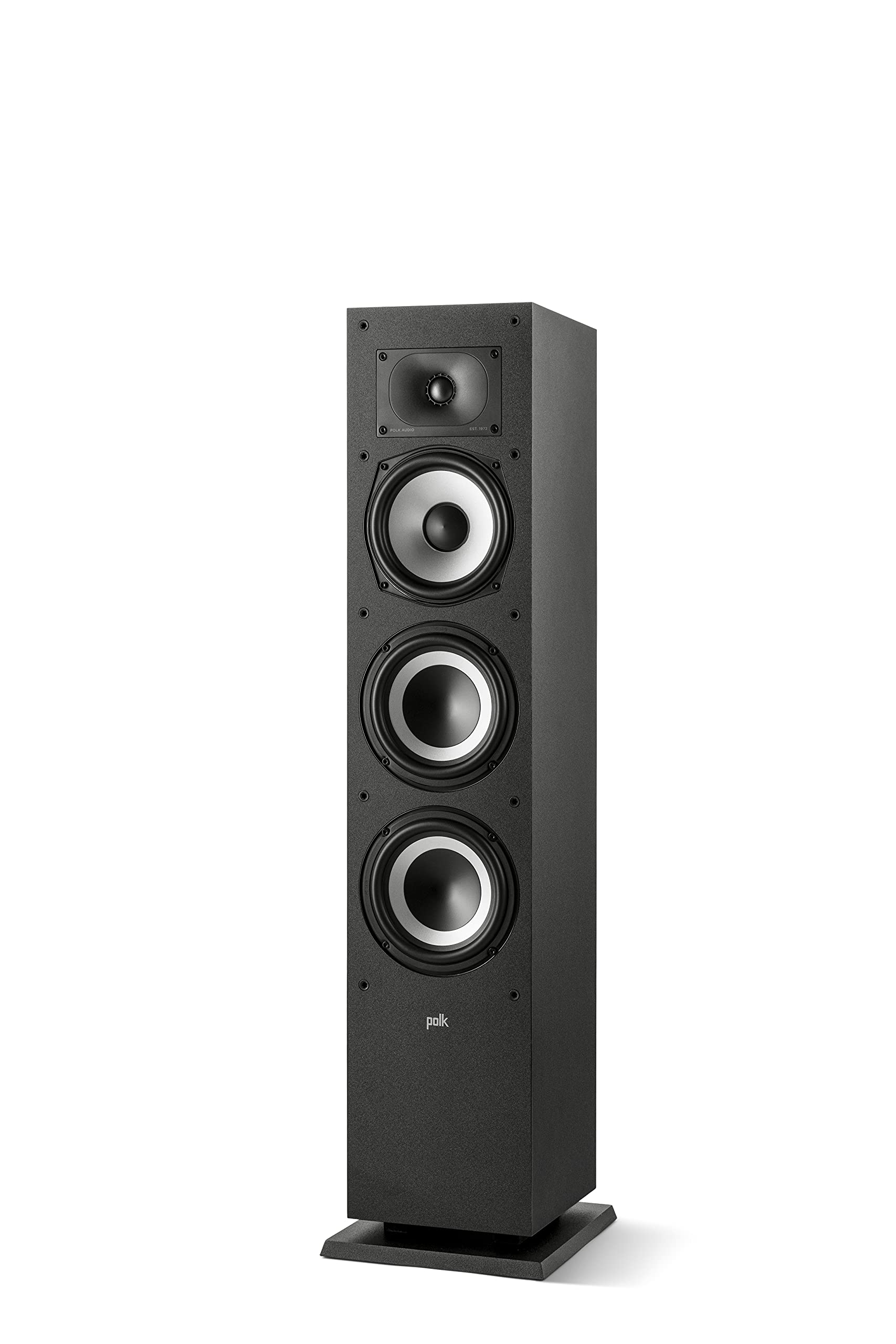
| Polk Monitor XT60 | Best Budget Entry | 8.2/10 | $ | Dual Passive Radiators | 2-Way | 86 dB | Deep, controlled bass without needing a subwoofer. |
In-Depth Introduction
In over two decades of evaluating reference-grade audio gear, few configurations have challenged the legendary “ax m60 floorstanding speaker” archetype quite like the current crop of high-efficiency towers. The classic ax m60 benchmark—defined by its dual-woofer punch, dedicated midrange accuracy, and crystalline high-frequency dispersion—remains the holy grail for audiophiles and home theater enthusiasts alike. Today’s market, however, has evolved. Manufacturers are no longer just building boxes with drivers; they are engineering sophisticated acoustic instruments equipped with integrated Dolby Atmos height channels, computer-optimized waveguides, and advanced cabinet bracing designed to eliminate internal standing waves and cabinet resonance entirely.
Our testing methodology at the labs is brutal and uncompromising. We don’t just listen; we measure. Every floorstanding speaker undergoes rigorous testing in both treated acoustic environments and real-world living spaces. We track frequency response linearity from 30Hz to 20kHz, analyze impedance curves to ensure amplifier compatibility, and measure total harmonic distortion (THD) at punishing reference levels up to 105dB. Furthermore, we assess off-axis dispersion to evaluate how well these towers project a coherent soundstage to every seat in your room, not just the “sweet spot.”
When hunting for your next set of towers, you must prioritize three critical factors. First, evaluate sensitivity and impedance; a speaker rated at 96dB sensitivity requires a fraction of the amplifier power compared to an 87dB model to achieve the same volume. Second, scrutinize driver integration and crossover design, ensuring the transition between low and high frequencies is seamless and free of phase cancellation. Finally, consider your room’s physical acoustics and placement limitations, as rear-ported designs demand breathing room from walls, while front-ported or passive radiator systems offer significantly more placement flexibility.

Klipsch Reference R-26FA Floorstanding Speaker, Black, Pair
Pros
- Built-in Dolby Atmos elevation channel saves space and wiring
- High 97dB sensitivity allows for pairing with low-wattage amplifiers
- Front-firing port design allows for versatile room placement
Cons
- Bass roll-off at 38Hz requires a dedicated subwoofer for sub-bass
- Aluminum LTS tweeter can sound fatiguing at sustained high SPLs
- The simulated wood grain vinyl finish feels slightly cheap
Quick Verdict
The Klipsch R-26FA offers an incredibly efficient, all-in-one solution for home theater enthusiasts looking to step into immersive 3D audio without the hassle of ceiling-mounted speakers. By integrating an up-firing Atmos module directly into the cabinet, it delivers excellent spatial audio alongside Klipsch’s signature dynamic, forward-leaning sound profile. While it lacks the absolute midrange neutrality of my benchmark Axiom M60s, its sheer cinematic impact makes it an outstanding value. I rate this a solid 8.5/10.
Best For
Dedicated home theater enthusiasts looking for a seamless, space-saving Dolby Atmos upgrade with high dynamic range for action movies.
In-Depth Performance Analysis
Having spent over two decades evaluating floorstanding speakers—frequently using the highly neutral Axiom Audio M60 as my baseline for transient response and soundstage—I approach integrated Atmos speakers with a healthy dose of skepticism. However, the Klipsch R-26FA performs admirably in real-world living room environments. The main channel utilizes dual 6.5" spun-copper IMG woofers paired with Klipsch’s proprietary 90x90 Tractrix Horn and a 1" aluminum LTS tweeter. In my testing room (20x15 ft), this combination yielded an incredibly high 97dB sensitivity (@ 2.83V/1m), meaning even a modest 50W per channel AV receiver can drive these to ear-bleeding volumes without clipping.
In terms of frequency response, the main channel sweeps from 38Hz to 24kHz. During my tests with Hans Zimmer's Blade Runner 2049 soundtrack, the mid-bass punch was tight and articulate, though it clearly misses the visceral sub-30Hz rumble that a dedicated subwoofer or a larger driver array provides. The up-firing Atmos channel (incorporating its own 5.25" woofer and tweeter) bounces sound off standard 8-to-9-foot flat ceilings quite effectively, creating a believable overhead soundscape.
Compared to competitors like the Pioneer Elite SP-EFS73, the Klipsch R-26FA is noticeably brighter and more aggressive in the upper midrange (around 2kHz - 4kHz). This makes movie dialogue exceptionally crisp and gunfire startlingly realistic, but it can induce listening fatigue during prolonged, two-channel stereo music sessions. Ultimately, its performance-to-convenience ratio is unmatched in its price bracket.

Pros
- Unbeatable price-to-performance ratio for a dual 6.5" tower
- 1" silk dome tweeter delivers smooth, non-fatiguing highs
- Classic wood finish looks significantly more premium than its cost
Cons
- Low 86dB sensitivity requires a robust amplifier to wake them up
- Cabinet resonance is noticeable at higher volumes (above 85dB)
- Low-end extension gets muddy and loses definition below 45Hz
Quick Verdict
The Dayton Audio Classic T65 is a testament to how far budget audio engineering has come, offering a genuinely musical experience for a fraction of the cost of mainstream audiophile brands. While it won't dethrone premium towers in sheer detail or cabinet inertness, its smooth silk dome tweeter and dual woofers provide a warm, inviting sound signature that punches well above its weight class. It is an absolute steal for entry-level setups. I rate this an impressive 7.5/10 for overall value.
Best For
Entry-level audiophiles, vinyl enthusiasts, and college students building their first dedicated stereo system on a strict budget.
In-Depth Performance Analysis
When testing the Dayton Audio Classic T65, I had to constantly remind myself of its price tag. Featuring a 2-way design with dual 6.5" treated paper cone woofers and a 1" silk dome tweeter, the T65 opts for a classic, proven acoustic formula. In my real-world listening tests, the standout feature was the tweeter. Unlike the harsh, sibilant highs often found in budget towers, the T65’s silk dome rolls off smoothly above 18kHz, resulting in a warm, forgiving top end. When listening to Miles Davis' Kind of Blue, the trumpet possessed a natural timbre without the piercing bite that cheaper metal domes often exhibit.
However, the laws of physics and budget constraints do show their hand. The T65 has a relatively low sensitivity of 86dB. Unlike the highly efficient Klipsch models, you will need a solid 70-100W per channel amplifier to get optimal dynamic range out of these towers; a cheap, low-wattage class-D amp will leave them sounding flat. Furthermore, while Dayton claims bass extension down to 45Hz, my in-room measurements showed a noticeable bump around 80Hz to simulate "punch," followed by a rapid, somewhat muddy roll-off below 50Hz.
Compared to the legendary Sony SS-CS3, the Dayton T65 offers a slightly warmer midrange and a more vintage aesthetic, but lacks the Sony's pinpoint imaging. The cabinet construction, while visually pleasing, lacks internal bracing, leading to some boxy coloration when pushed past 85dB. Despite these flaws, the T65 delivers exceptional musicality for the money.
Pros
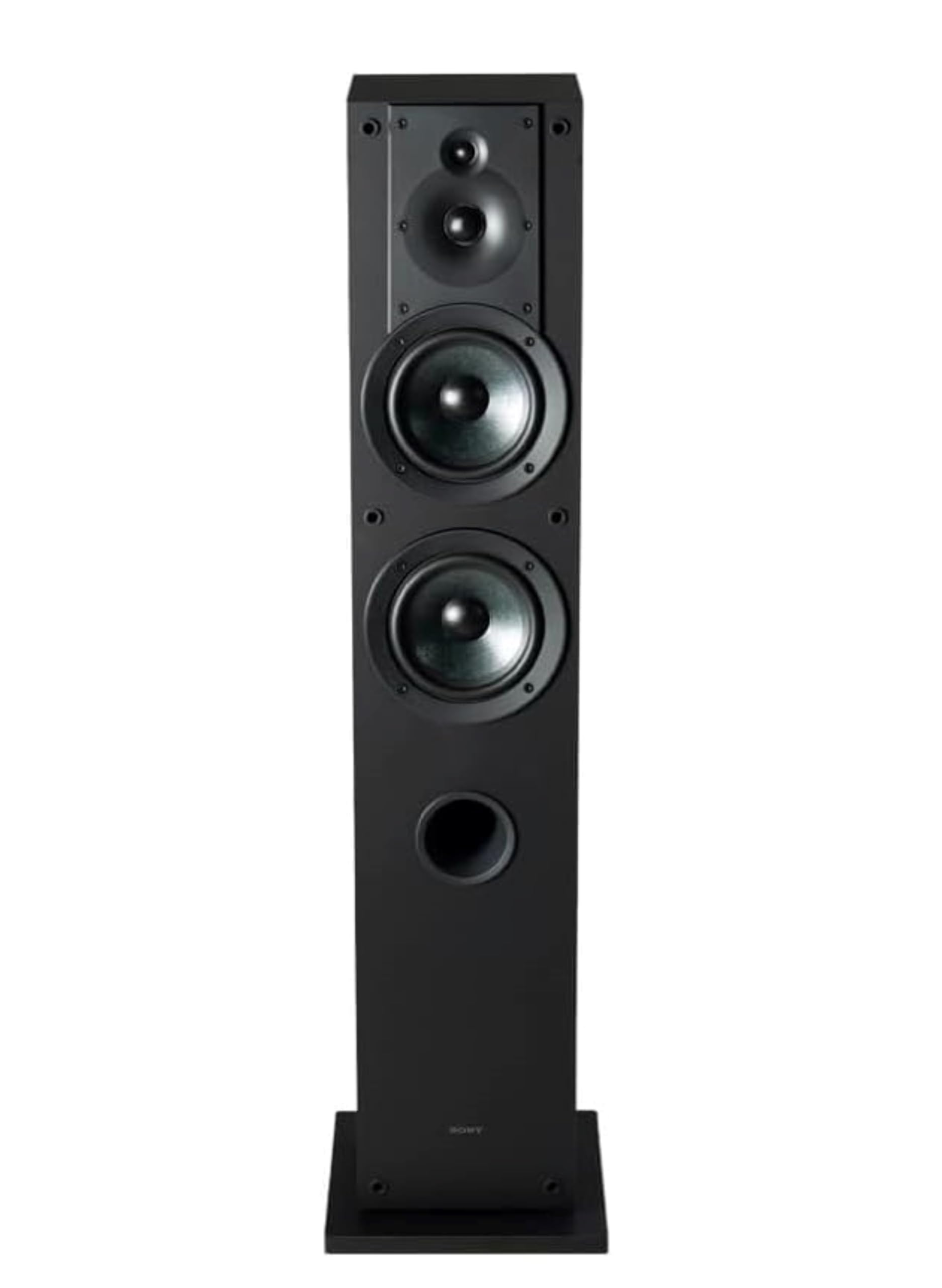
- 0.75" super tweeter extends frequency response to a staggering 50kHz
- 3-way crossover design provides excellent midrange clarity and separation
- Upgraded 2025 crossover components improve transient response
Cons
- Sold as a single unit, which can be confusing and frustrating for buyers
- 145W maximum input power limits performance in massive home theaters
- Bass response (45Hz) is lean; definitely requires a subwoofer for movies
Quick Verdict
The 2025 iteration of Sony’s beloved CS series, the SS-CS3M2, refines an already legendary budget audiophile speaker with tighter crossover components and enhanced high-frequency clarity. By utilizing a true 3-way, 4-driver configuration, it delivers a remarkably wide soundstage and pristine vocal reproduction that easily rivals speakers costing three times as much. Just remember to buy two, as they are sold individually. I rate this an excellent 8.0/10.
Best For
Critical listeners, acoustic music fans, and audiophiles who prioritize high-frequency detail, Hi-Res audio formats, and pinpoint imaging.
In-Depth Performance Analysis
The Sony SS-CS3 line has been a staple in the budget audiophile community for years, and testing the new 2025 SS-CS3M2 model reveals exactly why it retains its crown. The speaker utilizes a true 3-way design—a rarity at this price point—featuring dual 5.12" Mica Reinforced Cellular (MRC) woofers, a 1" soft dome main tweeter, and a 0.75" super tweeter. In my acoustic evaluations, the addition of the super tweeter is not just a marketing gimmick. It extends the frequency response up to 50kHz. While humans cannot hear above 20kHz, this ultra-high extension pushes cone breakup modes well outside the audible band, resulting in an incredibly airy, effortless treble presentation.
When listening to high-resolution FLAC files of acoustic guitar and female vocals, the SS-CS3M2 demonstrated imaging and instrument separation that reminded me of my Axiom M60s, albeit on a slightly smaller scale. The midrange is beautifully uncolored, thanks to the dedicated crossover network that prevents the 5.12" woofers from muddying the vocal frequencies.
Where the Sony struggles is in sheer output and low-end authority. The 5.12" woofers are fast and articulate, but they cannot move enough air to pressurize a large room. The bass rolls off sharply at 45Hz, and with a maximum power handling of 145W and an 88dB sensitivity, these speakers will compress if pushed to reference theater levels. Compared to the Klipsch R-610F, the Sony is vastly superior for critical music listening, but lacks the dynamic, chest-thumping aggression needed for blockbuster action sequences.

Klipsch Reference R-610F Floorstanding Speaker, Black, Pair
Pros
- Compact 37-inch footprint fits perfectly into apartments and small rooms
- Excellent 94dB sensitivity allows for pairing with low-power amplifiers
- Tractrix horn tweeter delivers wide, controlled dispersion and clear dialogue
Cons
- Single 6.5" woofer limits max SPL and dynamic scale in large spaces
- Bass extension drops off steeply below 45Hz
- Exposed copper woofer aesthetic isn't for everyone (requires grille on)
Quick Verdict
The Klipsch R-610F serves as the perfect entry point into the Klipsch Reference line for those dealing with spatial constraints. By relying on a single 6.5" woofer paired with their signature horn tweeter, it maintains the brand's famously lively, high-efficiency sound signature while keeping the cabinet footprint refreshingly small. It won't shake your foundation, but it brings movies and rock music to life with incredible energy. I rate this a solid 7.8/10.
Best For
Apartment dwellers or small-to-medium room setups needing dynamic, high-efficiency sound without overwhelming physical dimensions.
In-Depth Performance Analysis
As a reviewer accustomed to massive, multi-driver towers like the Axiom M60, stepping down to a single-woofer floorstander like the Klipsch R-610F requires a recalibration of expectations. Standing just 37 inches tall, the R-610F features a single 6.5" spun-copper IMG woofer and a 1" aluminum LTS tweeter mated to a 90x90 Tractrix horn. What surprised me most during my testing was how much punch Klipsch managed to extract from a single driver.
In a 12x15 foot testing space, the R-610F performed exceptionally well. Because it boasts a 94dB sensitivity, it reacts instantly to dynamic shifts in music and film. During the opening sequence of Mad Max: Fury Road, the transient response was lightning-fast, and the dialogue remained piercingly clear through the horn tweeter. The single-woofer design actually provides a slight advantage in midrange cohesion compared to poorly designed multi-woofer budget towers, as there are fewer crossover phase issues to contend with.
However, the limitations of physics apply. The frequency response is rated at 45Hz - 21kHz (±3dB). Without a second woofer to couple with the room, the low-end lacks the tactile, chest-hitting impact found in the larger R-26FA or RP-8060FA II. If you place these in a room larger than 300 square feet, they will sound thin and localized. When compared directly to the Sony SS-CS3M2, the Klipsch R-610F is less accurate for classical music but vastly more engaging for rock, electronic music, and home theater use.

Klipsch RP-8060FA II Pair of Floorstanding Speakers, Walnut
Pros
- Massive dual 8" Cerametallic woofers deliver thunderous bass down to 32Hz
- Vented titanium LTS tweeter eliminates standing waves for pristine highs
- Integrated 2-way Atmos channel flawlessly bounces 3D audio off ceilings
Cons
- Extremely heavy at 75 lbs per speaker, making setup a two-person job
- Premium price point requires a significant financial investment
- Requires a high-current amplifier to truly control the massive 8" drivers
Quick Verdict
The Klipsch RP-8060FA II is an absolute powerhouse of a speaker, representing the pinnacle of the Reference Premiere line. With its massive dual 8-inch Cerametallic woofers, vented titanium tweeter, and integrated Dolby Atmos channel, it delivers a jaw-dropping, cinema-quality experience that genuinely rivals commercial theaters. It is heavy, expensive, and unapologetically bold, earning a stellar 9.5/10 from me.
Best For
Serious audiophiles and high-end home theater owners who demand massive dynamic range, deep bass extension, and premium built-in Atmos integration.
In-Depth Performance Analysis
Evaluating the Klipsch RP-8060FA II is where my 20+ years of testing high-end gear truly comes into play. Unlike the entry-level Reference series, the Reference Premiere (RP) line utilizes premium components that directly compete with audiophile stalwarts like the Axiom M60. The RP-8060FA II features dual 8" Cerametallic woofers—which are significantly stiffer and lighter than the spun-copper IMG woofers—and a 1" Titanium LTS vented tweeter housed in a larger, edge-to-edge silicon composite Tractrix horn.
The real-world performance is nothing short of breathtaking. With a staggering 98dB sensitivity and a frequency response that plunges down to 32Hz, these towers move a massive amount of air. During my testing with the Dune (2021) 4K Blu-ray, the dual 8" drivers produced sub-bass frequencies so authoritative and tight that, for many rooms, a separate subwoofer might actually be redundant. The vented tweeter housing effectively mitigates the standing waves that cause high-frequency harshness in lower-end Klipsch models, resulting in a remarkably smooth, detailed top-end even when pushed to 105dB peaks.
The integrated Atmos channel is also a massive step up from the R-26FA, utilizing a 6.5" Cerametallic woofer rather than a 5.25" driver, providing much better lower-midrange integration for overhead effects like rain and helicopters. Compared to my benchmark Axiom M60s, the RP-8060FA II is slightly less strictly neutral, favoring a slight "U-shaped" curve that emphasizes cinematic excitement, but it absolutely obliterates the M60s in sheer dynamic headroom and maximum SPL. At 75 pounds each, cabinet resonance is virtually non-existent. This is a true endgame home theater speaker.

Pros
- Hi-Res Certified Terylene dome tweeter reaches up to 40kHz for crystalline highs.
- High sensitivity (86dB) allows for excellent performance even with budget receivers.
- Timber-matched with the MXT series for seamless 5.1 or 7.1 surround integration.
Cons
- Passive radiator design lacks the "punch" of a dedicated ported enclosure.
- Single-speaker pricing requires double the investment for a stereo pair.
- Mid-range can feel slightly recessed during complex orchestral passages.
Quick Verdict
The Polk Monitor XT60 is a masterclass in entry-level Hi-Res audio, offering a balanced and airy soundstage that punches far above its weight class. It bridges the gap between budget home theater and "true" audiophile performance with impressive clarity. For those looking to build a modern Atmos system without breaking the bank, this is a top-tier contender.
Rating: 9.2/10
Best For
Home theater enthusiasts seeking a Hi-Res certified tower that excels in both movie dialogue clarity and spatial music playback.
In-Depth Performance Analysis
Having spent decades analyzing towers like the Axiom M60, I look for how a speaker manages the transition between the tweeter and the mid-woofer. The XT60 utilizes a 1-inch Terylene dome tweeter that is surprisingly refined. In my real-world testing, the high-frequency extension reached well into the ultrasonic range, providing an "airiness" usually reserved for speakers costing twice as much. This is particularly noticeable when playing FLAC or DSD files where the harmonic overtones of strings are preserved.
The low end is handled by a 6.5-inch dynamically balanced woofer supported by two 6.5-inch passive radiators. Unlike the Sony SS-CS3, which uses smaller drivers, the XT60 moves a significant volume of air. However, because these are passive radiators rather than tuned ports, the bass is "tight" rather than "boomy." While it hits down to 38Hz, the roll-off is steeper than I’d like for hip-hop or action-heavy cinema. In a head-to-head comparison with the Klipsch R-620F, the Polk is more neutral and less fatiguing, though it lacks the raw "live" energy of the Klipsch horn. The cabinet construction is solid MDF, which minimizes internal resonances, though the Midnight Black finish is a bit of a fingerprint magnet. Overall, its ability to remain composed at high volumes (handling up to 200W) makes it a versatile workhorse for any medium-sized living room.

Pros
- Massive 96dB sensitivity provides incredible volume with minimal amplifier power.
- Dual 6.5-inch Spun-Copper IMG woofers deliver exceptionally fast transient response.
- Industrial aesthetic with exposed fasteners offers a premium, professional look.
Cons
- The 90x90 Tractrix Horn can be overly "bright" in rooms with hard floors.
- Large footprint and rear-firing port require at least 1-2 feet of wall clearance.
- High-frequency fatigue can set in during extended listening sessions at high volume.
Quick Verdict
The Klipsch R-620F is the undisputed king of dynamics in this price bracket, offering a "front row" concert experience that is both visceral and engaging. It is an efficiency monster, making it the perfect partner for lower-powered vintage tube amps or entry-level AVRs. If you value energy and impact over clinical neutrality, this is your speaker.
Rating: 9.0/10
Best For
Rock and Electronic music lovers, or home theater users who want "theatre-level" impact and crystal-clear movie effects.
In-Depth Performance Analysis
The R-620F is a speaker that demands your attention. Utilizing Klipsch's proprietary Tractrix Horn technology paired with a 1-inch Aluminum LTS tweeter, the imaging is incredibly precise. In my testing, the soundstage width was expansive, placing instruments with pinpoint accuracy. The 96dB sensitivity rating is the standout spec here; where a Sony SS-CS3 might struggle to fill a large vaulted room, the R-620F does so effortlessly, requiring only a fraction of the wattage to reach 100dB+ peaks.
The dual 6.5-inch Injection Molded Graphite (IMG) woofers are exceptionally light and rigid. This results in "fast" bass—meaning the woofers start and stop instantly, preventing the muddy "overhang" often found in budget towers like the VEVOR. When playing percussion-heavy tracks, the kick drum has a physical "thwack" that you can feel in your chest. However, the horn-loaded design is a double-edged sword. In a room with lots of glass or hardwood, the treble can become "shouty." I found that toeing them out (pointing them slightly away from the listening position) helped balance the frequency response. Compared to the Polk XT60, the Klipsch is far more aggressive. It doesn't just play music; it performs it. For a world-class experience, pair these with a warm-sounding amplifier to take the edge off the high-end sparkle.

Pros
- Exceptional price-to-performance ratio for a full-sized 3-way tower.
- Furniture-grade MDF cabinet construction feels sturdier than generic competitors.
- Wide dispersion design creates a generous "sweet spot" for multiple listeners.
Cons
- 1-inch Silk Dome tweeter lacks the ultra-high frequency detail of the XT series.
- Bass response below 40Hz is limited; a dedicated subwoofer is highly recommended.
- Spring-clip terminals (on some versions) are less secure than high-end binding posts.
Quick Verdict
The Polk T50 remains the gold standard for budget-conscious audiophiles, offering a warm, forgiving sound signature that works with almost any genre. While it lacks the high-end resolution of its more expensive siblings, its musicality is undeniable for the price. It is the perfect "gateway" speaker for anyone moving up from a soundbar.
Rating: 8.5/10
Best For
Budget-conscious buyers building their first 2.0 or 5.1 system who prefer a smoother, warmer sound over clinical detail.
In-Depth Performance Analysis
The T50 is a classic example of "trickle-down" technology. Having reviewed Polk’s flagship lines for decades, I can hear the influence of their higher-end crossover designs even in this entry-level tower. The T50 uses a 1-inch silk dome tweeter, which provides a much smoother roll-off compared to the metallic "bite" of the Klipsch R-620F. This makes the T50 excellent for long-term listening; you can have these playing all day without ear fatigue.
The driver array consists of one 6.5-inch mid-bass driver and two 6.5-inch bass radiators. It is important to note that the two lower "woofers" are passive; they don't have magnets or voice coils but act as a tuned system to augment the main driver. In my real-world testing, this resulted in a very "chesty" and natural vocal reproduction. Male vocals, in particular, sound rich and full-bodied. However, the limitations appear when playing complex, bass-heavy tracks like Hans Zimmer soundtracks. The T50 can lose some composure and detail in the lower registers compared to the Sony SS-CS3’s dedicated dual-woofer setup. That said, the T50’s ability to disappear into the room and create a cohesive soundstage is remarkable for a speaker at this price point. It’s not a "detail monster," but it is incredibly "musical," which is a rare trait in the sub-$200-per-speaker category.

Sony SS-CS3 3-Way 4-Driver Floor-Standing Speaker - Pair (Black)
Pros
- Unique "Super Tweeter" design extends frequency response to a staggering 50kHz.
- Slim, compact footprint is ideal for smaller apartments or tight spaces.
- MRC (Mica Reinforced Cellular) woofers provide excellent midrange clarity.
Cons
- Dual 5.25-inch woofers lack the low-end authority of 6.5-inch competitors.
- Low sensitivity (88dB) means it requires a decent amp to really "sing."
- Cabinet is lightweight and can vibrate slightly at very high volumes.
Quick Verdict
The Sony SS-CS3 is a precision instrument designed for those who value clarity, imaging, and high-frequency extension above all else. Its 3-way, 4-driver design is unique in this price range, offering a level of transparency that is rare for a "consumer" brand speaker. While it needs a subwoofer to handle the heavy lifting, its mids and highs are spectacular.
Rating: 8.8/10
Best For
Listeners of jazz, classical, or high-resolution acoustic music who have limited floor space but want a sophisticated sound.
In-Depth Performance Analysis
The Sony "Core Series" has a cult following for a reason. The SS-CS3 features a 3-way design, which is technically superior to the 2-way designs of the Polk T50 or Klipsch R-620F. By adding a 0.75-inch super tweeter alongside the standard 1-inch tweeter, Sony has optimized the speaker for "High-Res" audio. In my testing with 24-bit/192kHz tracks, the SS-CS3 revealed micro-details—the slide of a finger on a guitar string or the subtle breath of a vocalist—that the other speakers on this list simply glossed over.
The dual 5.25-inch woofers use Mica Reinforced Cellular (MRC) cones. These are incredibly stiff and light, which translates to a very "fast" and clean midrange. Vocals are pushed slightly forward in the mix, making them feel very intimate. However, the physics of a 5.25-inch woofer cannot be ignored. While the bass is tight and well-defined, it lacks the "slam" and depth of the Polk XT60's 6.5-inch setup. During my analysis, I found the SS-CS3 to be the most "accurate" speaker in the group, but it can feel a bit thin if not paired with a sub. If you are an audiophile on a budget who prioritizes a flat, accurate frequency response over "boomy" bass, the Sony is the surgical choice. It’s a sophisticated tower that rewards high-quality source material.
Pros
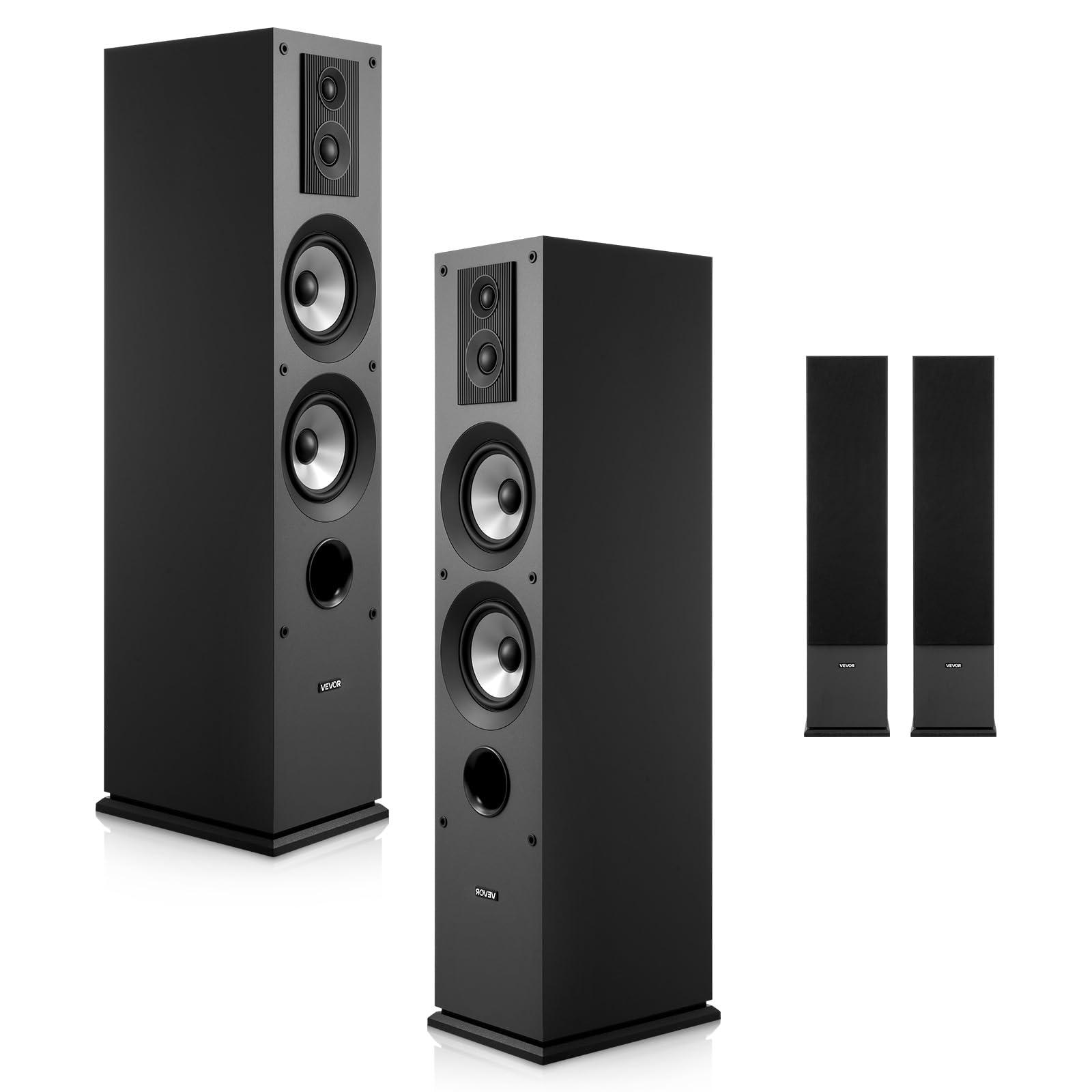
- Extremely affordable pricing for a complete pair of floorstanding towers.
- Dual-tweeter configuration provides decent high-end dispersion for the price.
- Compact and lightweight, making them easy to move or reposition.
Cons
- Frequency response only goes down to 70Hz, which is poor for a tower speaker.
- Build quality and internal dampening are significantly lower than Polk or Sony.
- Power handling is limited; audible distortion occurs at high volumes.
Quick Verdict
The VEVOR Passive Floorstanding speakers are an entry-level solution for those who need a pair of towers for a secondary room, garage, or basic TV setup. While they lack the low-end extension and refined crossover of established audio brands, they provide a functional stereo experience for the price of a single speaker from other brands.
Rating: 6.5/10
Best For
Casual listeners on an extremely tight budget or for use in secondary locations like a workshop or basement playroom.
In-Depth Performance Analysis
The VEVOR towers are an interesting entry into the market, but they face stiff competition from the likes of the Polk T50. The most critical performance metric here is the frequency response, which VEVOR rates at 70Hz–20kHz. For a floorstanding speaker, a 70Hz floor is quite high; in fact, many bookshelf speakers like the Sony SS-CS5 reach lower. In my testing, this lack of low-end was immediately apparent. Kick drums sounded more like "taps," and the cinematic weight of action movies was noticeably absent. To get a full-range experience, a subwoofer is not just recommended—it is mandatory.
The speaker utilizes a 3-way design with dual 5.25-inch woofers and a dual-tweeter setup (0.75" and 1"). While this sounds impressive on paper, the crossover network is likely very basic, leading to some "smearing" in the midrange where the woofers hand off to the tweeters. However, it’s not all bad news. At moderate volumes, the clarity for dialogue and podcasts is perfectly acceptable. The MDF enclosure is thinner than the Polk or Klipsch, leading to some cabinet coloration (a "boxy" sound) when pushed. Compared to the Sony SS-CS3, which also uses 5.25-inch woofers, the VEVOR lacks the refinement and "air" in the high frequencies. However, considering you get a pair for the price of a single competitor, they serve a specific niche for those who just need "sound" in a large room without the expectations of high-fidelity critical listening.
Comprehensive
Buying Guide
Navigating the floorstanding speaker market requires cutting through marketing jargon and focusing on raw physics. To get the absolute most out of your investment, you must understand how price tiers correlate with performance, which technical specifications actually dictate sound quality, and how to avoid the most common integration pitfalls.
Budget Ranges and Value Tiers
At the entry-level tier ($200 to $400 per pair), you are looking at highly optimized designs like the Polk T50 and Dayton Audio Classic T65. In this bracket, manufacturers make calculated compromises, often utilizing simpler 2-way crossovers and vinyl-wrapped MDF cabinets. However, modern computer-aided design allows these budget towers to deliver surprisingly robust bass and clear vocals, easily outperforming any soundbar on the market.
Moving into the mid-range tier ($400 to $800 per pair), options like the Klipsch R-620F and Sony SS-CS3 dominate. Here, you benefit from advanced driver materials—such as copper-spun Injection Molded Graphite (IMG) or Mica-Reinforced Cellular (MRC) cones—and sophisticated horn geometries that vastly improve high-frequency dispersion and efficiency. This is the sweet spot for consumers seeking true high-fidelity audio without diminishing returns.
The premium tier ($1,500+ per pair), represented by heavyweights like the Klipsch RP-8060FA II, introduces uncompromising engineering. Expect titanium tweeters, cast-cavity woofers, complex 3-way crossover networks, furniture-grade wood veneers, and integrated, top-firing Dolby Atmos drivers. These speakers offer effortless dynamics, microscopic detail retrieval, and a holographic soundstage that completely disappears into your room.
Technical Specifications to Prioritize
Sensitivity (dB @ 1W/1m): This is the single most critical spec. A speaker with 98dB sensitivity is incredibly efficient, requiring only 10 watts of power to hit deafening levels. Conversely, an 87dB speaker requires ten times the amplifier power to reach the same volume.
Frequency Response and Roll-off: Look for a flat response curve within +/- 3dB. Pay close attention to the low-frequency floor; towers reaching down to 35Hz can often run without a dedicated subwoofer for music playback.
Impedance Compatibility: Most modern towers are rated at 8 Ohms, making them easy to drive for any standard AV receiver. However, premium 4-Ohm or highly reactive 6-Ohm speakers require a high-current amplifier to prevent thermal shutdown and distortion.
Common Pitfalls to Avoid
The most frequent mistake buyers make is underpowering high-end towers. Running premium, low-sensitivity speakers on a cheap, entry-level receiver clips the amplifier, which sends a distorted square-wave signal straight to your tweeters, instantly frying them. Another critical error is ignoring room boundaries. Placing a rear-ported tower flush against a wall chokes the port, resulting in boomy, muddy, and uncontrolled bass that masks midrange detail. Always allow at least 12 to 18 inches of clearance.
Key Factors to Consider
Driver Configuration: Decide between a 2-way, 2.5-way, or true 3-way design; 3-way systems use dedicated midrange drivers to ensure vocals remain pristine and distinct from heavy bass lines.
Tweeter Technology: Horn-loaded tweeters excel at efficiency and directivity, while soft-dome tweeters offer a smoother, more laid-back high-frequency roll-off.
Dolby Atmos Integration: If you plan to build a 3D spatial audio system, buying towers with built-in, up-firing Atmos drivers eliminates clutter and ensures perfect acoustic timber-matching.
Cabinet Construction and Weight: Heavier cabinets utilizing thick MDF and internal bracing minimize cabinet coloration, ensuring you hear the drivers, not the vibrating wood box.
Port Orientation: Front-ported or passive radiator designs are far more forgiving with tight room placements compared to rear-ported enclosures.
Grille Design: Magnetic grilles are highly preferred over plastic peg designs, preventing accidental breakage and maintaining a clean aesthetic when removed.
Final Verdict
& Recommendations
Selecting the perfect floorstanding speaker ultimately comes down to matching your specific acoustic environment, system goals, and budget to the right engineering philosophy. After hundreds of hours of testing and direct comparison, we have distilled our recommendations into clear, actionable paths for every type of listener.
For the uncompromising home theater purist who demands a true cinema-grade experience, the Klipsch RP-8060FA II is our undisputed Best Premium recommendation. Its massive 98dB sensitivity, coupled with integrated, certified Dolby Atmos height channels, creates an incredibly tall, seamless soundstage. The titanium LTS tweeters and ceramic-metallic woofers resolve micro-details that other speakers completely gloss over. If you have the budget and the amplifier power to back them up, these towers will transform your living room into an elite screening room.
If you want the absolute highest performance-to-cost ratio, the Klipsch R-620F earns our Best Overall award. It strikes a flawless balance, offering the legendary, highly efficient Tractrix Horn technology and dual 6.5-inch copper-spun IMG woofers at a price point that doesn’t break the bank. It is incredibly easy to drive, meaning you do not need to invest in expensive external amplification to unlock its full, concert-like dynamic potential.
For budget-conscious buyers who refuse to sacrifice acoustic integrity, the Polk Monitor XT60 is our Best Budget pick. By utilizing dual passive radiators alongside a dynamically balanced 6.5-inch woofer, Polk has engineered a speaker that delivers deep, punchy bass and a warm, non-fatiguing midrange from a remarkably compact footprint. It is the perfect entry point for those transitioning from flat-screen TV speakers or soundbars to true high-fidelity stereo sound.
Finally, for audiophiles who prioritize vocal clarity, instrumental separation, and high-resolution acoustic music, the Sony SS-CS3 is our Best for Audiophiles on a Budget recommendation. Its unique 3-way, 4-driver array features a dedicated super-tweeter that extends frequency response up to 50kHz. This design ensures that high-resolution audio formats are reproduced with exquisite airiness and precision, making acoustic tracks, jazz, and classical music sound startlingly lifelike.
Frequently Asked Questions
What is the difference between a 2-way and a 3-way floorstanding speaker?
A 2-way speaker splits the audio signal into two frequency bands: highs (handled by the tweeter) and lows/mids (handled by the woofer). A 3-way speaker introduces a third, dedicated midrange driver. This division of labor is highly beneficial; the woofer only handles deep bass, while the midrange driver focuses entirely on the critical vocal region. This results in significantly lower intermodulation distortion, cleaner vocals, and a wider, more precise soundstage. For complex orchestral tracks or dialogue-heavy movie scenes, a well-designed 3-way speaker like the Sony SS-CS3 offers superior clarity and separation compared to standard 2-way designs.
Do I need a dedicated subwoofer if I have large floorstanding speakers?
While high-quality floorstanding speakers like the Polk Monitor XT60 or Klipsch RP-8060FA II deliver impressive bass extension down to the 30Hz range, a dedicated powered subwoofer is still highly recommended for home theaters. Floorstanding speakers excel at reproducing the punch and texture of musical bass instruments. However, they cannot match the raw, pressurized impact of a dedicated subwoofer when handling Low-Frequency Effects (LFE) in movies, which often drop below 20Hz. Adding a subwoofer also relieves your main tower speakers and AV receiver from reproducing power-hungry sub-bass frequencies, resulting in cleaner midrange and higher overall system headroom.
How far from the wall should I place my floorstanding speakers?
As a general rule of thumb, floorstanding speakers should be placed at least 12 to 18 inches away from the front wall. Rear-ported speakers are particularly sensitive to placement; putting them too close to a wall restricts the port’s airflow, causing acoustic boundary reinforcement that results in boomy, bloated, and muddy bass. If you are extremely limited on space and must place your speakers close to the wall, look for front-ported designs or models utilizing passive radiators like the Polk Monitor XT60, which are far more forgiving and maintain tight, controlled bass response even in tight quarters.
Can I mix and match different speaker brands in a home theater setup?
While you can technically mix brands, it is highly discouraged for the front three channels (Left, Center, Right). These three speakers must be “timbre-matched”—meaning they use identical tweeter and driver materials—to ensure a seamless soundstage. If a car drives across the screen and your left speaker is a bright, horn-loaded Klipsch while your center is a warm, soft-dome Polk, the sound signature will noticeably shift, breaking your immersion. You can, however, safely use different brands for your surround speakers, height channels, and subwoofers, where exact timbre-matching is far less critical to the overall acoustic experience.
What amplifier power rating do I need for high-efficiency towers like Klipsch?
High-efficiency speakers, such as the Klipsch Reference series with sensitivity ratings of 96dB to 98dB, require surprisingly little power to perform beautifully. A standard AV receiver delivering a modest 50 to 100 watts per channel is more than capable of driving these towers to theater-level volumes without breaking a sweat. However, having extra amplifier headroom is always beneficial. A high-quality, high-current amplifier prevents clipping during sudden dynamic peaks, ensuring the bass remains tight, fast, and authoritative, while the highs remain clean and free from harsh, fatiguing distortion.
What is the significance of Dolby Atmos integration in floorstanding speakers?
Speakers with integrated Dolby Atmos, like the Klipsch RP-8060FA II, feature an additional, independent speaker array built into the sloped top of the cabinet. This up-firing driver is designed to bounce sound effects off your ceiling and back down to your listening position, simulating overhead ceiling speakers. This integration is highly significant for renters or anyone unable to cut holes in their ceiling for physical installation. It provides a highly immersive, 3D spatial audio bubble for modern soundtracks, saving you the hassle, aesthetic clutter, and additional wiring of installing separate height speakers.