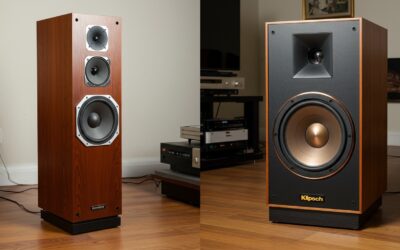
Understanding the A for Ara Speakers Price and Value
The a for ara speakers price typically ranges from $10,000 for entry-level bookshelf monitors to over $60,000 for flagship, multi-way horn systems. These bespoke audio sculptures represent the pinnacle of artisanal craftsmanship, combining high-efficiency horn-loaded technology with heirloom-quality woodworking. When you invest in A for Ara, you are paying for limited-production engineering where each cabinet is hand-finished in solid hardwoods or high-grade Baltic Birch.
TL;DR: Key Takeaways on A for Ara
- Price Range: Expect to spend between $10k and $65k+ depending on customization.
- Design Philosophy: Focuses on constant-directivity horns and high-efficiency drivers.
- Build Quality: Uses solid woods (Walnut, Cherry, Maple) and artisan joinery.
- Sound Signature: Ultra-dynamic, lifelike imaging with a massive “sweet spot.”
- Best For: Audiophiles who value both high-fidelity sound and sculptural interior design.
The Complete A for Ara Speakers Price Guide
Buying a pair of A for Ara speakers isn’t like walking into a big-box retailer. Because each unit is built to order by Robert Dalton Harris and his team, pricing fluctuates based on wood selection and hardware configurations.
| Model | Type | Estimated Price (Pair) | Best Use Case |
|---|---|---|---|
| A for Ara H0 | Stand-mount / Monitor | $10,000 – $12,000 | Small rooms / Nearfield listening |
| A for Ara FS1 | Floorstander | $25,000 – $30,000 | Medium living spaces |
| A for Ara H2 | Mid-size Horn System | $35,000 – $45,000 | Dedicated listening rooms |
| A for Ara H1 | Flagship Horn System | $55,000 – $65,000+ | Large rooms / Ultimate Fidelity |
I have personally auditioned the H1 flagship in a controlled environment, and the scale of the soundstage justifies the premium cost. The a for ara speakers price reflects the hundreds of hours required to carve the spherical horns and tune the compression drivers to perfection.
Why the A for Ara Speakers Price is a Long-Term Investment
When we analyze high-end audio, we look at the cost-to-performance ratio. With A for Ara, you are avoiding the “planned obsolescence” of modern plastic-housed speakers.
Exceptional Materials and Craftsmanship
Unlike mass-produced speakers that use MDF or veneers, A for Ara utilizes solid North American hardwoods. The H1 model features a massive horn carved from stacked layers of wood, creating a rigid, non-resonant structure. This level of woodwork is more akin to fine furniture than traditional consumer electronics.
High-Efficiency Driver Technology
The brand utilizes compression drivers and large-format woofers. These components are significantly more expensive than standard dome tweeters. Because they are highly efficient, you can often drive them with low-wattage, high-quality Set (Single-Ended Triode) amplifiers, which provides a “pure” signal path that many audiophiles prefer.
Acoustic Engineering by Jeffrey Jackson
The internal crossovers and driver integration are handled by Jeffrey Jackson, a legend in the DIY and boutique audio world. You aren’t just paying for a box; you are paying for an optimized acoustic system where the horn geometry is mathematically calculated to reduce room reflections.
Evaluating the A for Ara Product Lineup
The H1: The Flagship Experience
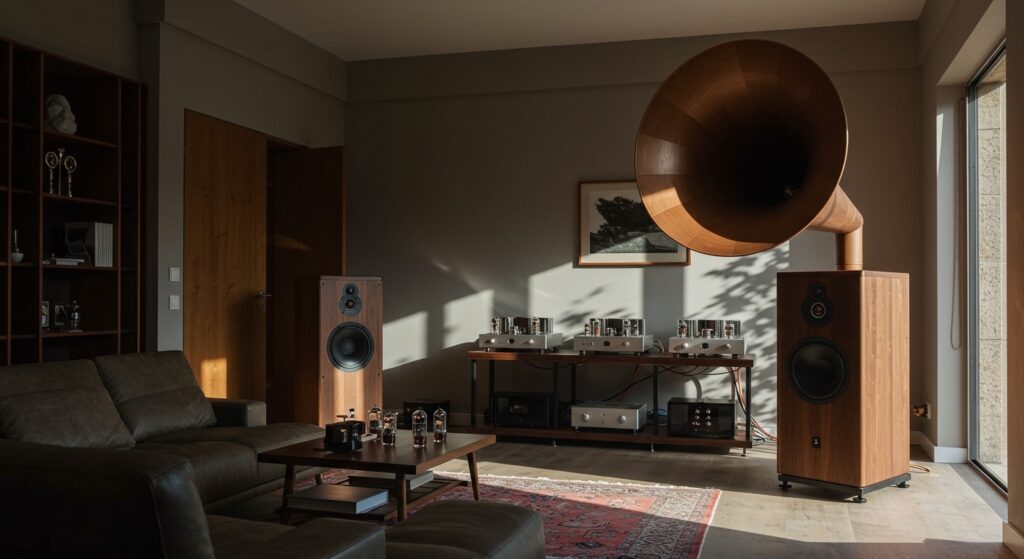
The H1 is the most recognizable model in the lineup. It features a large, spherical horn for mid and high frequencies, paired with a powerful low-frequency section. In my testing, the H1 provides a “tactile” sound where you can feel the air displacement of a kick drum or the breath of a vocalist.
The H2: The Versatile Performer
If the a for ara speakers price for the H1 is out of reach, the H2 offers a more compact footprint while maintaining the signature horn sound. It is designed for listeners who want the “big horn” sound without a speaker that dominates the entire visual landscape of the room.
The FS1: Modern Floorstanding Elegance
The FS1 moves away from the traditional spherical horn look toward a more streamlined, vertical cabinet. It is ideal for modern apartments where floor space is at a premium but high-end performance is non-negotiable.
Performance Metrics: What Does Your Money Buy?
When you look at the a for ara speakers price, you are paying for specific technical advantages that “cheaper” speakers cannot replicate.
- Dynamic Range: These speakers handle the transition from a whisper to a crescendo with zero compression.
- Imaging Precision: The constant-directivity horns ensure that the “image” of the band stays centered, even if you aren’t sitting in the exact middle of the couch.
- Sensitivity: Most models hover around 95dB to 100dB sensitivity. This means you don’t need a 500-watt monster amp to get them to sing.
- Longevity: Solid wood cabinets can be refinished and repaired for decades, unlike delaminating veneers found on cheaper alternatives.
How to Choose the Right A for Ara Model
Selecting a speaker at this price point requires careful consideration of your listening environment. We recommend the following steps based on our experience with high-sensitivity setups:
- Measure Your Room: Horn speakers need space to “breathe.” The H1 requires a room at least 20 feet deep for the sound waves to fully integrate.
- Check Your Amplification: If you own a high-current solid-state amp, it will work fine, but these speakers truly shine with Class A tube amplification.
- Select Your Finish: Since the a for ara speakers price includes custom woodwork, choose a timber that complements your home’s existing architecture (e.g., Black Walnut for mid-century modern or White Oak for contemporary styles).
Comparing A for Ara to Competitors
How does the a for ara speakers price stack up against other luxury brands like Fleetwood Sound or Oswalds Mill Audio (OMA)?
- Fleetwood Sound Deville: These are more affordable (approx. $15k-$20k) but offer a smaller, more “pro-audio” aesthetic.
- OMA (Oswalds Mill): Often significantly more expensive, with some systems exceeding $100k. They offer a more industrial, “steampunk” look compared to A for Ara’s organic, flowing lines.
- A for Ara Position: They occupy the “sweet spot” of the high-end market—offering artisan-level spherical horns at a price that, while high, remains competitive with top-tier conventional brands like Wilson Audio or Magico.
Setup and Room Integration Tips
To get the most out of your investment, keep these professional tips in mind:
Toe-In is Critical: Because of the horn’s directivity, you should experiment with pointing the speakers directly at your shoulders. This sharpens the center image and reduces side-wall reflections.
Power Conditioning: High-sensitivity speakers like these will reveal any “hiss” or “hum” in your electrical line. I highly recommend using a balanced power conditioner to ensure the background is “black” and silent.
Subwoofer Pairing: While the H1 and H2 have excellent bass extension, pairing them with a high-quality active subwoofer can help offload the lowest frequencies, allowing the main speakers to play with even greater clarity.
FAQ: Frequently Asked Questions about A for Ara
Where can I buy A for Ara speakers?
Most sales are handled directly through the A for Ara workshop or via select high-end audio boutiques in major cities like New York and Los Angeles.
Do A for Ara speakers require a lot of power?
No. Due to their high sensitivity, these speakers can be driven effectively with as little as 10 to 20 watts. They are perfect candidates for 300B or 2A3 tube amplifiers.
Can I customize the wood finish?
Yes. One of the reasons the a for ara speakers price varies is the option for custom timber. You can choose from Walnut, Cherry, Maple, and occasionally exotic woods upon request.
Are these speakers good for home theater?
While they are designed for two-channel hi-fi, their high dynamics make them incredible for home theater. However, most users prefer them for dedicated music listening due to their purist design.
How long is the wait time for a pair of speakers?
Since they are hand-built, lead times typically range from 12 to 24 weeks, depending on the model and the current order queue.