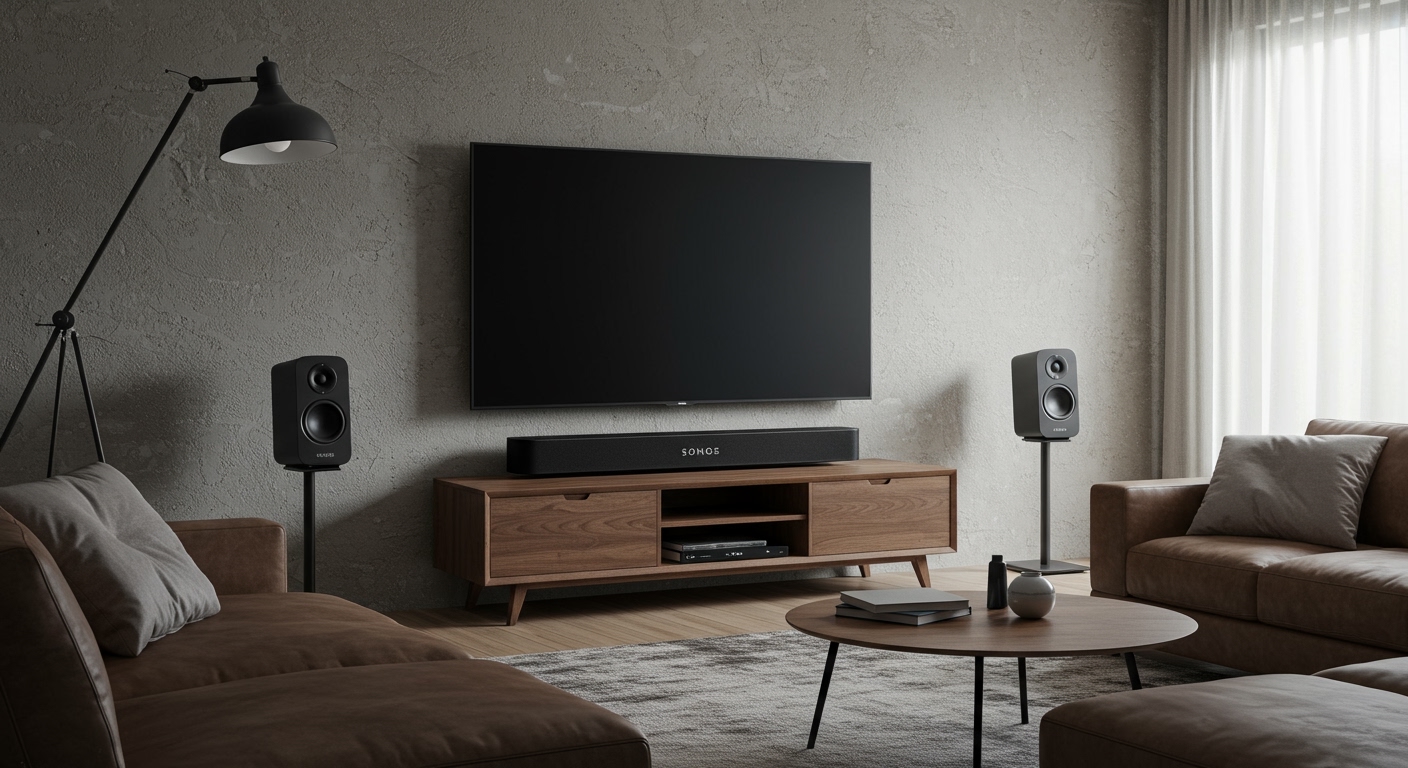
Your Ultimate Guide to Choosing and Setting Up A/V Speakers
Tired of thin, lifeless sound from your TV’s built-in speakers? You’re not alone. Creating a truly immersive home theater experience—where you can feel the rumble of an explosion and hear every whisper of dialogue—is impossible without a proper set of A/V speakers. But navigating the world of surround sound, speaker types, and complex specifications can feel overwhelming.
As someone who has designed and calibrated dozens of home theater systems, from simple soundbar setups to complex Dolby Atmos rooms, I’m here to demystify the process. This guide will walk you through every step, from understanding the components to choosing the right gear and placing it perfectly in your room. We’ll turn that confusion into a clear, actionable plan.
Key Takeaways: A/V Speaker Essentials
- Start with a 3.1 System: For the biggest immediate upgrade, begin with front left and right speakers, a center channel for clear dialogue, and a subwoofer for bass. You can always add surround speakers later.
- Match Your Fronts: Your front left, center, and right speakers should be from the same brand and series to ensure a seamless soundstage. This is called “timbre-matching.”
- The AV Receiver is Crucial: The AV receiver is the brain of your system. Make sure it has enough channels for your desired setup (e.g., 7 channels for a 5.1.2 Dolby Atmos system) and sufficient power for your speakers.
- Placement is Paramount: The quality of your A/V speakers is only half the battle. Proper placement is free and has a massive impact on sound quality.
- Calibrate Your System: Use your receiver’s built-in room correction software (Audyssey, Dirac Live, etc.) to automatically adjust levels, distances, and equalization for your specific room.
Understanding the Core Components of A/V Speakers
A surround sound system is a team of specialized players. Each speaker has a distinct role, and when they work together, they create a cohesive, three-dimensional sound field that puts you right in the middle of the action.
The Role of Each Speaker in a Surround Sound System
- Front Left & Right Speakers: These are the workhorses of your system. They handle the main stereo sound, musical scores, and off-screen sound effects. They can be either bookshelf speakers or larger floor-standing speakers.
- Center Channel Speaker: In my experience, this is the most important speaker for movie and TV watching. It is dedicated almost exclusively to dialogue, anchoring conversations to the screen so they sound clear and intelligible.
- Surround Speakers: Placed to the sides and/or behind you, these speakers handle ambient sounds, background noise, and directional effects. They are essential for creating that “enveloping” feeling.
- Height / Dolby Atmos Speakers: These are the key to next-generation immersive audio formats like Dolby Atmos and DTS:X. They can be installed in your ceiling or be upward-firing modules that bounce sound off the ceiling to create the illusion of overhead sound.
- Subwoofer (LFE Channel): The subwoofer is a specialized speaker designed to reproduce only low-frequency effects (LFE) and deep bass. It’s what provides the visceral rumble and impact in action movies.
Common Surround Sound Configurations
As you shop for A/V speakers and receivers, you’ll see numbers like 5.1 or 7.2.4. The first number represents the main speakers, the second is the number of subwoofers, and the third (if present) is the number of height speakers.
| Configuration | Speaker Layout | Best For |
|---|---|---|
| 2.1 | 2 Fronts, 1 Subwoofer | Music and a basic TV audio upgrade. |
| 3.1 | 2 Fronts, 1 Center, 1 Subwoofer | Excellent starting point for movie lovers, prioritizing dialogue clarity. |
| 5.1 | 3 Fronts, 2 Surrounds, 1 Subwoofer | The long-time standard for true surround sound. |
| 7.1 | 3 Fronts, 4 Surrounds, 1 Subwoofer | Adds rear-surround speakers for more precise rear sound placement in larger rooms. |
| 5.1.2 | 5.1 setup + 2 Height Speakers | The most common entry-point for an immersive Dolby Atmos experience. |
How to Choose the Right A/V Speakers for Your Room
There is no single “best” set of A/V speakers; there is only what’s best for your space, budget, and listening habits. Follow these steps to narrow down your options.
Step 1: Assess Your Room Size and Layout
The size of your room is the biggest factor in determining what type of speakers you need.
- Small Rooms (Under 150 sq. ft.): A high-quality set of bookshelf speakers paired with a good subwoofer is often the perfect choice. They provide detailed sound without overwhelming the space.
- Medium Rooms (150-300 sq. ft.): You can choose between larger bookshelf speakers or more compact floor-standing speakers.
- Large Rooms (Over 300 sq. ft.): Floor-standing speakers are highly recommended here. Their larger size allows them to move more air and fill the space with powerful, effortless sound.
Also, consider room acoustics. Rooms with lots of hard surfaces (hardwood floors, large windows) will reflect sound and can sound harsh. Adding rugs, curtains, or acoustic panels can make a huge difference.
Step 2: Bookshelf vs. Floor-Standing vs. In-Wall Speakers
Your primary choice for front speakers will be between these three types.
- Bookshelf Speakers:
* Pros: Compact, versatile, can be placed on stands or furniture, often more affordable.
* Cons: Limited bass output, requiring a capable subwoofer to sound full-range.
* I recommend these for: Smaller rooms, tighter budgets, or when a discreet look is preferred. Great brands to look at include KEF, Elac, and Q Acoustics.
- Floor-Standing Speakers (Towers):
* Pros: Produce a larger, more dynamic sound with deeper bass extension. They don’t require separate stands.
* Cons: Take up significant floor space, can be more expensive.
* I recommend these for: Medium to large rooms, dedicated listening spaces, and anyone who wants a powerful, full-range sound for both movies and music. Check out models from Klipsch, SVS, and Polk Audio.
- In-Wall/In-Ceiling Speakers:
* Pros: The ultimate in stealth. They disappear into your room for a clean, minimalist aesthetic.
* Cons: Installation is more complex and permanent. Placement is less flexible, and performance can be compromised by wall cavity acoustics.
* I recommend these for: Custom media rooms or living rooms where aesthetics are the top priority.
Step 3: Understanding Key Speaker Specifications
Don’t get lost in the numbers, but a few key specs are important for matching speakers to your AV receiver.
- Impedance (Ohms Ω): This measures electrical resistance. Most A/V speakers are rated at 8 ohms or 6 ohms. Just ensure your AV receiver is rated to handle the impedance of your chosen speakers.
- Sensitivity (dB): This measures how loud a speaker gets with a certain amount of power (e.g., 90dB with 1 watt at 1 meter). A higher sensitivity rating means the speaker can get louder with less power, making it easier for an AV receiver to drive.
- Frequency Response (Hz-kHz): This indicates the range of tones the speaker can reproduce, from low bass to high treble. A wider range is generally better, but this spec should be taken with a grain of salt as manufacturers measure it differently.
Step 4: Don’t Forget the AV Receiver
Your AV receiver is the central command hub. It receives audio and video signals from your sources (like a streaming device or Blu-ray player), decodes the audio, sends power to your A/V speakers, and passes the video to your TV.
When choosing a receiver, look for:
Sufficient Channels: Get a receiver that can power the system you want now and in the future