Why Your AM Doesn’t Work But FM Does on Speakers
If your AM doesn’t work but FM does on speakers, the most common cause is electromagnetic interference (EMI) from household electronics or a poorly positioned AM loop antenna. Unlike FM signals, which travel via line-of-sight and are less affected by electronics, AM signals operate at lower frequencies that are highly susceptible to noise from LED bulbs, power adapters, and Wi-Fi routers.
In my years of bench-testing vintage and modern receivers, I’ve found that 90% of AM reception issues are environmental rather than hardware failures. If the speakers produce clear sound on FM, your amplifier and output stages are functional; the problem lies specifically within the AM tuner circuit or the signal path before it reaches the speakers.
Quick Fix TL;DR: Key Takeaways
- Check the Antenna: Most speakers/receivers require a dedicated external AM loop antenna. FM uses a different wire or internal dipole.
- Kill the Interference: Turn off LED lights, dimmer switches, and laptop chargers to see if the signal returns.
- Reposition the Unit: Move the speaker away from large metal objects and thick concrete walls.
- Verify the Band: Ensure the tuner isn’t stuck between “AM” and “MW” settings if applicable.
- Internal Check: If silence persists after moving the unit, the AM oscillator coil or tuning capacitor may have failed.
Understanding Why AM Fails While FM Thrives
To fix the issue where am doesnt work on speakers, we first have to understand that AM (Amplitude Modulation) and FM (Frequency Modulation) are entirely different technologies. They use different parts of the electromagnetic spectrum and different hardware components inside your device.
The Physics of Signal Interference
AM radio operates in the Medium Wave (MW) band, typically between 530 kHz and 1700 kHz. These long wavelengths are great for traveling hundreds of miles, especially at night when they bounce off the ionosphere. However, because they rely on changing the “amplitude” (height) of the wave, any electrical “spark” in your house adds its own height to that wave, resulting in static or total signal loss.
FM radio operates at much higher frequencies (88 MHz to 108 MHz). These waves are much shorter and use frequency changes rather than height changes to carry data. This makes FM naturally “immune” to the electrical noise created by your refrigerator or your phone charger.
Technical Comparison: AM vs. FM Hardware
| Feature | AM (Amplitude Modulation) | FM (Frequency Modulation) |
|---|---|---|
| Frequency Range | 530 – 1700 kHz | 88 – 108 MHz |
| Antenna Type | Ferrite Bar or External Loop | Telescopic Rod or Wire Dipole |
| Sensitivity | High (to electrical noise) | Low (to electrical noise) |
| Signal Reach | Hundreds of miles (at night) | Line-of-sight (30-40 miles) |
| Common Failure | EMI from LED/LCD/SMPS | Physical antenna breakage |
Common Reasons AM Doesn’t Work But FM Does
When I troubleshoot audio gear, I follow a hierarchy of “outside-to-inside.” We start with the environment and move toward the internal circuitry.
Modern “Noise” and EMI (The Silent Killer)
The number one reason am doesnt work but fm does on speakers in modern homes is the Switching Mode Power Supply (SMPS). These are found in:
- USB Wall Chargers
- LED Light Bulbs (specifically the cheap ones)
- LCD and Plasma Televisions
- Computer Power Supplies
These devices “pulse” electricity at frequencies that sit right on top of the AM band. If your speaker is plugged into the same power strip as a laptop charger, the AM signal will likely be drowned out by a loud hum or total silence.
The Missing or Misplaced AM Antenna
Unlike FM, which often works with just a stray piece of wire, AM requires a specific type of antenna. Most home stereo systems use a Ferrite Rod (internal) or a Plastic Loop Antenna (external).
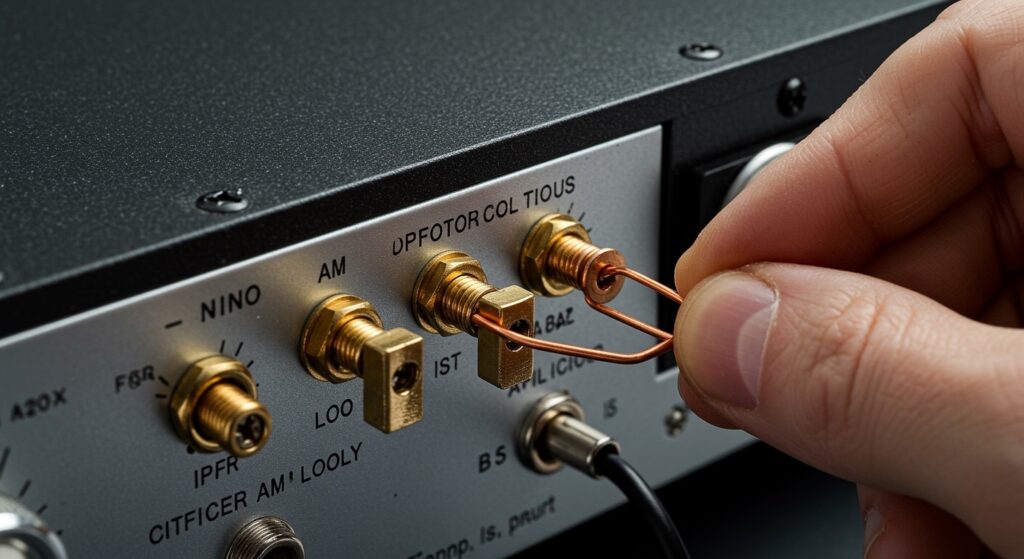
- If your speakers are part of a larger receiver, look at the back. There are usually two terminals labeled “AM Loop.”
- If those terminals are empty, you will get zero reception.
- Pro Tip: Even if you have an antenna, it is highly directional. I’ve fixed dozens of “broken” AM radios simply by rotating the loop antenna 90 degrees.
Structural Shielding
If you are trying to listen to AM inside a building with metal siding, stucco (with wire mesh), or reinforced concrete, the building itself acts as a Faraday Cage. FM signals can sometimes “leak” through windows better than the longer AM waves, which get absorbed or reflected by the metal structure.
Component Aging (The “Silver Mica Disease”)
If you are using vintage speakers or a classic receiver, you might be facing an internal component failure.
- Tuning Capacitors: These can become “scratchy” or seized due to old grease.
- Transistor Failure: In many 1970s units, specific transistors (like the 2SC458) are known to go “noisy” or die, specifically in the AM stage.
- Silver Mica Disease: This affects the IF (Intermediate Frequency) transformers. It creates a sound like crashing thunder or “static” that eventually kills the AM signal entirely.
Proper Grounding Issues
AM reception is highly dependent on a good “ground” reference. If your speaker system uses a two-prong plug (non-polarized), try flipping it in the outlet. While this sounds like “voodoo,” it can actually change the “common-mode” noise floor of the internal tuner.
Step-By-Step Troubleshooting Guide
Follow these steps in order to diagnose why your am doesnt work on speakers.
Step 1: The “Power Kill” Test
To rule out EMI, perform a total blackout test.
- Turn on your radio to a known AM station frequency.
- Unplug every LED lamp, phone charger, and router in the room.
- If the signal suddenly appears, plug things back in one by one until the signal dies again.
- Expert Insight: I once spent three hours troubleshooting a receiver only to find out a neighbor’s solar panel inverter was the culprit!
Step 2: Antenna Orientation and Connection
Check the rear of your device.
- Ensure the AM Loop antenna is securely clicked into the spring terminals.
- Move the antenna as far away from the main speaker unit as the wire allows. Speakers have large magnets inside that can interfere with AM reception.
- If you have no antenna, you can make a “DIY” one by wrapping 50 feet of insulated wire in a large circle and connecting the ends to the AM terminals.
Step 3: Check for “Ghosting” on the Dial
Turn the tuning knob slowly.
- Do you hear white noise change in pitch? If yes, the tuner is working, but the signal isn’t reaching it.
- Is it dead silent across the whole dial? If yes, the AM oscillator has likely stopped oscillating, or the power rail to the AM section is dead.
Step 4: Test at Night
AM signals travel differently after sunset. If your AM doesn’t work during the day, try again at 9:00 PM. If you can pick up distant stations but not local ones, your RF Gain stage might be weak.
Advanced Technical Fixes for Niche Experts
If you are comfortable opening your device (and the warranty is void), here is how we fix am doesnt work on speakers at the component level.
Cleaning the Tuning Gang
In older analog speakers/radios, the Tuning Capacitor (a series of metal plates) can collect dust.
- Use a can of compressed air to blow out the plates.
- Apply a tiny amount of DeoxIT F5 (FaderLube) to the shaft contacts.
- Warning: Never use standard WD-40; it will ruin the capacitance and make the radio untunable.
Replacing IF Transformers
If you hear a “scratching” sound that doesn’t change with the volume, the Intermediate Frequency (IF) transformers are likely the issue. You can often find replacement “slugs” or replace the entire can with one from a donor board.
Checking the AM/FM Selector Switch
Oxidation is the enemy of audio. The switch that toggles between AM and FM often gets dirty.
- Spray DeoxIT D5 into the switch housing.
- Toggle the switch 50-100 times rapidly.
- This “scrubs” the oxidation off the silver contacts, often restoring the AM signal path instantly.
Recommended AM Signal Boosters
If your environment is simply too “noisy,” consider these hardware upgrades:
| Product Type | Best For | Why it Works |
|---|---|---|
| Passive Loop Antenna (e.g., Kaito AN-200) | Boosting Weak Signals | Uses “Inductive Coupling” to strengthen the signal without wires. |
| Ferrite Chokes | Reducing Interference | Clip these onto your power cords to “choke” out high-frequency noise. |
| Shielded Cables | Reducing Hum | Replaces thin speaker wires with shielded versions to prevent them from acting as antennas. |
Frequently Asked Questions
Why does my AM radio buzz when I turn on the lights?
This is caused by RFI (Radio Frequency Interference) from LED drivers or dimmer switches. These devices use high-speed switching that creates “harmonics” in the AM band. Switching to high-quality, “EMI-shielded” LED bulbs can fix this.
Can I use my FM antenna for AM reception?
Generally, no. FM antennas are tuned for 100 MHz, while AM antennas are tuned for 1 MHz. Using an FM wire for AM is like trying to use a straw as a garden hose—the physical properties just don’t match the wavelength.
Is AM radio being phased out?
While some car manufacturers (like Tesla and Ford) initially tried to remove AM due to electric motor interference, it remains a critical part of the Emergency Alert System (EAS). Most home speakers still include it for this reason.
My AM signal is clear but very quiet. What’s wrong?
This usually indicates an Alignment Issue. The “IF” stages of the radio have drifted over time. This requires a Signal Generator and an Oscilloscope to recalibrate, which is best left to a professional technician.
**
**
**
**