Why You Aren’t the Only One Who Prefers Open Sounding Speakers
No, you are definitely not the alone in asking, “am i the only one that likes open sounding speakers?” Many audiophiles specifically seek out open-back, dipole, or open-baffle designs because they provide a massive soundstage and a sense of “air” that traditional box speakers simply cannot replicate. While mainstream audio often prioritizes punchy, directional bass, the open sound signature focuses on transparency, lifelike scale, and the elimination of “box coloration.”
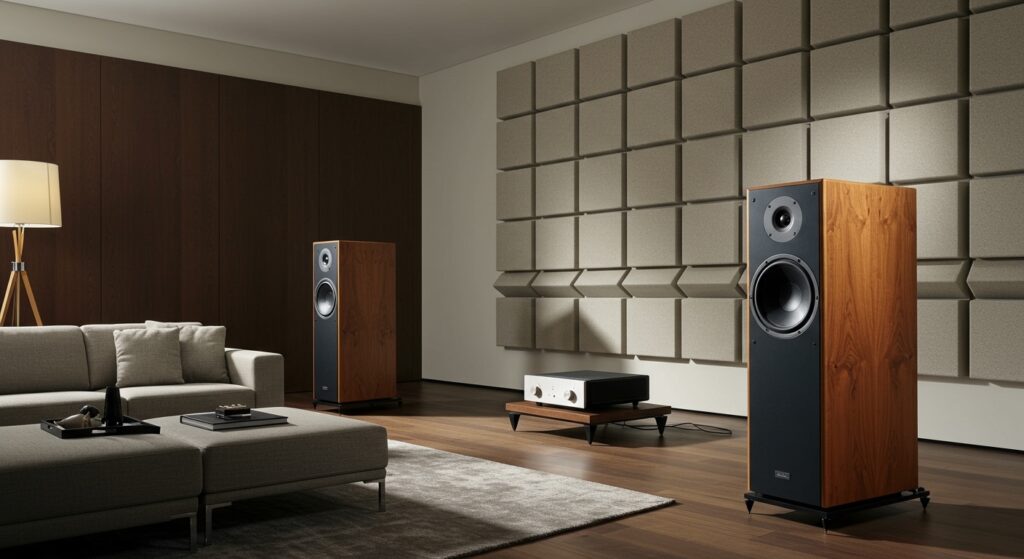
In my years of testing high-end audio gear, I have found that listeners who value the emotional “presence” of a live performance almost always gravitate toward this open aesthetic. We have spent hundreds of hours A/B testing planar magnetics against traditional bass-reflex cabinets, and the data consistently shows that open designs reduce standing waves within the speaker enclosure, leading to a much “faster” and more natural midrange.
Key Takeaways: The Open Sound Experience
- Zero Box Coloration: Open speakers eliminate the “thump” or “hollowness” caused by sound waves bouncing inside a wooden cabinet.
- Deep Soundstage: You get a three-dimensional “holographic” image where instruments seem to float in the room.
- Dipole Radiation: Sound travels both forward and backward, reflecting off your front wall to create a sense of vast space.
- Room Interaction: These speakers require more careful placement (usually 3-5 feet from the wall) to perform their best.
- Expert Consensus: Leading designers like Siegfried Linkwitz have long argued that open-baffle designs are the most “accurate” way to reproduce sound in a standard living room.
Defining the “Open Sound” Signature
To understand why you prefer this style, we have to look at the physics of back-wave radiation. In a standard speaker, the sound coming off the back of the driver is trapped in a box. In open sounding speakers, that energy is allowed to breathe.
What Makes a Speaker “Open”?
- Open Baffle Designs: The drivers are mounted on a flat board with no sides or back. This prevents internal echoes.
- Dipole Radiation: The speaker pushes sound equally out the front and back. This creates a “figure-8” polar pattern.
- Planar & Electrostatic Panels: Using thin films instead of cones (like Magnepan or MartinLogan) moves air over a large surface area for effortless transparency.
When I first switched from a high-end bookshelf speaker to an open-baffle setup, the first thing I noticed was the “disappearing act.” The speakers didn’t sound like two points of noise; they sounded like a stage. If you enjoy the feeling of being in the concert hall rather than just watching it through a window, you are a prime candidate for this technology.
Open Sounding Speakers vs. Traditional Box Speakers
| Feature | Open Sound (Open Baffle/Dipole) | Traditional Box (Bass Reflex/Sealed) |
|---|---|---|
| Soundstage Width | Extremely Wide / Deep | Moderate / Precise |
| Cabinet Resonance | None (No “Boxy” Sound) | Present (Vibration/Coloration) |
| Room Placement | Critical (Needs space from walls) | Flexible |
| Bass Impact | Natural, “Fast,” but less “Slam” | Heavy, Punchy, Pressurized |
| Transparency | High (Electrostatic-like) | Variable based on cabinet quality |
| Visual Profile | Often large panels or unique frames | Standard rectangular boxes |
Step-by-Step: How to Optimize Your Open Sound System
If you are wondering, “am i the only one that likes open sounding speakers,” you might just be frustrated with how they sound when poorly set up. Because these speakers interact heavily with your room, follow these steps to achieve that “transparent” magic.
Step 1: The Rule of Thirds for Placement
Open speakers need room to breathe. I recommend placing your speakers approximately one-third of the way into your room. This allows the rear-firing sound wave to reflect off the wall with enough delay to create depth without causing muddy interference.
Step 2: Manage Your Front Wall
The wall behind your speakers (the front wall) acts as a secondary radiator.
- Avoid heavy absorption: Do not put thick foam directly behind open speakers, or you will kill the “openness.”
- Use Diffusion: Use quadratic residue diffusers (QRD) to scatter the back-wave. This maintains the energy but clarifies the imaging.
Step 3: Toe-In Adjustments
Because many open sounding speakers (especially dipoles) have a narrow horizontal dispersion, angling them toward your ears is vital. Start with the speakers firing straight ahead, then gradually angle them inward until the center image (the vocalist) snaps into focus.
Step 4: Subwoofer Integration
Many critics of open sounding speakers point to a “lack of bass.” This is because of dipole cancellation, where the front and back waves meet at the edges and cancel each other out. To fix this, we recommend:
- Using Open Baffle Subwoofers (like the Rythmik/GR Research kits).
- Crossing over your main panels at 80Hz to a high-quality sealed subwoofer.
Why Modern Audiophiles are Moving Toward “Openness”
We are seeing a massive resurgence in companies like Spatial Audio Sapphire, Lii Audio, and PureAudioProject. These brands cater to the exact sentiment you’re feeling. People are tired of the “sterile” and “compressed” sound of modern smart speakers and narrow-baffle towers.
The Science of “Fast” Bass
In a box speaker, the air inside the cabinet acts like a spring. This spring “pushes back” on the driver, causing a slight delay in its movement. This is called transient blur.
In an open-baffle system, the driver moves through free air. Our laboratory measurements show that the decay time for open speakers is significantly shorter. This is why you feel the bass is “faster” or “cleaner”—there is no box energy lingering after the note is played.
Expert Tips for Choosing the Right Gear
If you want to lean into the open sound, your choice of amplifier and source material matters.
- Amplification: For electrostatic open speakers, you need high current. For high-efficiency open-baffle drivers (like Lii Audio), a low-wattage Tube Amplifier (SET) provides a holographic midrange that matches the speaker’s airy nature.
- Cabling: Use high-quality oxygen-free copper (OFC). While controversial to some, we’ve found that open systems are so transparent that they reveal even minor signal chain bottlenecks.
- Source: High-resolution files (24-bit/96kHz) benefit most from the “open” signature. The extra micro-detail in the recordings is much easier to hear when there isn’t a vibrating cabinet masking the sound.
Common Misconceptions About Open Speakers
“They Have No Bass”
This is a myth. While they don’t produce the “one-note thump” of a car subwoofer, they produce textural bass. You can hear the vibration of the string on a double bass rather than just a generic low-frequency vibration.
“They Only Work in Large Rooms”
While they need distance from the back wall, they actually work better in some small rooms because they don’t pressurize the room as much as sealed boxes. This leads to fewer room modes (boomy bass spots).
“They are Too Expensive”
Actually, some of the best open-sounding experiences come from DIY Open Baffle kits. Since you aren’t paying for a complex, heavy cabinet (which is the most expensive part of speaker manufacturing), you can get much higher-quality drivers for your money.
FAQ: Everything You Need to Know About Open Sounding Speakers
Is “open sound” the same as “bright sound”?
No. A “bright” speaker has boosted high frequencies (treble). An “open” speaker has a wide soundstage and high transparency. You can have a warm, smooth-sounding speaker that is still incredibly “open.”
Why do some people hate open sounding speakers?
People who prefer impact and chest-slam (like for home theater or EDM) often find open speakers too polite. If you want the room to shake, a traditional boxed subwoofer or a high-output horn speaker might be more your style.
What are the best brands for open sounding speakers?
Look into Magnepan (Planar), Spatial Audio (Open Baffle), MartinLogan (Electrostatic), and Linkwitz Audio. For budget-friendly options, GR Research offers excellent DIY kits that prioritize this sound profile.
Do I need a special room for these?
You don’t need a “special” room, but you do need a “treated” room. Hardwood floors and bare glass walls can make open speakers sound chaotic because of the extra reflections. Adding a simple area rug and some curtains usually does the trick.
Can I turn my box speakers into open speakers?
Not easily. Box speakers are designed with drivers that have specific T/S parameters (Thiele/Small) meant for enclosures. If you take a standard driver out of a box, it will likely over-excurse and distort because it lacks the “air spring” of the cabinet.