Are Acoustic Amps Just PA Speakers? The Technical Reality
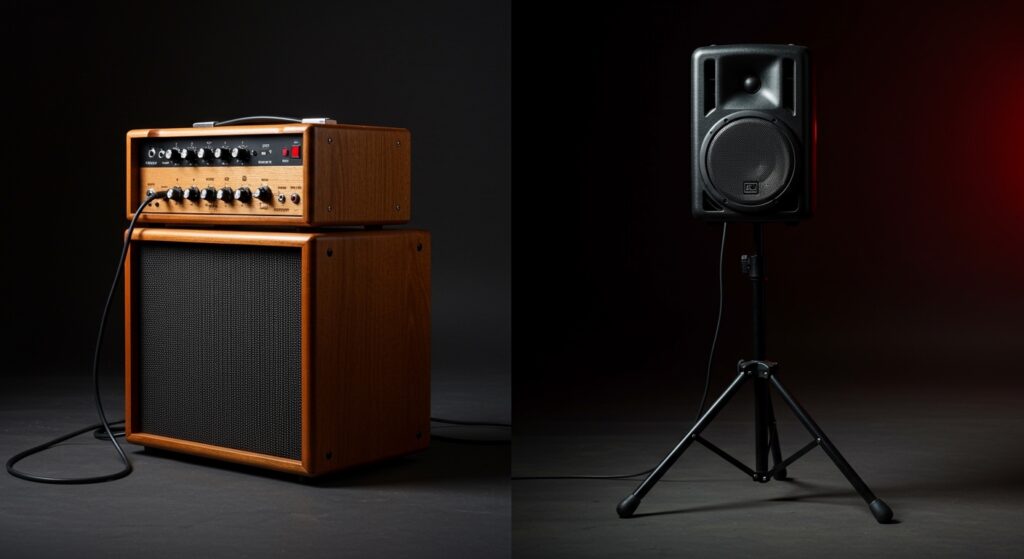
Are acoustic amps just PA speakers? Technically, no; while both systems aim to amplify sound, acoustic amps include specialized preamps, impedance-matching inputs, and tonal shaping circuits specifically designed for guitar pickups, whereas PA speakers are designed for a “flat” frequency response to handle a full range of audio. Acoustic amps act as an all-in-one performance solution for soloists, while PA systems are modular tools meant for broad coverage.
I’ve spent over 15 years gigging in every venue imaginable—from cramped coffee shops to massive outdoor festivals. In my experience, the choice between these two isn’t just about volume; it’s about how your instrument interacts with the air. While you can plug an acoustic guitar into a PA, doing so without the right interface often results in a “sterile” or “quacky” tone that lacks the warmth of a dedicated acoustic amplifier.
🚀 Key Takeaways: Choosing Your Sound
- Acoustic Amps: Best for solo performers who need a “plug-and-play” solution with built-in EQ, reverb, and feedback suppression.
- PA Speakers: Ideal for larger venues or groups where you need to project multiple instruments and vocals to a wide audience.
- Input Impedance: Acoustic amps feature high-impedance (Hi-Z) inputs that properly load Piezo pickups, preventing a thin, brittle sound.
- Portability: Modern all-in-one PA systems (like the Bose L1) bridge the gap, but dedicated amps like the Fishman Loudbox offer more guitar-centric control.
- Signal Chain: If using a PA, you often need an external Preamp/DI box to match the quality of an acoustic amp’s internal circuitry.
The Technical Architecture: Are Acoustic Amps Just PA Speakers?
To the untrained eye, a Fishman Loudbox and a JBL EON might look similar, but their internal “brains” are worlds apart. A PA speaker is designed to be a “blank canvas.” It takes a line-level signal and makes it louder without adding color.
Acoustic amps, however, are designed to compensate for the technical shortcomings of acoustic guitar pickups. Most acoustic guitars use Piezoelectric pickups, which have an incredibly high output impedance. If you plug these directly into a standard PA mixer’s line input, you lose bass and gain harsh high-end frequencies.
Comparison Table: Acoustic Amps vs. PA Speakers
| Feature | Acoustic Amplifier | PA Speaker (Active/Powered) |
|---|---|---|
| Primary Goal | Tone shaping & instrument character | Transparent, wide-range projection |
| Input Type | High-Impedance (Hi-Z) for Pickups | Line-level or Mic-level |
| Onboard FX | Chorus, Reverb, Notch Filters | Minimal (usually just basic EQ) |
| Feedback Control | Dedicated Phase & Notch switches | Requires external mixer processing |
| Typical Drivers | Woofer + Tweeter (Optimized for mids) | Full-range Woofer + Compression Driver |
| Weight/Size | Highly portable, small footprint | Varies; often heavier/bulkier |
Understanding Why Acoustic Amps Are Specialized Gear
When we ask, “are acoustic amps just pa speakers?”, we have to look at the Preamp. I remember testing a Boss Singer Pro against a high-end QSC K12.2. Even though the QSC was “better” on paper, my Taylor 814ce sounded more “woody” and natural through the Boss. This is because acoustic amps have EQ curves specifically tuned to the frequencies of wood and strings.
The Role of the Preamp
The preamp is the heart of the acoustic amp. It performs three critical functions:
- Impedance Matching: It ensures the high-voltage signal from your pickup is handled correctly.
- Gain Staging: It boosts the weak signal from your guitar to a level the power amp can use without adding noise.
- Tone Sculpting: It often includes a “Mid-Shift” or “Shape” button that targets the “boxy” frequencies common in acoustic-electric guitars.
Feedback Suppression: The Silent Hero
Acoustic instruments are hollow boxes designed to vibrate. At high volumes, they become feedback magnets. Dedicated acoustic amps almost always feature a Notch Filter. This allows you to “dial out” the specific frequency that is causing your guitar to howl, without ruining the rest of your tone. Standard PA speakers rarely have this feature built-in.
Step-by-Step: How to Choose the Right Setup for Your Gig
If you are struggling to decide if you need a dedicated amp or a PA, follow this workflow we use when advising professional musicians.
Step 1: Analyze Your Venue Size
- Coffee Shops/Small Rooms: A dedicated acoustic amp is superior. It’s a monitor for you and a sound source for the crowd.
- Medium Clubs (100-200 people): You may want an acoustic amp for your stage sound, sending a DI Out to the house PA.
- Outdoor Events: A PA system’s wider dispersion pattern is necessary to prevent the sound from “vanishing” into the open air.
Step 2: Evaluate Your Input Needs
How many things are you plugging in?
- Guitar only: Acoustic amp.
- Guitar + Vocal: Many acoustic amps (like the AER Compact 60) have a dedicated mic channel with Phantom Power.
- Full Band: You need a PA mixer. Plugging a full band into acoustic amps results in a muddy mess.
Step 3: Check Your Pickup Type
- Passive Pickups (No battery): You must use an acoustic amp or a high-quality DI box. A PA will not have the gain or impedance to handle this.
- Active Pickups (With battery): These have a stronger signal and are more “PA-friendly,” but still benefit from an amp’s EQ.
When to Use a PA Speaker Instead of an Acoustic Amp
While we’ve established that acoustic amps are not just PA speakers, there are times when the PA is actually the better choice. In my testing of the Bose S1 Pro, I found it functions as a “hybrid.” It has the wide dispersion of a PA but the “ToneMatch” circuitry of an amp.
Advantages of the PA Approach:
- Vertical Coverage: PA speakers are usually mounted on stands. This allows the sound to travel over the heads of the front row and reach the back of the room.
- Stereo Imaging: If you use modern effects like lush shimmer reverbs or ping-pong delays, a pair of PA speakers provides a 3D soundstage an amp can’t match.
- Versatility: You can use a PA for house parties, public speaking, or playing backing tracks. An acoustic amp is a specialized tool that doesn’t always handle recorded music well.
Advanced Tech: Making a PA Sound Like an Acoustic Amp
If you decide to go the PA route, you can “bridge the gap” by using specific hardware. We’ve found that using an Acoustic DI Preamp (like the L.R. Baggs Venue DI) effectively turns any PA speaker into a high-end acoustic amp.
Essential Gear for the PA User:
- IR Loaders (Impulse Responses): Devices like the TC Electronic BodyRez or Strymon Iridium (Acoustic settings) use digital “fingerprints” of high-end studio microphones to make your pickup sound like a mic’d guitar.
- Compressors: A subtle touch of compression helps “glue” the guitar sound, making it feel more professional through a flat PA system.
Frequently Asked Questions
Can I use a regular electric guitar amp for my acoustic?
I strongly advise against this. Electric guitar amps are designed to distort and have a very limited frequency range (usually rolling off at 5kHz). Acoustic guitars need the “full range” (up to 15-20kHz) provided by the tweeters in acoustic amps or PA speakers to sound natural.
Is a “Column PA” better than an acoustic amp?
Systems like the Maui 5 or Bose L1 are excellent for acoustic performers. They provide the “PA” benefit of wide sound dispersion but often include “Acoustic Guitar” presets that mimic the circuitry of an amp. They are more expensive but very effective.
Do I need an acoustic amp if the venue has a PA?
Not necessarily, but having one gives you control. If you rely on the house PA, you are at the mercy of the sound engineer. With your own acoustic amp, you can adjust your volume and EQ on stage, ensuring you always hear yourself clearly.
Why do some acoustic amps have two speakers?
Usually, this consists of a woofer for the low-end and a tweeter for the high-end “shimmer.” This “two-way” design is exactly what makes people ask, “are acoustic amps just pa speakers?”—because the physical speaker layout is similar, even if the processing is different.
What is the “Quack” people talk about with acoustic gear?
“Quack” refers to the harsh, nasal, and percussive sound produced by Piezo pickups when they are pushed too hard or plugged into a low-impedance input (like a PA line-in). Acoustic amps use specialized compression and EQ to “tame the quack.”