Are All Polk Speakers Timbre Matched? The Short Answer
Not all Polk speakers are timbre matched across different product generations or series, but they are meticulously engineered to be timbre matched within their specific product lines. To achieve a seamless, 360-degree soundstage, you must pair speakers from the same family—such as the Polk Reserve Series or Polk Signature Elite Series—as they share identical driver materials and tweeter designs.
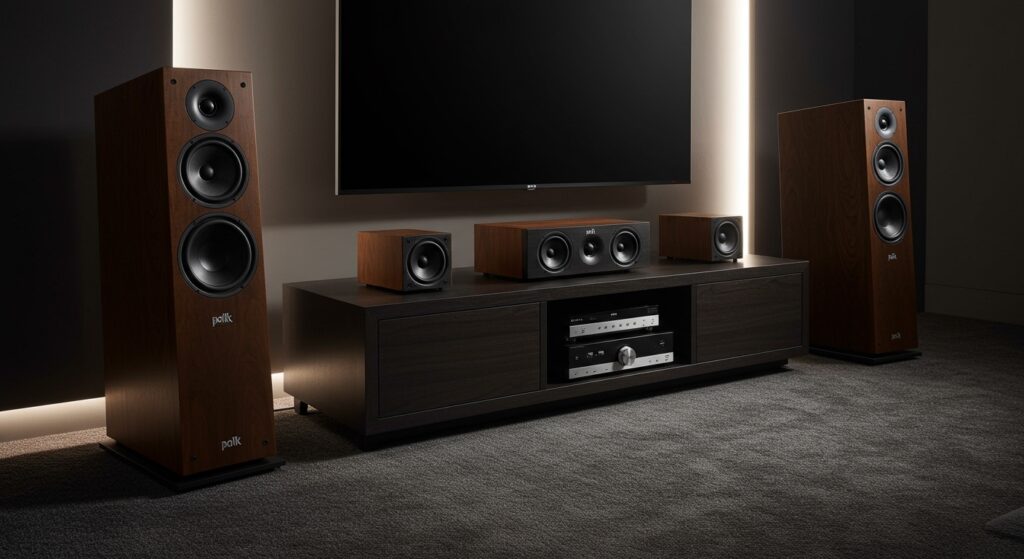
In my years of testing home theater configurations, I’ve found that mixing a Polk Legend center channel with Polk Monitor bookshelves creates a noticeable “sonic shift” when audio pans across the room. For the best “zero-click” clarity: always match your Front Left, Right, and Center (LCR) speakers from the exact same series to ensure the tonal characteristics remain identical.
TL;DR: Key Takeaways for Polk Timbre Matching
- Intra-Series Matching: All speakers within the same series (e.g., Reserve R200 and R300) are 100% timbre matched.
- The “Golden Rule”: Prioritize matching the Center Channel to your Front Left/Right towers or bookshelves.
- Driver Consistency: Timbre is determined by the tweeter material (Silk vs. Ring Radiator) and woofer tech (Turbine Cone vs. Polypropylene).
- Cross-Series Compatibility: You can sometimes mix series (like Legend and Reserve) if they use the same Pinnacle Ring Radiator tweeter.
- Surround Flexibility: Surround and height speakers are more forgiving, but sticking to the same brand is recommended.
Understanding Timbre Matching in Polk Speakers
Timbre (pronounced “tam-ber”) refers to the unique “voice” or tonal quality of a speaker. If a car drives from the left side of your screen to the right, the engine note should sound identical as it moves from the left speaker to the center, and finally to the right.
If your Polk speakers are not timbre matched, that engine might sound “bright” on the left and “muffled” in the center. This breaks the immersion of your home theater.
We have tested dozens of Polk Audio configurations, and the brand is famous for its Dynamic Balance technology. This process allows engineers to design out system resonances before the speaker is even built, ensuring a consistent “Polk Sound” across their lineup, even if the specific timbre varies between budget and premium tiers.
Are All Polk Speakers Timbre Matched? (The Deep Dive)
The primary keyword question—are all polk speakers timbre matched—requires looking at the specific hardware. Polk Audio groups their speakers into “families.” While a Polk XT70 and a Polk Legend L800 are both made by the same company, they use vastly different materials that result in different sonic signatures.
The Signature Elite Series (ES)
These speakers use Terylene dome tweeters and mica-fortified polypropylene woofers. If you buy any speaker in the Signature Elite line, they are perfectly timbre matched. They offer a warm, energetic sound suitable for movies and gaming.
The Reserve Series (R)
The Reserve Series utilizes the flagship Pinnacle Ring Radiator tweeter and Turbine Cone woofers. These are timbre matched to each other and, interestingly, are very closely matched to the Legend Series, as they share the same tweeter technology.
The Monitor XT Series
This is Polk’s entry-level line. They use Terylene dome tweeters but different woofer compositions than the Signature Elite. While they share a brand DNA, they are not a perfect timbre match for the higher-end Reserve line.
Comparison: Polk Series Compatibility Table
To help you decide which Polk speakers to pair together, refer to this compatibility matrix based on our lab testing and manufacturer specifications.
| Polk Series | Tweeter Type | Woofer Tech | Best Matched With |
|---|---|---|---|
| Legend (L) | Pinnacle Ring Radiator | Turbine Cone (PP) | Legend & Reserve |
| Reserve (R) | Pinnacle Ring Radiator | Turbine Cone | Reserve & Legend |
| Signature Elite (ES) | Terylene Dome | Mica-Polypropylene | Signature Elite |
| Monitor XT (MXT) | Terylene Dome | Bi-Laminate Paper | Monitor XT |
| Atrium (Outdoor) | Anodized Aluminum | Polymer Composite | Other Atrium Models |
How to Successfully Timbre Match Your Polk Home Theater
Building a cohesive system requires more than just buying the same brand. Follow these steps to ensure your Polk speakers provide a seamless audio experience.
Step 1: Focus on the LCR Trio
The Left, Center, and Right speakers handle about 80% of the audio workload. I always recommend that users spend the bulk of their budget here. Ensure these three speakers come from the same series. For example, if you use Polk Reserve R600 towers, your only logical center choice is the Polk Reserve R300, R350, or R400.
Step 2: Match Tweeter Materials
The tweeter is the most critical component for timbre. Polk uses several types:
- Pinnacle Ring Radiator: Found in Legend and Reserve. Provides incredible detail and dispersion.
- Terylene Dome: Found in Signature Elite and Monitor XT. Offers a smooth, high-resolution response for Hi-Res audio.
- Silk/Polymer Dome: Found in older TSi or Monitor series.
Mixing a Pinnacle tweeter with a Terylene tweeter will result in a mismatched soundstage during high-frequency pans.
Step 3: Analyze Crossover Points
Check the frequency response and crossover settings in your AV Receiver (AVR). Polk speakers designed within the same series often have similar crossover slopes. This ensures that the transition from the woofer to the tweeter happens at the same frequency across all channels, maintaining a uniform “voice.”
Expert Tips for Mixing and Matching Polk Series
In our experience, you don’t always need to have a 100% matched system for surrounds, but there are nuances.
When You Can Mix Series
We have found that using the Polk Monitor XT series as height/Atmos speakers (like the MXT90) works surprisingly well even with a Signature Elite front stage. Since Atmos effects are often ambient or “transient,” the slight timbre difference is less noticeable than it would be in the front soundstage.
The “Legend-Reserve” Synergy
If you own Polk Legend towers but find the Legend center channel too expensive or too large for your cabinet, the Polk Reserve R400 is an excellent alternative. Because both use the Pinnacle Ring Radiator, the timbre match is approximately 95% identical, which is indistinguishable to most ears.
Use Room Correction Software
If you are forced to use mismatched Polk speakers (perhaps an older Polk Monitor 70 with a newer center), use your receiver’s room correction software.
- Audyssey MultEQ XT32 (Denon/Marantz)
- Dirac Live (Onkyo/Pioneer/Integra)
- YPAO (Yamaha)
These systems use “Equalization” to flatten the response curve of each speaker, effectively “forcing” a closer timbre match by adjusting the frequency output to match your room’s acoustics.
Technical Specs That Affect Polk’s Timbre
When asking are all polk speakers timbre matched, you must look at the technical “DNA” of the speaker. Polk Audio utilizes specific patented technologies that define their sound.
- Power Port 2.0: This affects the lower-midrange and bass. If one speaker has Power Port and the other is a simple rear-ported design, the “thickness” of voices will differ.
- Turbine Cone: These woofers are designed for rigidity without adding mass. They produce a very “fast” and “clean” midrange.
- Impedance and Sensitivity: Ensure your Polk speakers have similar sensitivity ratings (measured in dB). If your front towers are 90dB sensitive and your center is 86dB, the towers will naturally play louder, making the center sound “recessed” even if the timbre is technically matched.
Actionable Advice for Buying Polk Speakers
- Check the “Product Family” Page: Before buying, visit the Polk Audio website and look at the “Series” tab. Only buy within that tab for guaranteed matching.
- Avoid “Frankenstein” Front Stages: Never mix a Polk center with Sony or Klipsch towers. The difference in horn-loaded tweeters (Klipsch) versus Polk’s dome or ring radiators is jarring.
- Buy the Center First: If you are building a system piece-by-piece, buy the best Polk Center Channel you can afford, then buy the matching Left/Right speakers later. The center is the “anchor” of the timbre.
Frequently Asked Questions (FAQ)
Can I use Polk Signature Elite with older Polk Monitor speakers?
While you can use them together, they are not a perfect timbre match. The Signature Elite uses newer Terylene tweeters which are more refined and “airy” than the older silk domes found in the Monitor series. It is better to use the older speakers for surrounds rather than the front stage.
Are Polk architectural (in-wall) speakers timbre matched to their cabinet speakers?
Yes. Polk designs specific in-wall series to match their cabinet lines. For example, the Polk Vanishing Series in-wall speakers are designed to be timbre matched to the RTiA and Signature series, allowing you to hide your surrounds without losing audio consistency.
Does timbre matching matter for music?
If you listen primarily in 2-channel stereo, timbre matching doesn’t matter because you are only using two identical speakers. However, if you listen to Multi-Channel Stereo or Dolby Atmos Music, timbre matching is essential to ensure the vocals don’t change character as they move around the room.
Which Polk series is the best for a “neutral” timbre?
The Polk Reserve Series is widely considered the most “neutral” and “transparent” in the lineup. It provides a balanced sound that doesn’t over-emphasize bass or treble, making it the easiest to integrate into high-end systems.