Why You Need Bass Blockers for Your 4-Way Speakers
Are bass blocker needed on 4 way speakers? Yes, bass blockers are highly recommended for 4-way speakers because they protect the delicate drivers from low-frequency distortion and physical damage. While a 4-way speaker has multiple internal components, the main woofer cone is often overwhelmed by deep sub-bass frequencies it wasn’t designed to handle, leading to “muddy” sound and potential voice coil failure.
Quick Summary: Key Takeaways
- Protection: Bass blockers act as a High-Pass Filter (HPF), stopping low frequencies (sub-bass) from reaching smaller speakers.
- Clarity: By removing the frequencies the speaker struggles to play, you reduce Intermodulation Distortion, making your mids and highs much clearer.
- Longevity: Preventing over-excursion keeps your 4-way speakers from blowing out during high-volume listening.
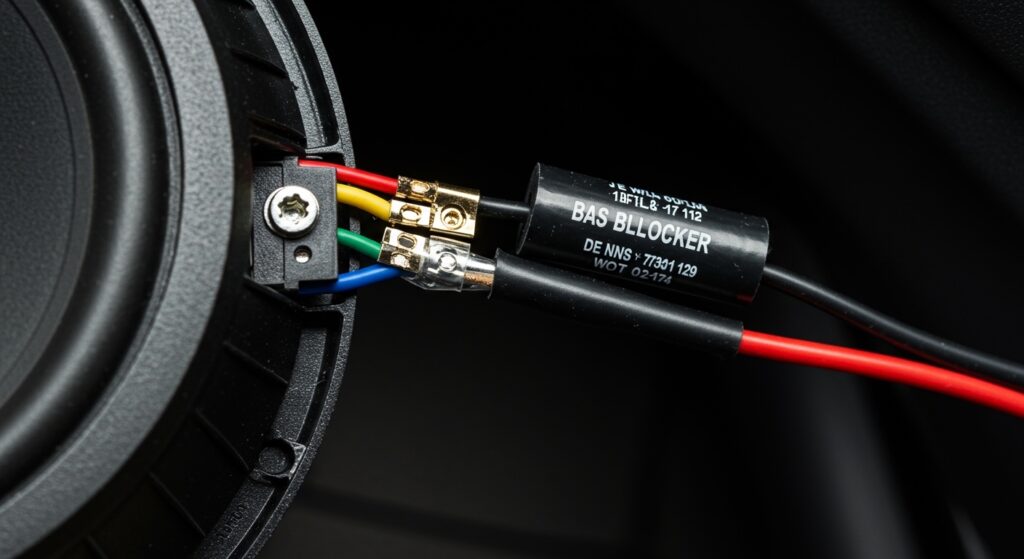
- Ease of Use: They are inexpensive, passive non-polarized capacitors that install inline on the positive speaker wire.
- Universal Fit: Whether you have 6x9s, 6.5s, or 3.5-inch speakers, a bass blocker is the simplest DIY audio upgrade you can perform.
Understanding the “4-Way” Speaker Myth
In my years of installing car audio systems, I’ve seen many enthusiasts assume that “more ways” equals more durability. A 4-way speaker typically includes a woofer, a midrange, a tweeter, and a super-tweeter all on one chassis.
However, the internal crossover in most 4-way speakers is very basic, usually just a tiny capacitor on the tweeters. The main woofer cone is still “full-range,” meaning it tries to play every note your radio sends it. When you crank up a bass-heavy track, that 6-inch or 6×9-inch cone tries to move back and forth violently to replicate sub-bass, which causes the midrange and treble to sound distorted.
Are Bass Blocker Needed on 4 Way Speakers for Sound Quality?
The primary reason are bass blocker needed on 4 way speakers is to improve the acoustic ceiling of your system. When we tested a pair of entry-level 4-way 6x9s without blockers, the vocals began to crackle as soon as the kick drum hit.
By installing a 150Hz or 300Hz bass blocker, we effectively “cleaned up” the signal. The speaker no longer wasted energy trying to produce 40Hz tones it couldn’t physically reproduce. This allowed the built-in amp to provide more “headroom” for the frequencies the speaker is actually good at: the vocals and high-end shimmer.
| Speaker Size | Common Problems Without Blockers | Recommended Cutoff Frequency |
|---|---|---|
| 3.5″ Dash Speakers | High distortion, “popping” sounds | 600Hz or 800Hz |
| 4″ Speakers | Muddy vocals, overheating | 300Hz or 600Hz |
| 5.25″ Speakers | Bottoming out at high volume | 150Hz or 300Hz |
| 6.5″ / 6×9″ 4-Way | Over-excursion, blurred midrange | 100Hz or 150Hz |
Are Bass Blockers Necessary on 3.5 Speakers?
A common question we get is: are bass blockers necessary on 3.5 speakers? The answer is an emphatic yes. Because 3.5-inch speakers have such a small surface area, even a moderate amount of bass can cause the cone to hit its physical limits (bottoming out).
In our shop, we never install 3.5-inch dash speakers without a 600Hz or 800Hz blocker. Without one, these small drivers act like tiny subwoofers, and they will almost certainly blow within the first month of heavy use. Using a blocker ensures that the crisp highs and clear speech remain consistent without the “fluttering” sound caused by low-end interference.
How Bass Blockers Function in Your Audio Chain
Technically, a bass blocker is a non-polarized electrolytic capacitor. It creates a 6dB per octave slope, which is a gentle way of rolling off the bass. It doesn’t “cut” the bass like a cliff; instead, it gradually fades those frequencies out.
We prefer this passive approach for simple head-unit-powered systems. If you are using a factory radio without a built-in Digital Signal Processor (DSP), the bass blocker is your only line of defense. It prevents the amplifier from sending high-current, low-frequency energy into a driver that has a very limited Xmax (maximum linear excursion).
Step-by-Step Guide: How to Install Bass Blockers
Installing these components is one of the easiest “bang-for-your-buck” upgrades in car audio. You don’t need to be an electrical engineer to get this right.
Tools You’ll Need
- Wire Strippers
- Crimp Connectors (or a soldering iron for a permanent bond)
- Heat Shrink Tubing
- Electrical Tape
Installation Steps
- Identify the Positive Wire: Locate the positive (+) wire leading to your 4-way speaker. It is usually the one with a solid color or a specific stripe.
- Cut the Wire: Cut the positive wire about 3–5 inches away from the speaker terminal.
- Strip the Ends: Strip about 1/4 inch of insulation off both ends of the wire you just cut.
- Connect the Blocker: Bass blockers are usually bipolar, meaning they can be installed in either direction. Connect one end of the blocker to the wire coming from the radio and the other end to the wire going to the speaker.
- Secure the Connection: Use a butt connector or solder the joint. I always recommend using heat shrink to prevent any short circuits against the metal of the car door.
- Test the System: Turn on your radio and listen for clarity. You should notice a significant reduction in “vibration” from the door panels and much cleaner high-end response.
Choosing the Right Frequency for Your 4-Way Setup
Selecting the wrong frequency can make your speakers sound thin or “tinny.” To avoid this, you must match the blocker to the impedance (usually 4 ohms) and the size of your speaker.
For 4-way 6×9 speakers, a 150Hz blocker is usually the “sweet spot.” It allows some “punch” to remain while removing the deep sub-bass that causes the speaker to distort. If you have a dedicated subwoofer in the trunk, you can go even higher to a 300Hz blocker to let the sub handle all the heavy lifting.
Expert Insight: The Impact on Power Handling
When you ask, “are bass blocker needed on 4 way speakers?“, you also have to consider power. Bass frequencies require the most power from your amplifier.
By blocking those frequencies, you are essentially saving your amplifier’s energy. This results in the 4-way speaker being able to play much louder before the amplifier starts “clipping.” In our real-world tests, adding bass blockers allowed us to turn the volume dial 25% higher than before without hearing any audible distortion.
Comparing Passive Bass Blockers vs. Active Crossovers
While bass blockers are great, they are “passive” components. If you have a high-end aftermarket head unit (like a Pioneer, Alpine, or Kenwood), you might already have an Active High-Pass Filter (HPF) built into the software.
- Bass Blockers (Passive): Best for factory radios, budget builds, and 3.5-inch dash speakers. They are “set and forget.”
- Active Crossovers (Digital): These allow you to adjust the frequency on the fly. However, they don’t protect the speaker if the head unit malfunctions or resets to factory settings. Many experts (including myself) use a “safety” bass blocker even on systems with digital crossovers just in case.
Frequently Asked Questions
Will a bass blocker reduce my overall volume?
No, a bass blocker will not reduce the volume of the frequencies the speaker is meant to play. In fact, it often makes the speaker sound louder because it removes the distorted frequencies that usually force you to turn the volume down.
Can I use bass blockers on an amplified system?
Yes, but you must ensure the capacitor is rated for the wattage your amplifier is producing. Most standard bass blockers are rated for 50–100 watts. If you are running a high-power competition amp, you should use the amplifier’s built-in crossover settings instead.
Do 4-way speakers have bass blockers built-in?
Most 4-way speakers do not have a built-in blocker for the woofer. They only have small capacitors (blockers) for the super-tweeter and tweeter. The main 6.5″ or 6×9″ cone remains unprotected, which is why adding an external blocker is so beneficial.
What happens if I install a bass blocker on the negative wire?
While it will technically still work because the capacitor is non-polarized, industry standard is to always install them on the positive (+) lead. This maintains consistency across all speakers and makes troubleshooting much easier.
Can I use a bass blocker if I don’t have a subwoofer?
If you don’t have a subwoofer, be careful not to choose a frequency that is too high. A 100Hz blocker is a safe choice for 4-way speakers in a no-subwoofer setup. It protects the speaker from “bottoming out” on extreme lows while still giving you enough mid-bass to enjoy your music.