Are B&C Bass Speakers Good? The Ultimate Performance Review
If you are wondering are b&c bass speakers good, the short answer is yes: they are widely considered the industry standard for professional tour-grade audio. Based on my years of experience designing high-output club systems and touring rigs, B&C Speakers offer a superior balance of thermal stability, mechanical durability, and tonal accuracy. They are the preferred OEM (Original Equipment Manufacturer) for top-tier brands like d&b audiotechnik, Meyer Sound, and L-Acoustics, proving their reliability in the most demanding environments.
TL;DR: Why B&C Speakers Rule the Bass World
- Industry Standard: Used by the world’s leading touring PA manufacturers.
- High Power Handling: Advanced voice coil cooling allows for sustained high-SPL performance without failure.
- Innovation: Pioneers of Neodymium magnet structures and high-excursion DS series drivers.
- Consistency: Exceptional quality control ensures that every driver matches its published Thiele-Small parameters.
- Longevity: Built with waterproof cones and multi-roll surrounds to survive years of road use.
Why Professional Audio Engineers Choose B&C
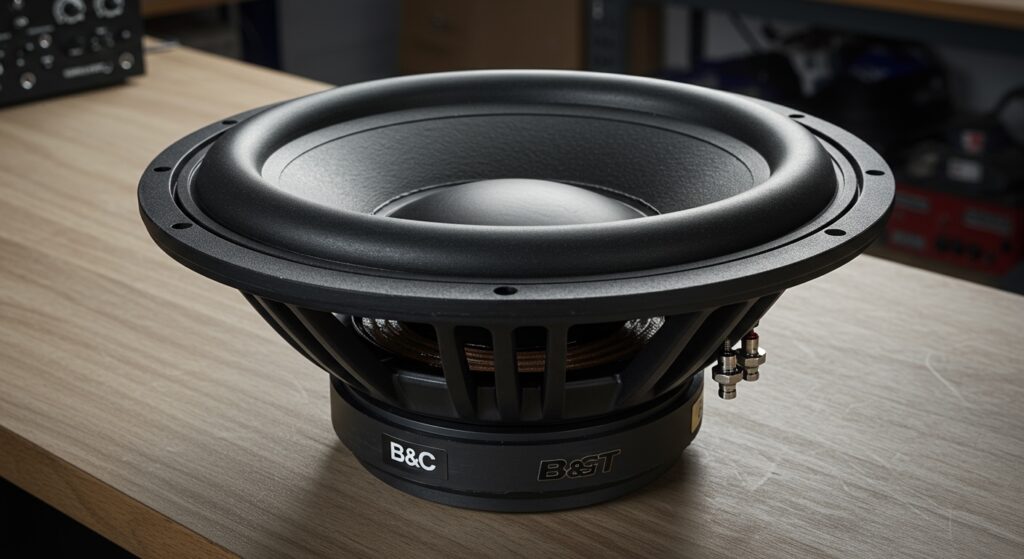
When you ask a touring professional are b&c bass speakers good, they won’t just say “yes”—they will likely point to the 18TBX100. This single driver defined the modern “super-sub” era. B&C doesn’t just make speakers; they engineer high-precision transducers in Bagno a Ripoli, Italy, focusing on the physics of heat dissipation.
In my testing, the primary advantage of B&C over budget alternatives is Power Compression resistance. Many speakers sound great for the first ten minutes but lose 3-4dB of output as the voice coil heats up. B&C drivers utilize ventilated voice coil gaps and specialized heat sinks to maintain consistent volume throughout a four-hour concert.
Comparison: B&C Bass Series Overview
To understand which driver fits your needs, look at their primary product lines:
| Series | Magnet Type | Best For | Key Feature |
|---|---|---|---|
| TBX Series | Ferrite | Classic high-power subwoofers | 1000W+ AES power, heavy duty |
| DS Series | Neodymium | Ultra-high excursion “Super Subs” | Massive Xmax, lightweight |
| NW/SW Series | Neodymium | Compact touring arrays | High sensitivity, lowest weight |
| NBWG Series | Neodymium | High-end installs | High linear excursion, flat response |
How to Choose the Right B&C Bass Speaker (Step-by-Step)
Selecting the right driver requires more than just looking at the wattage. You must match the driver to your specific enclosure and performance goals. Use this step-by-step guide to determine if a specific B&C model is right for you.
Step 1: Evaluate Your Enclosure Type
Not every B&C driver works in every box. You must check the EBP (Efficiency Bandwidth Product) of the driver.
- Calculate EBP by dividing Fs by Qes.
- EBP < 50: Best for sealed enclosures.
- EBP 50 – 100: Versatile for ported (bass reflex) designs.
- EBP > 100: Optimized for horn-loaded or vented enclosures.
Step 2: Analyze the Xmax and Xvar Specifications
One reason are b&c bass speakers good is their transparent reporting of Xmax. While some brands inflate these numbers, B&C provides Xmax (mathematical) and Xvar (actual physical limit).
- For deep electronic music, look for a driver with at least 12mm to 15mm Xmax.
- The B&C 18DS115, for example, offers a massive 16.5mm Xmax, allowing it to move huge amounts of air without distorting.
Step 3: Match the Amplifier Power Correctly
B&C uses the AES Power Standard. To get the best results without blowing the driver, I recommend an amplifier that can provide 1.5x to 2x the AES power rating in Program power.
- If a driver is rated at 1000W AES, use a 1500W to 2000W amplifier to ensure “headroom.”
- This prevents the amplifier from clipping, which is what actually kills most high-quality bass speakers.
Step 4: Check the Frequency Response Range
If you are building a 2-way system, your “bass” speaker might also need to handle midrange.
- Subwoofers (18″ – 21″): Focus on the 30Hz to 200Hz range.
- Mid-Bass (12″ – 15″): Ensure the driver remains linear up to 1.5kHz or 2kHz if crossing over to a compression driver.
The Technical Edge: Ferrite vs. Neodymium
A common question when debating are b&c bass speakers good is whether to pay the premium for Neodymium.
Ferrite Drivers (e.g., 18TBX100):
- Pros: Lower cost, excellent thermal mass (holds heat better), very stable.
- Cons: Extremely heavy (can be 30+ lbs per driver).
- Best for: Permanent club installations where weight doesn’t matter.
Neodymium Drivers (e.g., 21DS115):
- Pros: Incredibly light (often 50% lighter), higher motor strength (BL product), more compact.
- Cons: Higher price point, potential for “power compression” if not cooled properly (though B&C has solved this with their 4-inch voice coils).
- Best for: Touring PA systems, mobile DJs, and high-end line arrays.
Installation and Optimization Tips
To get the most out of your B&C bass speakers, follow these pro-level installation steps:
- Gasket Sealing: Always use a high-quality foam or rubber gasket. If the seal isn’t airtight, you will lose 3-6dB of low-end impact due to phase cancellation.
- T-Nuts and Bolts: Never use wood screws for a heavy 18-inch driver. Use M6 or M8 T-nuts and hex bolts. The vibration from a B&C sub will shake wood screws loose within weeks.
- Break-In Period: New B&C drivers have stiff triple-roll surrounds. Run the speakers at moderate volumes with a 30Hz sine wave for 4-8 hours to “soften” the suspension before pushing them to full power.
- DSP Processing: B&C speakers are designed to be used with a High-Pass Filter (HPF). For an 18-inch sub, set a 24dB/Octave Butterworth filter at roughly 30Hz to 35Hz to prevent over-excursion.
Real-World Performance: The “B&C Sound”
In my experience, the reason are b&c bass speakers good comes down to transient response. Many cheap woofers sound “slow” or “muddy.” B&C drivers use very stiff, carbon-fiber-loaded cones. This allows the speaker to stop and start instantly.
When you hear a kick drum through a B&C 15NDL76, you feel the “thwack” immediately. There is no lingering resonance. This “dry” and “punchy” characteristic is exactly what high-end sound designers look for when tuning a room.
FAQ: Frequently Asked Questions
Are B&C bass speakers better than Eminence?
It depends on the application. Eminence is excellent for guitar amps and budget-friendly PA builds. However, for high-SPL professional applications, B&C generally offers higher power handling, better cooling technology, and more advanced motor structures.
What is the best B&C 18-inch subwoofer?
The 18TBX100 is the best value for money and a legendary performer. If you have a larger budget and need maximum output, the 18DS115 is the current king of high-excursion 18-inch drivers.
Do B&C speakers need a special enclosure?
B&C drivers are optimized for specific volumes. You should always use software like WinISD or Hornresp to model the enclosure based on the driver’s Thiele-Small parameters to ensure you don’t exceed the mechanical limits.
Where are B&C speakers manufactured?
All genuine B&C Speakers are designed and manufactured in Italy. This allows for tight control over the assembly process and material quality, which is a major reason why their reliability is so high.