Are Coaxial Speakers Bad? The Definitive Truth About Full-Range Audio
No, coaxial speakers are not bad; they are actually the most practical and cost-effective upgrade for the majority of car audio systems. While professional audiophiles often prefer component speakers for superior soundstaging, high-quality coaxial speakers deliver excellent clarity, simple installation, and integrated crossovers that work perfectly for daily listeners.
I have spent over 15 years tearing down car interiors and installing everything from $50 budget drivers to $2,000 active 3-way systems. In my experience, the “bad” reputation of coaxials usually stems from people comparing a bottom-tier entry-level speaker to a high-end component set. When you invest in a premium coaxial, the performance gap narrows significantly, making them an elite choice for many builds.
Key Takeaways: Coaxial Speakers at a Glance
- Best For: Simple factory replacements, budget-conscious builds, and rear-fill audio.
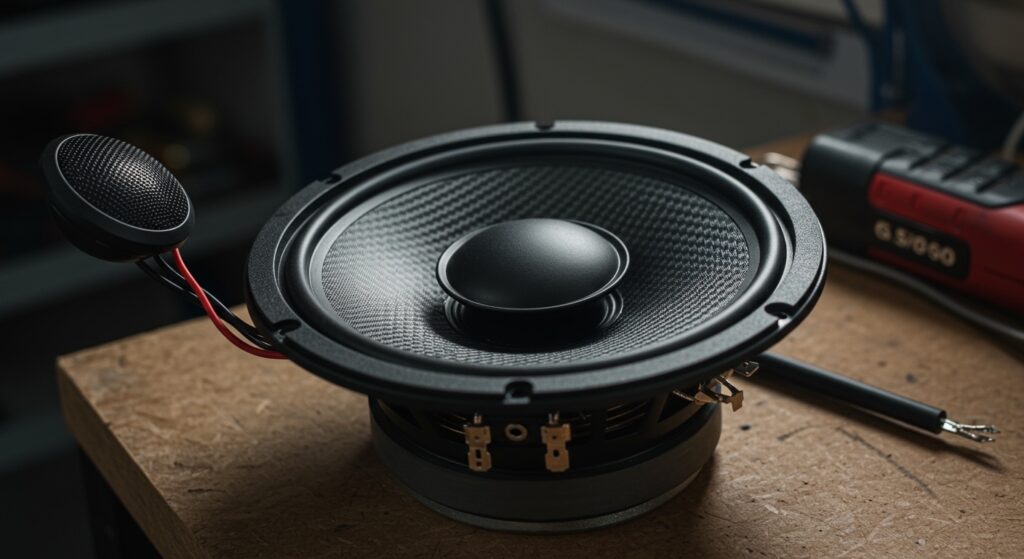
- The Design: A 2-way or 3-way speaker where the tweeter is mounted on a pole directly over the woofer.
- Space Saving: Ideal for vehicles with limited mounting locations or small door cavities.
- Cost Efficiency: Generally 30% to 50% cheaper than component sets of similar material quality.
- Installation: “Plug and play” friendly; no need to cut new holes for separate tweeters.
Why You Might Think Coaxial Speakers Are Bad (and Why You’re Wrong)
The myth that are coaxial speakers bad usually comes from the “point source” debate. In a coaxial design, the high frequencies (tweeter) and low frequencies (woofer) originate from the same physical location. Some critics argue this “muddies” the sound or lowers the soundstage toward your feet.
However, modern engineering has solved many of these legacy issues. I recently installed a set of Focal Access Coaxials in a client’s SUV, and the off-axis response was so sharp that the soundstage felt elevated and wide. If you choose a speaker with a swivel-mount tweeter, you can actually aim the highs toward your ears, even if the speaker is mounted low in the door.
The Benefits of a Point-Source Design
Interestingly, many high-end home theater speakers use a “coincident” or coaxial-style driver. Why? Because having all frequencies originate from one point eliminates phase alignment issues. In a car, this means the sound reaches your ears at the exact same time, providing a very cohesive and natural listening experience.
Coaxial vs. Component Speakers: The Realistic Comparison
To understand if are coaxial speakers bad for your specific needs, you must compare them to their main rival: the component speaker system.
| Feature | Coaxial Speakers (Full-Range) | Component Speakers (Separates) |
|---|---|---|
| Tweeter Placement | Integrated on the woofer | Mounted separately (A-pillars/Dash) |
| Crossover | Built-in (Passive/Simple) | External box (Complex/Precise) |
| Installation Difficulty | Low (Drop-in replacement) | High (Requires custom mounting) |
| Soundstage Height | Lower (Usually at knee level) | Higher (At ear level) |
| Cost | $50 – $250 | $150 – $1,000+ |
| Imaging | Good | Exceptional |
If you are a casual listener who enjoys podcasts, Top 40 hits, or rock music while commuting, you will likely find that coaxial speakers provide a massive jump in quality over your paper-cone factory speakers. You don’t always need the complexity of components to find “audio bliss.”
Anatomy of a High-Quality Coaxial Speaker
When people ask “are coaxial speakers bad?”, they are often looking at cheap, $30 speakers from a big-box store. To get “good” sound, you need to look for specific technical specifications and materials.
The Woofer Cone Material
Look for Injection-Molded Polypropylene (IMPP) or Carbon Fiber. In my testing, treated paper cones tend to warp in humid car environments, whereas polypropylene maintains its shape and provides a snappier mid-bass response.
The Tweeter Composition
Avoid “piezo” tweeters found in ultra-cheap 4-way speakers. Instead, look for:
- Silk Domes: For a warm, smooth, and natural sound.
- Aluminum or Titanium Domes: For bright, crisp highs that “cut” through road noise.
- PEI (Polyetherimide): A durable, lightweight plastic that offers a balance between the two.
Built-in Crossovers
A “bad” coaxial uses a simple capacitor glued to the side. A “good” coaxial uses an integrated high-quality crossover that properly directs frequencies, preventing the woofer from trying to play high notes it can’t handle.
How to Choose the Best Coaxial Speakers for Your Car
Choosing the right speaker is about more than just the brand name. You need to match the hardware to your vehicle’s specific environment.
Check the Sensitivity Rating
If you are running your speakers directly off a factory head unit (without an external amp), look for a Sensitivity (dB) rating of 90dB or higher. High sensitivity means the speaker can produce more volume with less power. If you buy “power-hungry” speakers with low sensitivity and no amp, they will sound thin and distorted.
Pay Attention to RMS Power, Not Peak
Ignore the “1000 Watts Peak” labels on the box. RMS (Root Mean Square) is the only number that matters. This represents the continuous power the speaker can handle.
- Factory Head Units: Look for 2-15 Watts RMS.
- Aftermarket Head Units: Look for 15-22 Watts RMS.
- External Amplifiers: Match the speaker RMS to the Amp’s output (e.g., 50-100 Watts RMS).
Way vs. 3-Way vs. 4-Way
Don’t fall for the “more ways is better” marketing trap. A high-quality 2-way coaxial (Woofer + Tweeter) almost always sounds better than a cheap 4-way speaker. More drivers on a single pole often lead to frequency interference and “harshness” in the high-end.
Step-by-Step Guide: How to Install Coaxial Speakers Like a Pro
If you’ve decided that are coaxial speakers bad is a myth and you’re ready to upgrade, follow these steps to ensure you get the best performance possible.
Step 1: Gather Your Tools
You will need:
- A set of nylon panel removal tools (to avoid scratching your door).
- Screwdrivers (Phillips and Torx).
- Wire strippers or vehicle-specific wiring harnesses.
- Sound deadening material (like Dynamat or Noico).
Step 2: Remove the Door Panel
Gently pry the plastic clips holding the door panel. I always recommend starting at the bottom corner. Be careful of hidden screws behind door handles or armrest plastic covers. Disconnect the window and lock switches before fully removing the panel.
Step 3: Apply Sound Deadening
This is the “secret sauce.” Even the best speakers sound bad in a vibrating metal door. Apply butyl rubber sheets to the inner door skin. This stops the metal from “ringing” and turns your door into a solid speaker enclosure, significantly boosting mid-bass response.
Step 4: Wire the Speakers
Use a plug-and-play wiring harness. This ensures you maintain proper polarity (positive to positive). If you wire one speaker backward, the “out of phase” sound will cancel out all your bass, making you think your new speakers are defective.
Step 5: Seal the Speaker
Use a foam gasket ring (Fast Rings) between the speaker and the door panel. This forces all the sound through the speaker grille and prevents it from getting lost inside the door cavity.
Maximizing Performance: Making Your Coaxials Sound High-End
Even if you buy mid-range coaxials, you can make them sound “audiophile-grade” with these three professional tips.
Add a Small 4-Channel Amplifier
Most head units “clip” or distort at high volumes because their internal chips are tiny. An external amplifier (even a small 45W x 4 “Power Pack”) provides clean, headroom-heavy power. This makes the coaxial speakers sound much fuller and more authoritative.
Use Bass Blockers
If you don’t have a subwoofer, your 6.5-inch coaxials will try to play deep sub-bass (below 60Hz), which causes distortion. Install Passive High-Pass Filters (Bass Blockers) or use the High-Pass Filter (HPF) on your head unit. Set it to 80Hz to let the speakers focus on the frequencies they were actually designed for.
Optimize the Tweeter Angle
If your coaxial has a pivot-mount tweeter, aim it toward the center of the cabin (near the rearview mirror). This “tricks” your brain into hearing a higher soundstage, overcoming the disadvantage of having speakers mounted low in the doors.
Common Mistakes When Buying Coaxial Speakers
- Ignoring Mounting Depth: Just because a speaker is 6.5 inches doesn’t mean it fits. Some high-end coaxials have massive magnets that will hit your window glass when it’s rolled down. Always check the mounting depth before buying.
- Skipping the Brackets: Many modern cars use weird, non-standard speaker shapes. Don’t try to “rig” it with wood screws. Buy the vehicle-specific adapter brackets for a secure, airtight fit.
- Mixing Brands: For a cohesive “sound signature,” try to use the same brand and series for both your front and rear speakers. Mixing a “bright” brand like Hertz with a “warm” brand like Morel can create a confusing soundstage.
FAQs: Everything You Need to Know About Coaxials
Are coaxial speakers bad for bass?
They are not inherently bad for bass, but they are limited by their size. A 6×9 coaxial can produce significant bass, while a 4-inch coaxial will produce almost none. To get true “thump,” you should always pair coaxial speakers with a dedicated powered subwoofer.
Can I run coaxial speakers and component speakers together?
Yes. A very common “SQ” (Sound Quality) setup is to put component speakers in the front for a perfect soundstage and coaxial speakers in the rear doors for “rear-fill.” This provides a balanced surround-sound experience without the high cost of two component sets.
Do coaxial speakers need an amplifier?
Most do not need one to function, but all will benefit from one. If your speakers have an RMS rating above 50 Watts, you are wasting their potential by running them off a factory head unit.
Why do my new coaxial speakers have less bass than my factory ones?
Factory speakers are often made of very thin paper and high-roll foam surrounds designed to be “boomy” at low volumes. High-quality aftermarket speakers have stiffer surrounds that require a break-in period (usually 10-20 hours of play) and more power to move the heavier, higher-quality cone.
Is a 3-way coaxial better than a 2-way?
Usually, no. In the coaxial world, “3-way” is often a marketing gimmick where they add a tiny, cheap “super-tweeter” that adds more hiss than actual music. Stick to high-quality 2-way designs from reputable brands like JL Audio, Alpine, or Focal.