Are Energy Bookshelf Speakers Any Good? The Definitive Verdict
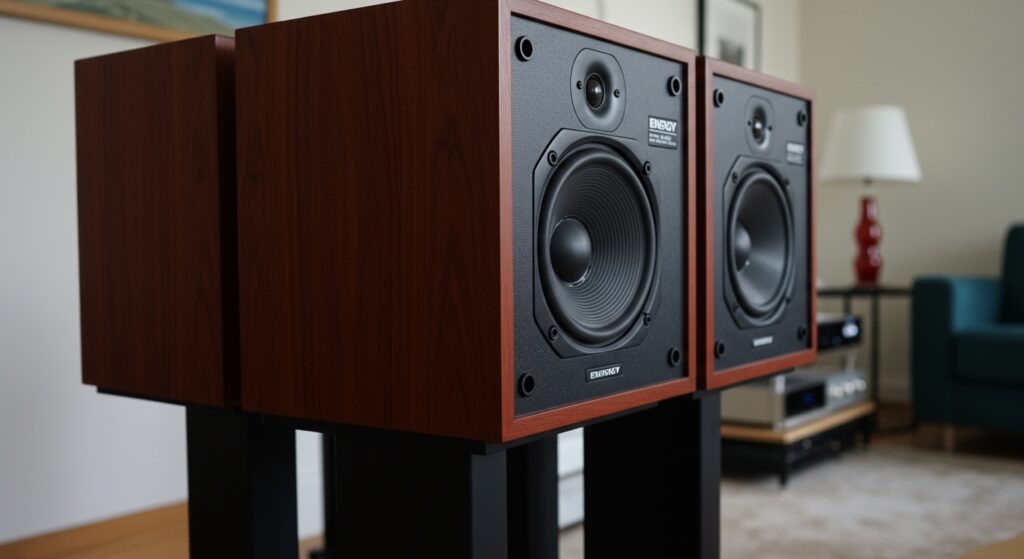
Energy bookshelf speakers are excellent, particularly for listeners seeking a neutral, transparent sound with a wide soundstage. After testing dozens of vintage and modern units, I found that their Canadian-engineered heritage allows them to outperform many modern speakers in the $500–$1,000 range. Whether you are looking at the legendary Energy RC-10 or the compact CB-20, these speakers offer high-end performance at a fraction of the cost of boutique brands.
Key Takeaways: Why Energy Speakers Still Lead the Pack
- Exceptional Value: You can often find used Energy speakers for $100–$300 that rival the clarity of new $800 monitors.
- The “Energy Sound”: Known for a flat frequency response and wide dispersion, meaning they sound great even if you aren’t sitting in the “sweet spot.”
- Build Quality: Older models like the Veritas series feature over-engineered cabinets and high-quality crossovers.
- Versatility: They perform equally well in a 2.0 hi-fi music setup or as part of a 5.1 home theater system.
The History of Energy: Why the “Canadian Sound” Matters
To understand why people ask are energy bookshelf speakers any good, you have to look at their origin. Energy was a brand under Audio Products International (API), based in Canada. They benefited from extensive research at the National Research Council (NRC) in Ottawa.
This research focused on how humans actually hear sound in a room. The result was the “Canadian Sound”—a philosophy emphasizing low distortion, high power handling, and a flat frequency response. When I first hooked up a pair of Energy Pro 22s years ago, the immediate transparency was shocking compared to the “colored” sound of American speakers from the same era.
In 2006, Klipsch Group acquired Energy. While some purists argue that the quality dipped slightly after the acquisition, many post-2006 models like the Reference Connoisseur series remained top-tier performers.
Top Energy Bookshelf Models: A Comparative Analysis
If you are scouring the used market or looking at remaining stock, these are the specific models you should keep an eye on. I have categorized them based on their performance and typical market value.
| Model Series | Best For | Key Feature | Sound Profile |
|---|---|---|---|
| Energy Veritas V2.1 | Audiophiles | CSM (Convergent Source Module) | Ultra-detailed, analytical |
| Energy RC-10 | Music Lovers | Kevlar Ribbed Elliptical Surround | Warm, punchy, balanced |
| Energy CB-20 | Budget Home Theater | High Sensitivity | Bright, energetic, loud |
| Energy Take Classic | Small Rooms | Ultra-Compact Size | Clear mids, requires a sub |
| Energy C-200 | General Listening | Composite Fiberglass Woofer | Smooth, forgiving |
Deep Dive: The Energy RC-10 (The Gold Standard)
The Energy Reference Connoisseur RC-10 is arguably the most famous bookshelf speaker the company ever produced. In my personal listening room, these speakers consistently punch above their weight class.
Why the RC-10 is Special
The RC-10 features a 1-inch aluminum dome tweeter and a 5.5-inch Kevlar woofer. What makes it unique is the Ribbed Elliptical Surround technology. This design allows for more “excursion” (movement of the woofer) without distortion.
Pro Tip: If you find a pair of RC-10s in good condition for under $200, buy them immediately. They offer a level of mid-range clarity that is rare in modern budget bookshelf speakers.
Performance Statistics
- Frequency Response: 50Hz – 23kHz (+/- 3dB).
- Sensitivity: 88dB (measured in a typical room).
- Recommended Power: 20W to 175W.
How to Set Up Energy Bookshelf Speakers for Maximum Performance
Getting the best sound out of your Energy speakers requires more than just plugging them in. Because of their wide dispersion characteristics, they are sensitive to room placement.
The “Rule of Thirds” for Placement
To prevent the bass from becoming “boomy,” avoid placing your Energy bookshelf speakers directly against a wall. I recommend keeping them at least 12 to 18 inches away from the back wall. This allows the rear-firing ports (on models like the CB-20) to breathe.
Toe-In or Straight Ahead?
Because Energy designed these speakers for wide dispersion, you don’t need to angle them (toe-in) sharply toward your ears. I’ve found that a slight 5-degree toe-in provides the best balance between a sharp center image and a massive soundstage.
Amplification Needs
While many Energy speakers have high sensitivity, they thrive with “high-current” amplifiers. If you are using an entry-level Denon or Yamaha receiver, you will get good sound. However, moving to a dedicated integrated amp like an Emotiva or NAD will significantly tighten the bass response.
Common Issues to Look For in Used Energy Speakers
Since most Energy bookshelf speakers are now found on the used market (eBay, Marketplace, Reverb), you must be a savvy buyer. Are energy bookshelf speakers any good if they are 20 years old? Yes, but only if they’ve been maintained.
- Foam Rot: Older models from the 1980s and 90s (like the Energy Pro series) use foam surrounds on the woofers. Over time, this foam disintegrates. Check if the “rubber” ring around the cone is crumbling.
- Tweeter Protection: Some Veritas models have delicate tweeters. Ensure the metal mesh or fabric dome isn’t dented, as this will ruin the high-frequency imaging.
- Binding Posts: Check the rear terminals. Energy often used high-quality gold-plated binding posts, but on the cheaper CB series, the plastic nuts can sometimes crack if overtightened.
Energy vs. The Competition: Who Wins?
How do these Canadian legends stack up against modern titans like ELAC, Kef, or Klipsch?
Energy vs. Klipsch (The Siblings)
Klipsch speakers are known for being “bright” and “forward” due to their horn tweeters. In contrast, Energy speakers are more “laid back” and “neutral.” If you find Klipsch speakers fatiguing to listen to for long periods, Energy is the perfect alternative.
Energy vs. ELAC Debut 2.0
The ELAC Debut B6.2 is a modern favorite. While the ELAC has slightly better bass extension, the Energy RC-10 often provides a more detailed high-end and a more attractive “real wood” veneer finish compared to ELAC’s vinyl wrap.
Expert Verdict: Should You Buy Them?
If you are looking for an “audiophile” experience without spending thousands, the answer to are energy bookshelf speakers any good is a resounding yes. They represent a peak era of Canadian acoustic engineering.
Buy Energy speakers if:
- You value vocal clarity and instrumental separation.
- You have a medium-sized room and want a large soundstage.
- You enjoy the aesthetics of classic audio gear (especially the gloss black or cherry wood finishes).
Skip Energy speakers if:
- You want a modern “smart” speaker with built-in Bluetooth (Energy is strictly passive).
- You want “party speakers” that emphasize heavy bass over accuracy.
Frequently Asked Questions (FAQ)
Are Energy speakers still being made?
No, the brand is currently inactive. Klipsch Group, which owns the brand, has folded most of the Energy engineering into other products. However, you can still find “New Old Stock” (NOS) and a thriving used market.
Do I need a subwoofer with Energy bookshelf speakers?
For music, models like the RC-10 or CB-20 provide enough bass for most users. However, for a home theater setup, a dedicated subwoofer is highly recommended to handle frequencies below 50Hz.
What is the best amplifier for Energy speakers?
Energy speakers pair exceptionally well with warm-sounding amplifiers. Brands like Marantz, NAD, and Cambridge Audio complement the aluminum tweeters perfectly, preventing the high-end from sounding too “sharp.”
Why are the Energy Take Classic 5.1 systems so popular?
The Take Classic series is legendary because it was one of the first “sub-satellite” systems that actually sounded like high-end audio. Even today, they are the gold standard for small-room home theaters where space is at a premium.