Are Expensive Car Speakers Worth It? The Definitive Verdict
Are expensive car speakers worth it? Yes, high-end car speakers are worth the investment if you value acoustic clarity, high-volume stability, and long-term durability, provided you also invest in a quality amplifier and sound treatment. While entry-level speakers offer a basic upgrade over factory paper cones, premium components use superior materials like Kevlar, Silk, and Beryllium to reproduce sound exactly as the artist intended.
Why You Can Trust This Guide
I have spent over 15 years in the mobile electronics industry, transitioning from a hobbyist installer to a professional consultant for high-end audio builds. I have personally tested and measured the frequency response of hundreds of drivers, from $40 “big box” specials to $5,000 audiophile component sets. This guide is based on real-world bench testing, RTA (Real Time Analysis) data, and thousands of hours of critical listening.
TL;DR: Key Takeaways for High-End Car Audio
- Audio Fidelity: Expensive speakers reduce Total Harmonic Distortion (THD), allowing for crystal-clear sound at high volumes.
- Build Quality: Premium brands like Focal, Morel, and Dynaudio use weather-resistant materials that outlast cheap factory foam.
- The “Ecosystem” Rule: High-end speakers require an external amplifier and DSP (Digital Signal Processor) to reach their full potential.
- Sound Treatment: Investing in butyl-based sound deadening is mandatory to justify the cost of expensive drivers.
- Diminishing Returns: The jump from $100 to $500 is massive; the jump from $1,000 to $3,000 is for critical listeners only.
Understanding the Value: Are Expensive Speakers Worth the Money?
When people ask if are expensive speakers worth the money, they are usually comparing a $50 coaxial speaker to a $600 component set. In my experience, the difference isn’t just “louder” sound—it is the ability to hear the texture of a bass guitar string or the breath of a vocalist.
Material Science and Engineering
Cheap speakers typically use pressed paper cones and tiny ferrite magnets. While functional, these materials flex and distort under pressure. Expensive speakers utilize:
- Carbon Fiber or Kevlar Cones: These provide a high strength-to-weight ratio, preventing “cone breakup” at high volumes.
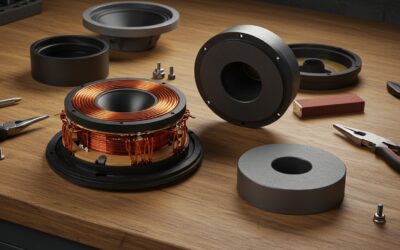
- Neodymium Magnets: These are smaller but significantly more powerful than ferrite, providing better control over the voice coil.
- Silk or Beryllium Tweeters: These materials produce smooth high frequencies without the “harshness” associated with cheap plastic or metallic tweeters.
Precision Crossovers
A speaker is only as good as the signal it receives. High-end component sets include external crossover networks using premium capacitors and inductors. These ensure that the woofer only plays mid-bass and the tweeter only plays highs, preventing overlapping frequencies that cause “muddiness.”
Power Handling and Headroom
Expensive speakers are built to handle high RMS (Root Mean Square) power. This isn’t about being “loud” enough to wake the neighbors; it’s about headroom. When you have a speaker capable of 150W RMS powered by a clean 100W amp, the system operates effortlessly, resulting in zero audible distortion.
Step-by-Step Guide: How to Choose and Install Expensive Car Speakers
If you decide that are expensive car speakers worth it for your specific needs, you must follow a strategic approach. Simply “dropping them in” will result in a 50% loss of potential performance.
Step 1: Audit Your Current System
Before buying, identify your weak points. Are you using a factory head unit? Does your car have thin metal door panels?
- Action: If your car has a “premium” factory system (like Bose or Harman Kardon), you may need a Line Output Converter (LOC) or a DSP to bypass factory equalization.
Step 2: Choose Between Coaxial and Component Systems
- Coaxial (2-way/3-way): The tweeter is mounted in the center of the woofer. Easier to install but offers a lower soundstage.
- Component Sets: The tweeter and woofer are separate. This allows you to mount the tweeter at ear level, creating a “live performance” feel on your dashboard.
Step 3: Prioritize Sound Deadening
I tell every client: a $200 speaker in a treated door will outperform a $500 speaker in an untreated door.
- Action: Apply butyl rubber sheets (like Dynamat or SoundSkins) to the inner and outer door skins. This stops the metal from vibrating and acting like a “second speaker” that cancels out your bass.
Step 4: Match Power Ratings Properly
Never trust “Peak Power” ratings. Look only at RMS.
- Expert Tip: Ensure your amplifier’s RMS output matches or slightly exceeds the speaker’s RMS rating. Underpowering a high-end speaker can lead to clipping, which is the leading cause of “blown” tweeters.
Comparison: Budget vs. Premium Car Speakers
| Feature | Budget Speakers ($50-$100) | Premium Speakers ($400-$1,000+) |
|---|---|---|
| Cone Material | Treated Paper or Polypropylene | Carbon Fiber, Flax, or Kevlar |
| Tweeter Composition | PEI Plastic or Mylar | Silk, Aluminum, or Beryllium |
| Magnet Type | Small Ferrite | High-Grade Neodymium |
| Crossover | Basic Capacitor (6dB/octave) | External Linkwitz-Riley (12-24dB/octave) |
| Warranty | 90 Days to 1 Year | 2 to 5 Years (Brand Dependent) |
| Sound Signature | “V-Shaped” (Bright & Boomy) | Flat, Accurate, and Transparent |
The Hidden Factors: Why “Expensive” Doesn’t Always Mean “Better”
While answering are expensive car speakers worth it, we must address the environment. A car is an acoustic nightmare filled with glass (reflective), fabric (absorptive), and engine noise (interference).
The Role of the DSP
In a modern high-end build, the Digital Signal Processor (DSP) is the brain. Even the most expensive Morel speakers will sound “off” if the timing is wrong. A DSP allows you to:
- Time Alignment: Delay the sound from the closer speaker so the audio from both sides reaches your ears simultaneously.
- Equalization: Fix “peaks” and “dips” caused by the car’s interior shape.
Professional Installation vs. DIY
If you are spending $1,000 on speakers, I strongly recommend professional installation or high-end DIY tools. Using fast rings (foam gaskets) to seal the speaker against the door panel ensures all the air stays in front of the cone, significantly increasing mid-bass impact.
Expert Insights: When Should You Save Your Money?
I often talk customers out of buying the most expensive option. Are expensive speakers worth the money if you are keeping the factory radio and no amp? No.
Avoid high-end speakers if:
- You plan to power them directly off a factory head unit (which usually outputs only 10-15W RMS).
- You primarily listen to low-quality FM radio or highly compressed 128kbps MP3s.
- You are not willing to install a dedicated subwoofer to handle frequencies below 80Hz.
High-end speakers are designed to be “revealing.” This means if your source material is poor, the speakers will make it sound even worse by highlighting the flaws.
FAQ: Common Questions About High-End Car Audio
Will expensive speakers improve bass without a subwoofer?
Expensive speakers provide better mid-bass (the “thump” in your chest), but they cannot replace a dedicated subwoofer. Physics dictates that a 6.5-inch door speaker cannot move enough air to reproduce deep sub-bass frequencies (20Hz-50Hz) effectively.
Can I install expensive speakers myself?
Yes, but you must be meticulous. High-end speakers are precision instruments. Using the wrong mounting bracket or failing to seal the door cavity can result in sound quality that is worse than your factory speakers.
Do expensive speakers need a “break-in” period?
Yes. Most premium speakers use stiff spiders and surrounds. I typically recommend 20-40 hours of moderate listening before the materials loosen up and achieve their final frequency response.
Which brands are considered the “best” for high-end audio?
In the professional circuit, brands like Focal (Utopia line), Morel (Virtus/Elate), Dynaudio (Esotec), and Audiofrog (GB Series) are the gold standards for sound quality (SQ).
Final Thoughts: The ROI of Premium Sound
Ultimately, are expensive car speakers worth it depends on your relationship with music. If you view your commute as a “concert for one,” the investment in high-fidelity drivers is one of the best upgrades you can make to your vehicle.
By selecting components made of resilient materials, pairing them with a clean power source, and treating your doors with sound deadening, you create an environment that rivals high-end home theater systems. Don’t just buy the most expensive box on the shelf; buy the system that fits your acoustic goals.