Determining if Your Fender Vintage Speakers Are Worth Keeping
Are fender vintage speakers worth keeping? Yes, in nearly every scenario, vintage Fender speakers from the 1950s, 60s, and 70s are worth keeping because they define the classic “American sound” and significantly maintain the resale value of your amplifier. While modern replacements offer reliability, the unique harmonic complexity and breakup characteristics of an original Jensen, Oxford, or CTS speaker are nearly impossible to replicate perfectly.
If you own a silver-face or black-face era amp, the speakers are the final filter for your tone. I have spent decades swapping drivers in Deluxe Reverbs and Twin Reverbs, and I have found that a well-preserved vintage speaker offers a “sweetness” in the high-end that modern “reissue” speakers often lack. Even if the speaker is blown, the frame and magnet assembly are valuable assets for reconing.
Key Takeaways: The Quick Verdict
- Tone Preservation: Original speakers provide the “chime” and “growl” intended by Leo Fender.
- Market Value: Amps with original speakers typically sell for 15% to 25% more than those with replacements.
- Repairability: High-quality vintage speakers can be reconed to original specifications, preserving their soul.
- The “Vibe” Factor: For collectors, “all-original” is the gold standard for investment-grade gear.
Identifying the Icons: Which Vintage Speakers Do You Have?
Before deciding their fate, you must identify exactly what is sitting in your cabinet. Fender didn’t make their own speakers; they sourced them from various American manufacturers. Each brand has a distinct tonal profile and collector value.
The Jensen “Golden Era” (EIA Code 220)
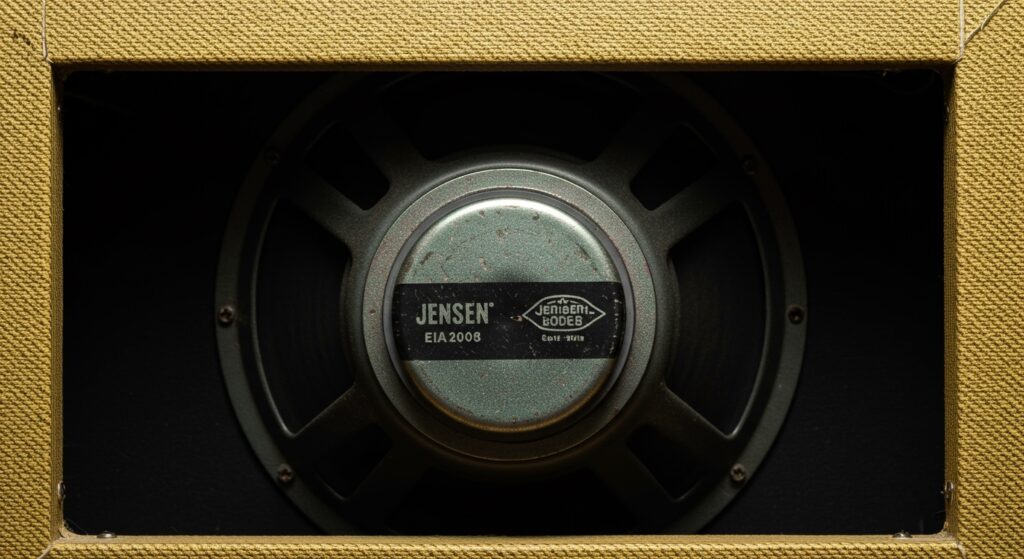
Jensen speakers are the most sought-after. If you see a P12N, P10R, or C12N, you are looking at the pinnacle of vintage tone.
- Alnico (P Series): Known for “compression” and a warm, musical top end.
- Ceramic (C Series): Known for higher headroom and a punchier low end, standard in 1960s Blackface amps.
The Oxford “Deep Gap” Mystery (EIA Code 465)
Often found in mid-60s to 70s Fenders, Oxfords have a mixed reputation. Early versions are legendary, but later 1970s models often had a wider voice coil gap to reduce warranty claims, which some players find “dull.” However, they are still highly worth keeping for historical accuracy.
The Workhorse CTS and Utah (EIA Codes 137 and 328)
CTS (Chicago Telephone Supply) speakers, especially the Alnico 10-inch models found in Super Reverbs, are phenomenal. Utah speakers were often the budget choice but offer a gritty, mid-forward sound that many blues players crave.
The Comparison: Vintage vs. Modern Replacements
Deciding whether fender vintage speakers are worth keeping often comes down to a side-by-side comparison of performance versus nostalgia.
| Feature | Vintage (Original) | Modern Boutique Replacement |
|---|---|---|
| Tone Character | Soft, compressed, “broken-in” | Bright, stiff, high-headroom |
| Resale Value | Increases Amp Value | Neutral or Decreases Value |
| Reliability | Moderate (Paper is fragile) | High (Modern adhesives) |
| Sensitivity | Usually Lower (94-96 dB) | Usually Higher (98-101 dB) |
| Best For | Studio, Recording, Collecting | Touring, High-Volume Gigging |
How to Test if Your Vintage Speakers Are Still Viable
If you are questioning if are fender vintage speakers worth keeping, you need to perform a “health check.” Follow these steps to evaluate your gear without causing damage.
The Visual Inspection (The “Spider” and Cone)
Check the paper cone for “light leaks.” Hold a flashlight behind the cone; if you see pinpricks of light, the paper is drying out. Look at the surround (the outer edge) and the dust cap. If these are intact, the speaker is a prime candidate for preservation.
The Manual “Rub” Test
With the amp off, place your fingers evenly around the center of the cone and push back gently and straight. If you feel a “scratchy” sensation or hear a rubbing sound, the voice coil is warped or full of debris. While this means the speaker needs repair, the vintage frame is still worth keeping for a professional recone.
The 9V Battery “Pop” Test
Touch a 9V battery briefly to the speaker terminals. A healthy speaker will make a distinct “pop” and the cone will move outward (or inward depending on polarity). If there is no sound, the voice coil is open (broken), and the speaker is currently a “paperweight” until repaired.
Why “Original Cone” Matters (E-E-A-T Insights)
In the vintage market, the term “Original Cone” acts like a multiplier for value. I recently appraised a 1965 Deluxe Reverb where the owner had replaced the original Oxford with a modern Celestion. While the Celestion sounded “better” for rock, the amp lost $400 in market value because the original speaker was thrown away.
Expert Advice: If you find the vintage speakers too “farty” or “flubby” for your playing style, pull them out and box them up. Buy a modern replacement for your nightly gigs, but keep the originals in a climate-controlled environment. This preserves the investment while giving you the performance you need.
The Art of the Recone: Saving Your Investment
If your speakers are blown, don’t throw them in the trash. Fender vintage speakers are worth keeping even when they don’t work.
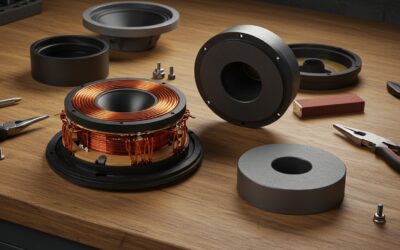
A professional recone involves replacing the paper cone, voice coil, and spider while keeping the original Alnico or Ceramic magnet and metal frame.
- Cost: Usually between $80 and $150.
- Result: A speaker that sounds like it did the day it left the Fullerton factory in 1966.
- Pro Tip: Request “Vintage Spec” paper and voice coils from shops like Ted Weber or Orange County Speaker to maintain the tonal integrity.
Step-by-Step Guide: How to Safely Store Vintage Speakers
If you’ve decided to swap your vintage speakers for modern ones to protect them, follow this storage protocol:
- Clean the Frame: Use a dry microfiber cloth to remove dust and “white rust” (oxidation) from the metal.
- Plastic Wrap the Front: Gently wrap the face of the speaker in plastic wrap to prevent moisture from hitting the paper cone.
- Face-Down Storage: Store the speaker “face down” on a flat, clean surface or in a dedicated speaker box. This prevents the heavy magnet from sagging the “spider” over years of gravity.
- Avoid Humidity: Keep them in a closet inside your house, never in a garage or damp basement. Humidity is the #1 killer of vintage Fender paper cones.
Frequently Asked Questions
Does reconing a vintage Fender speaker ruin its value?
While an “original cone” is worth the most, a professionally reconed vintage speaker is worth significantly more than a modern replacement. It maintains the period-correct look and the specific magnetic strength of the original era.
Can I use vintage 20-watt speakers with a modern high-gain pedal?
You must be careful. Vintage Jensen P12R speakers are only rated for about 12-15 watts. If you run a high-output “cranked” amp with pedals into them, you risk tearing the 60-year-old paper. This is a common reason why players swap them out for gigging.
How do I read the date codes on my Fender speakers?
Look for a 6 or 7-digit number stamped on the rim or magnet. For example, 220642 means: 220 (Manufacturer: Jensen), 6 (Year: 1966), and 42 (Week: 42nd week of the year). This is the definitive way to prove your speakers are original to the amp.
Why do my vintage speakers sound “darker” than new ones?
Over decades, the paper fibers in the cone break down and soften. This creates a “natural compression” and a rolled-off high end. Most jazz and blues players find this “darkness” to be the “Holy Grail” of tone, as it removes the harsh “ice-pick” frequencies.
Is it worth buying “broken” vintage Fender speakers?
Yes, if the price is low (under $50). You can have them reconed for around $100, resulting in a high-end vintage driver for about half the price of a functioning “original cone” unit.