Understanding the Requirement: Are Fire Alarm Speakers Required in Stairwells?
Yes, fire alarm speakers are required in stairwells for most high-rise buildings and large-scale commercial facilities under NFPA 72 and IBC (International Building Code) standards. These speakers are critical components of an Emergency Voice/Alarm Communication System (EVACS), designed to ensure that evacuation instructions are clearly audible and intelligible to occupants during an emergency.
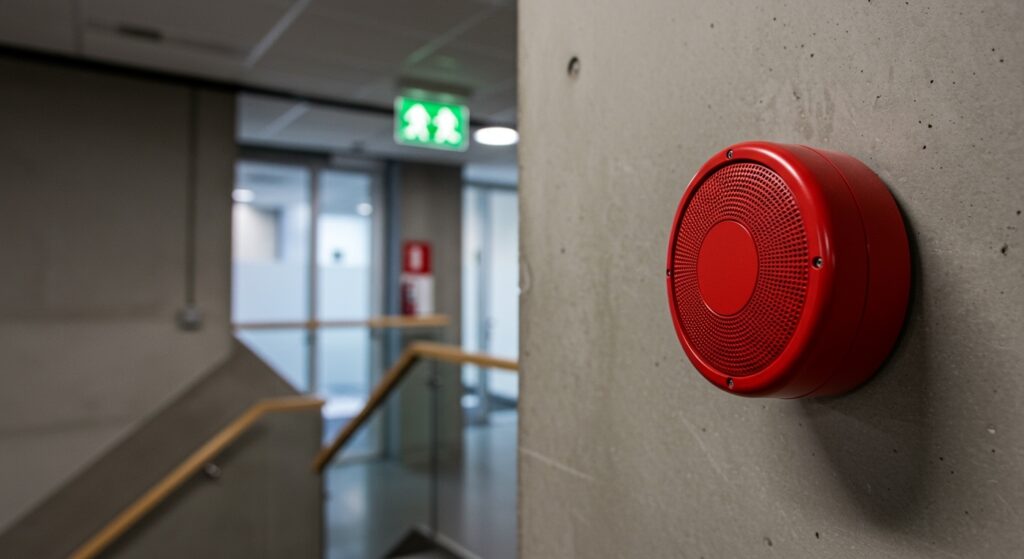
Navigating fire codes can feel like walking through a maze of jargon and conflicting local amendments. I have spent over a decade inspecting commercial fire systems, and the most common point of confusion is whether a simple horn/strobe is enough or if a full voice evacuation speaker is mandatory in the “exit enclosure” (the stairwell). The short answer is that if your building is classified as a high-rise or requires a “Mass Notification” strategy, those speakers are non-negotiable for life safety compliance.
TL;DR: Key Takeaways for Fire Alarm Compliance
- Mandatory for High-Rises: Buildings with floors located more than 75 feet above the lowest level of fire department vehicle access must have voice evacuation speakers.
- Intelligibility is King: National codes require that messages in stairwells meet a specific Speech Transmission Index (STI) to ensure people can actually understand the words.
- Survivability Requirements: Stairwell speakers often require Level 2 or Level 3 circuit survivability, meaning the wiring must withstand fire for up to 2 hours.
- Code References: Key regulations are found in NFPA 72 (National Fire Alarm and Signaling Code) and Section 907.5.2.2 of the IBC.
Why Fire Alarm Speakers are Required in Stairwells
The primary reason fire alarm speakers are required in stairwells involves the transition from “simple evacuation” to “managed relocation.” In a modern high-rise, we don’t always want everyone rushing the stairs at once, which can lead to crushing or blocked access for firefighters.
Voice Evacuation Systems (EVACS) allow fire officials to give live or pre-recorded instructions. We use these to implement defend-in-place or phased evacuation strategies. Without speakers in the stairwells, an occupant who has already entered the exit enclosure would be “blind” to new instructions, such as being told to exit at a different floor due to fire spread.
The Role of Intelligibility
In my experience, many older buildings have loud horns that “blast” noise, making it impossible to hear anything else. NFPA 72 shifted the focus from “loudness” to intelligibility. Because stairwells are often made of concrete and steel, they create significant echo (reverberation). Specially calibrated fire alarm speakers are necessary to overcome these acoustic challenges and deliver a clear message.
Regulatory Framework: NFPA 72 and IBC Standards
To understand if your specific project requires these devices, you must look at the interplay between the International Building Code (IBC) and NFPA 72.
IBC Section 907.5.2.2
The IBC dictates where a voice alarm system is needed. Generally, a voice alarm system (and thus stairwell speakers) is required in:
- Group A Occupancies with an occupant load of 1,000 or more.
- High-rise buildings (as defined by the local jurisdiction, usually 75+ feet).
- Special Amusement Buildings.
- Group E (Educational) occupancies.
NFPA 72 Section 24.3.1
Once the IBC says you need a voice system, NFPA 72 tells you how to install it. It specifies that speakers must be placed in all “required exit enclosures,” which includes interior exit stairways.
| Feature | Horn/Strobe System | Voice Evacuation (Speaker) System |
|---|---|---|
| Primary Goal | Alert only (Get out now) | Inform & Direct (Strategic instruction) |
| Stairwell Req. | Often optional in low-rise | Required in high-rise/large assembly |
| Acoustic Focus | Sound Pressure Level (dBA) | Speech Transmission Index (STI) |
| Wiring | Standard fire-rated cable | 2-Hour Fire Rated (Level 2/3 survivability) |
Step-by-Step Guide to Complying with Stairwell Speaker Regulations
If you are a building owner or a contractor, follow these steps to ensure your stairwell notification system meets current codes.
Step 1: Determine the Occupancy Classification
Check your local building department’s definition of a High-Rise. In most jurisdictions, this is 75 feet, but some cities (like Chicago or New York) have stricter triggers. If you fall into this category, fire alarm speakers are required in stairwells by law.
Step 2: Calculate the Required dBA and STI
Fire codes require the alert signal to be at least 15 dBA above the average ambient sound level.
- In a quiet stairwell, this is easy.
- The real challenge is Intelligibility. We recommend placing speakers every 2 to 3 landings to minimize the “echo effect” that occurs when sound travels too far in a vertical concrete shaft.
Step 3: Ensure Circuit Survivability
This is where many installers fail inspections. NFPA 72 requires that the “backbone” of the voice system remains functional even if part of the building is on fire.
- You must use CI (Circuit Integrity) Cable or install wiring in a 2-hour fire-rated enclosure.
- The goal is to ensure that a fire on the 4th floor doesn’t cut off communication to the speakers on the 10th floor.
Step 4: Implement Strategic Speaker Placement
Don’t just slap a speaker on the top floor and hope for the best.
- Mounting Height: Usually between 80 and 96 inches above the floor.
- Spacing: We have found that placing a 1-watt or 2-watt speaker every two floors provides the best balance of clarity and cost.
Acoustic Challenges in Stairwell Environments
Stairwells are notoriously difficult for audio. The hard surfaces cause sound waves to bounce, creating a “muddy” sound. If a person cannot understand the message, the system has failed, regardless of how loud it is.
Key Technical Factors:
- Reverberation Time (RT60): The time it takes for sound to decay by 60 decibels. In concrete stairs, this is high.
- Signal-to-Noise Ratio (SNR): The voice must be significantly clearer than the background noise.
- Total Harmonic Distortion (THD): High-quality speakers like those from System Sensor or Wheelock are designed to keep distortion low even at high volumes.
Maintenance and Testing Requirements
Installing the speakers is only half the battle. NFPA 72 requires rigorous ongoing testing.
- Annual Functional Test: Every speaker must be activated to ensure it produces sound.
- Intelligibility Testing: Upon initial installation (and after major renovations), a calibrated STI meter should be used to verify that the “Speech Transmission Index” is 0.45 or greater on the common intelligibility scale.
- Battery Backup: The system must be able to power all speakers for 24 hours of standby followed by 15 minutes of full alarm.
Common Mistakes to Avoid
In my professional consulting work, I see these three errors repeatedly:
- Mixing Horns and Speakers: You cannot have a “hybrid” system where some areas have speakers and others have horns within the same notification zone. This creates mass confusion.
- Ignoring Taps: Most fire speakers have power taps (e.g., 1/4W, 1/2W, 1W, 2W). Contractors often leave them all on the highest setting, which actually decreases intelligibility in a stairwell because it creates too much echo.
- Poor Labeling: Stairwell speakers are often part of a separate “Zone.” If they aren’t labeled correctly on the Fire Alarm Control Panel (FACP), emergency responders won’t be able to use the paging system effectively.
Frequently Asked Questions
Are fire alarm speakers required in stairwells for two-story buildings?
Generally, no. For most low-rise, two-story commercial buildings, a standard horn/strobe notification system is sufficient. However, if the building is a school (Group E) or a large assembly hall, local codes may still require voice evacuation.
Can I use a regular PA system speaker in a stairwell?
Absolutely not. Fire alarm speakers must be UL 1480 listed for Fire Protective Signaling. They are built to withstand higher temperatures and are monitored by the fire alarm panel for “wire supervision” (checking for breaks in the line).
What is the decibel requirement for speakers in a stairwell?
Under NFPA 72, the sound must be at least 15 dBA above the average ambient sound level or 5 dBA above the maximum sound level having a duration of at least 60 seconds. In most stairwells, this results in a target of about 70-75 dBA.
Do stairwell speakers need to be synchronized?
Yes. If multiple speakers are audible from a single location (which often happens in open-well stairs), they must be synchronized to prevent the “echo” or “canyon effect” that makes speech unintelligible.
What happens if the stairwell speakers fail an intelligibility test?
You must either add more speakers at lower power taps or apply acoustic treatment to the walls. In most cases, adding more speakers to reduce the distance sound travels is the most effective fix.