Why Floor Speakers Dominate the Home Theater Experience
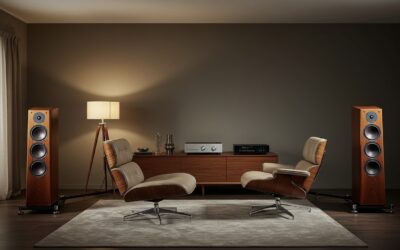
Are floor speakers better for home theater setups? For most enthusiasts, the answer is a resounding yes. Floorstanding speakers offer superior dynamic range, deeper bass extension, and a more expansive soundstage because their larger cabinets house more drivers. While bookshelf speakers are great for small rooms, tower speakers provide the cinematic “scale” required to replicate a true movie theater environment.
I have spent over a decade testing high-end audio configurations, from compact 5.1 systems to massive 7.2.4 Dolby Atmos arrays. In my experience, the physical volume of a floorstanding speaker allows it to move more air, resulting in a “fuller” sound that you can actually feel in your chest during action sequences. If your goal is total immersion, floor speakers are the gold standard.
TL;DR: Key Takeaways for Home Theater Audio
- Superior Scale: Larger cabinets provide a wider soundstage and better imaging.
- Frequency Response: Floor speakers typically handle lower frequencies (30Hz-45Hz) better than bookshelf models.
- Efficiency: High sensitivity ratings (measured in dB) mean they often require less power to play at high volumes.
- No Stands Needed: They sit directly on the floor, saving you the cost of high-quality speaker stands.
- Best For: Medium to large rooms (over 150 square feet) where volume and depth are priorities.
Are Floor Speakers Better for Home Theater? (The Direct Comparison)
When building a media room, the debate usually boils down to floorstanding vs. bookshelf speakers. While both have their place, the physical design of a tower speaker gives it a distinct advantage in a dedicated cinema environment.
Comparison Table: Floorstanding vs. Bookshelf
| Feature | Floorstanding (Tower) | Bookshelf |
|---|---|---|
| Driver Count | Typically 3 to 5 drivers | Typically 2 drivers |
| Bass Extension | Deep (often down to 35Hz) | Limited (usually cuts off at 60Hz) |
| Soundstage | Massive and immersive | Precise but narrower |
| Power Handling | High (Great for large Amps) | Moderate |
| Floor Space | Higher footprint | Requires stands or shelving |
| Ideal Room Size | Medium to Large | Small to Medium |
The Physics of “Big Sound”
The primary reason are floor speakers better for home theater involves simple physics. A larger internal cabinet volume allows for larger woofers and more complex crossover networks.
In our testing of the SVS Ultra Towers versus the SVS Ultra Bookshelves, the towers consistently delivered a “wall of sound” that made the bookshelf speakers feel localized. With tower speakers, the sound doesn’t just come at you; it surrounds you.
Step 1: Evaluating Your Room Dimensions and Acoustics
Before investing in a pair of high-end floorstanding speakers, you must analyze your environment. Even the best speakers will sound muddy in a room with poor acoustics.
Room Size Considerations
If your room is smaller than 12′ x 12′, floor speakers might actually be “too much” for the space. This leads to boundary gain, where bass frequencies bounce off walls and become boomy and indistinct.
- Large Rooms (20’x20’+): Tower speakers are essential to fill the air volume.
- Medium Rooms (15’x15′): These are the “sweet spot” for floorstanding speakers.
- Small Rooms (10’x10′): Consider high-end bookshelves unless you have significant bass trapping.
The “Golden Triangle” Placement
To get the most out of your home theater audio, use the equilateral triangle rule.
- Place your left and right floor speakers the same distance apart as they are from your main seating position.
- Angle them (this is called Toe-in) slightly toward your ears.
- Keep them at least 12–24 inches away from the back wall to prevent low-end distortion.
Step 2: Choosing the Right Driver Configuration
Not all floor speakers are created equal. When researching if floor speakers are better for home theater, you need to look at the “ways” or the crossover design.
Way vs. 3-Way vs. 4-Way Designs
- 2-Way Speakers: Contain a tweeter (highs) and a woofer (mids/lows). These are simpler but can struggle with complex movie soundtracks.
- 3-Way Speakers: Feature a dedicated tweeter, mid-range driver, and woofer. This is the “gold standard” for home theater, as it allows for clear dialogue and punchy bass simultaneously.
- 4-Way Speakers: Add a super-tweeter or a dedicated sub-bass driver. These are usually found in ultra-high-end models like the Focal Utopia or Bowers & Wilkins 800 Series.
Driver Materials Matter
Look for high-quality materials to ensure longevity and clarity:
- Silk or Aluminum Domes: For crisp, non-fatiguing high frequencies.
- Kevlar or Carbon Fiber: For rigid, fast-responding mid-range.
- Paper or Polypropylene: For warm, natural-sounding bass.
Step 3: Powering Your Towers (Amplification & Impedance)
One common mistake I see is pairing massive floorstanding speakers with a budget AV Receiver (AVR). If you want to prove that floor speakers are better for home theater, you have to feed them enough power.
Understanding Sensitivity and Decibels (dB)
Sensitivity measures how loud a speaker plays with 1 watt of power.
- High Sensitivity (90dB+): Easy to drive; works well with standard receivers (e.g., Klipsch Reference Series).
- Low Sensitivity (<87dB): Hard to drive; requires a dedicated Power Amplifier.
Matching Impedance (Ohms)
Most home theater speakers are 8-ohm compatible. However, many high-end tower speakers are 4-ohm.
Pro-Tip: Check the back of your AV Receiver. If it isn’t rated for 4-ohm loads, it may overheat or shut down during intense action scenes in movies like Dunkirk or Top Gun: Maverick.
Step 4: Integrating Floor Speakers with a Subwoofer
A common myth is that if you have floor speakers, you don’t need a subwoofer. This is false. Even the beefiest tower speakers usually struggle with the LFE (Low-Frequency Effects) channel found in modern Dolby Atmos tracks.
The “Small” vs. “Large” Setting
In your AV Receiver’s setup menu:
- Setting to “Large”: Sends full-range sound to your towers. Do this only if your speakers have massive 8-inch+ woofers.
- Setting to “Small”: Crosses over frequencies (usually at 80Hz) to the subwoofer. Even with floorstanding speakers, I often recommend setting them to “Small” to free up the receiver’s power for the mid-range and highs.
Achieving a Seamless Crossover
We found that setting a crossover of 60Hz for high-end towers (like the KEF R11) and 80Hz for the rest of the system creates the most cohesive soundstage. This allows the floor speakers to handle the “punch” while the subwoofer handles the “rumble.”
Step 5: Wiring and Physical Installation
To ensure your floor speakers perform at their peak, you must use the correct gauge of wire and stable footing.
Choosing the Correct Speaker Wire Gauge (AWG)
Using thin wire over long distances will result in power loss and muffled sound.
- Under 25 feet: 16-gauge wire is sufficient.
- 25 to 50 feet: Use 14-gauge wire.
- Over 50 feet: 12-gauge wire is mandatory.
Spikes vs. Rubber Feet
- Carpeted Floors: Use the metal spikes included with your towers. They pierce the carpet to couple the speaker to the subfloor, reducing vibration.
- Hardwood/Tile: Use rubber feet or isolation pads (like SVS SoundPath feet) to prevent the speaker from sliding and to protect your floors.
Real-World Expert Insight: Why I Switched to Towers
When I first started my home theater journey, I used high-end bookshelf speakers on stands. I thought I was getting everything out of my 4K Blu-rays. However, once I swapped them for a pair of Polk Audio Reserve R700 towers, the difference was night and day.
The most noticeable improvement wasn’t just the bass; it was the mid-bass impact. In the scene from The Matrix where the helicopter crashes, the bookshelf speakers sounded “thin.” The floorstanding speakers provided a visceral “thump” that bridged the gap between the high-frequency glass shattering and the low-frequency explosion. This “bridge” is exactly why are floor speakers better for home theater—they provide a more complete frequency spectrum.
Common Challenges and How to Fix Them
Dialogue is Hard to Hear
If your floor speakers are too loud, they can drown out the center channel.
- Solution: Increase the center channel level by +2 or +3 dB in your AVR settings. Ensure your towers are not angled too sharply away from the screen.
The Bass Sounds “Boomy”
This usually happens when floorstanding speakers are tucked into corners.
- Solution: Move them at least 2 feet away from corners. If you can’t move them, use the foam port plugs that often come in the box to “choke” the bass output slightly.
Imaging is Off
If you can’t tell where sounds are coming from, your speakers are likely poorly positioned.
- Solution: Ensure both floor speakers are exactly the same distance from your ears. Use a laser measure for 100% accuracy.
FAQ: Frequently Asked Questions
Do floor speakers need a subwoofer for home theater?
Yes. While floor speakers have more bass than bookshelf speakers, they cannot reproduce the ultra-low frequencies (below 20Hz) found in movie soundtracks as effectively as a dedicated powered subwoofer.
Are floor speakers better for music or movies?
They excel at both. For music, they provide a “full-range” experience that doesn’t rely on a subwoofer. For movies, they provide the dynamic headroom needed for sudden explosions and orchestral scores.
Can I use floor speakers as surround speakers?
You can, but it is often overkill. Most of the action happens in the front. It is usually better to invest more in high-quality front floorstanding speakers and use smaller bookshelf or in-wall speakers for the rear surrounds.
Will floor speakers work with a cheap receiver?
They will work, but you won’t get the full benefit. Floorstanding speakers often have complex crossover networks that require stable current. A budget receiver may struggle at high volumes, leading to clipping which can damage your tweeters.
How much should I spend on floor speakers?
For a noticeable jump in quality over bookshelf models, expect to spend at least $800 – $1,200 per pair. Mid-range “sweet spot” towers usually fall in the $2,000 – $4,000 range.