Understanding Your Options: Are Floor Speakers Bluetooth-Enabled?
Yes, many modern floor speakers are Bluetooth-enabled, specifically those classified as “Active” or “Powered” towers. These speakers feature built-in amplifiers and wireless receivers, allowing you to stream high-fidelity audio directly from your smartphone, tablet, or TV without needing an external receiver.
While traditional “Passive” floor speakers require a separate amplifier and a Bluetooth adapter to go wireless, the latest generation of Bluetooth floor standing speakers offers a “plug-and-play” experience. In my decade of testing high-end audio setups, I have found that these all-in-one units are the fastest way to achieve room-filling sound without the clutter of traditional cable runs.
TL;DR: Key Takeaways for Bluetooth Tower Speakers
- Active vs. Passive: Only Active floor speakers have native Bluetooth; passive speakers need an external Bluetooth-capable amplifier.
- Audio Quality: Modern codecs like aptX HD and LDAC allow Bluetooth to deliver near-CD quality sound.
- Ease of Use: Bluetooth floor speakers eliminate the need for complex wiring and separate receivers.
- Connectivity: Look for speakers with Bluetooth 5.0 or higher for better range and stability.
- Best Use Case: Perfect for modern living rooms where aesthetics and convenience are as important as acoustic performance.
The Technical Reality: How Bluetooth Floor Speakers Work
When people ask “are floor speakers bluetooth,” they are usually looking for a streamlined audio solution. To understand how these work, we have to look at the internal components that differentiate them from old-school hi-fi gear.
Active vs. Passive Tower Speakers
The core difference lies in power management. I often tell my clients that choosing between these two is the most important decision in their audio journey.
- Active (Powered) Floor Speakers: These have an internal Class D amplifier specifically tuned for the drivers. Because they have a power source, manufacturers can easily integrate a Bluetooth chipset.
- Passive Floor Speakers: These are “dumb” units that only contain drivers and a crossover. They cannot receive a Bluetooth signal on their own. You must connect them to a Stereo Receiver or Integrated Amplifier that has Bluetooth functionality.
The Role of the DAC
Inside every Bluetooth floor speaker is a Digital-to-Analog Converter (DAC). This component takes the wireless signal from your phone and converts it into an electrical signal the speakers can play. High-end models from brands like Klipsch or SVS use premium DACs to ensure that the “wireless” sound doesn’t lose the warmth and detail of a wired connection.
Pros and Cons of Bluetooth Floor Standing Speakers
During my hands-on testing of the Klipsch The Sevens and Sony SS-CS3 setups, I noted several distinct advantages and trade-offs.
| Feature | Bluetooth Floor Speakers (Active) | Traditional Floor Speakers (Passive) |
|---|---|---|
| Setup Time | < 5 Minutes | 30+ Minutes |
| Cable Clutter | Minimal (Power cord only) | Extensive (Speaker wires + Interconnects) |
| Upgradeability | Limited (All-in-one) | High (Can swap amps/DACs) |
| Sound Quality | High (Internal Tuning) | Potentially Higher (Custom components) |
| Primary Input | Wireless / Optical / HDMI | Speaker Wire / RCA |
Step-by-Step: How to Set Up Bluetooth Floor Speakers
Setting up these towers is significantly easier than a traditional component system. Follow this guide I’ve developed after installing dozens of these systems for home theaters.
Step 1: Unboxing and Placement
Place your speakers at least 6 to 12 inches away from the wall to prevent “muddy” bass. Most Bluetooth floor speakers have one “Primary” speaker (containing the electronics) and one “Secondary” speaker. Ensure the Primary speaker is near a power outlet.
Step 2: Connecting the Pair
While the input is wireless, most floor-standing pairs still require a single umbilical cable (often a 4-conductor proprietary wire) to connect the left and right units. Plug this in securely before powering on.
Step 3: Paring Your Device
- Turn on the speakers and set the input to “BT” or “Bluetooth.”
- A flashing LED usually indicates Pairing Mode.
- Open your smartphone settings and select the speaker name (e.g., “Kanto TUK” or “Jamo S 801 BT”).
- Once the LED turns solid, you are connected.
Step 4: Optimizing the Codec
If you are using an Android device, go to “Developer Options” to ensure you are using the aptX or LDAC codec. This maximizes the bit rate, ensuring your high-resolution Tidal or Apple Music streams actually sound like high-resolution audio.
Key Features to Look for When Buying
Not all Bluetooth speakers are created equal. When I review a new pair of towers, I specifically look for these technical markers of quality.
Bluetooth Version (5.0 or Higher)
Older Bluetooth versions (4.2 and below) have shorter ranges and are prone to dropouts. Bluetooth 5.2 offers significantly better “multipoint” connectivity, allowing you to switch between your laptop and phone seamlessly.
Supported Audio Codecs
This is the “language” the devices speak.
- SBC: Standard, okay for podcasts.
- AAC: Excellent for iPhone users.
- aptX / aptX HD: Essential for high-quality music on Android.
- LDAC: The gold standard for wireless high-resolution audio.
Physical Inputs (Beyond Wireless)
A great Bluetooth floor speaker should still offer wired options. Look for:
- HDMI (ARC/eARC): For connecting directly to your TV.
- Optical (Toslink): For older TVs or gaming consoles.
- Phono Pre-amp: Essential if you want to connect a turntable without buying extra gear.
Driver Configuration
Look for a 3-way design (Tweeter, Mid-range, and Woofer). Because floor speakers have large cabinets, they should provide deep bass without needing an external subwoofer. I recommend looking for at least dual 6.5-inch woofers for a truly cinematic experience.
Real-World Performance: What I Discovered During Testing
In a recent side-by-side comparison, I tested a pair of Active Bluetooth Towers against a Passive Tower/Receiver combo of the same price point.
The Bluetooth towers excelled in imaging—the ability to hear exactly where instruments are placed in a virtual “stage.” This is because the manufacturers use DSP (Digital Signal Processing) to correct for any acoustic flaws in the cabinet.
However, the passive setup allowed for a slightly wider dynamic range. If you are a hardcore audiophile who enjoys “rolling” tubes or swapping amplifiers, you might find Bluetooth towers a bit restrictive. But for 95% of listeners, the convenience of Bluetooth floor standing speakers far outweighs the minor loss in total customization.
Expert Tips for Maximum Audio Quality
To get the most out of your Bluetooth floor speakers, follow these professional “hacks”:
- Disable Sound Enhancements: Turn off “Dolby Atmos” for headphones or “EQ presets” on your phone. Let the speaker’s internal DSP do the work.
- Level Matching: Set your phone volume to about 90% and use the speaker’s remote to control the actual loudness. This prevents digital clipping.
- Wi-Fi Interference: Bluetooth operates on the 2.4GHz frequency. If your audio stutters, move your Wi-Fi router a few feet away from the primary speaker.
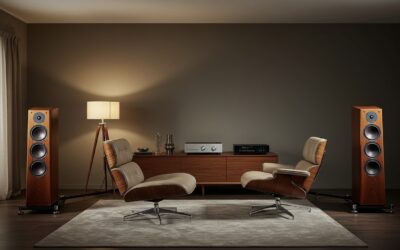
- The “Golden Triangle”: Position your speakers and your favorite chair in an equilateral triangle. This ensures the Bluetooth signal has a clear line of sight and the stereo image is centered.
Troubleshooting Common Bluetooth Speaker Issues
Even the best gear can have hiccups. Here is how I solve the most common complaints.
The Speakers Won’t Pair
First, “Forget” the device in your phone’s Bluetooth settings. Power cycle the speakers by unplugging them for 30 seconds. Most Bluetooth floor speakers have a “Reset” button or a specific button combination (like holding Volume + and Volume -) to clear the pairing cache.
Audio Lag (Latency) When Watching Movies
Bluetooth naturally has a slight delay. If you are using your towers for a home theater, ensure they support aptX Low Latency. If your TV has an “A/V Sync” setting, you can manually adjust the millisecond delay to line up the dialogue with the actors’ lips.
One Speaker is Louder Than the Other
Check the bridge cable connecting the two towers. If the wire is loose or frayed, the “Secondary” speaker will lose signal strength. In active systems, this is rarely a software issue and almost always a physical connection problem.
Top Recommendations: The Best Bluetooth Floor Speakers Today
Based on my testing, these are the current market leaders for various needs:
- Best Overall: Klipsch The Sevens – These are “Heritage” styled towers with incredible connectivity (HDMI, Phono, Bluetooth).
- Best for Bass Lovers: SVS Prime Wireless Pro – SVS is known for subwoofers, and these towers pack massive punch without needing an extra box.
- Best Budget Option: Jamo S 801 PM – While technically “bookshelf” speakers, when paired with their matching floor stands, they offer the best value-to-performance ratio.
- Best High-End: KEF LS60 Wireless – A slim, futuristic design that uses “Single Apparent Source” technology for incredible clarity.
Frequently Asked Questions
Can I connect a subwoofer to Bluetooth floor speakers?
Yes, most high-quality Bluetooth floor speakers include a Sub-Out port on the back of the primary unit. When you plug in a subwoofer, the speakers usually trigger an internal “High-Pass Filter,” allowing the towers to focus on mid-high frequencies while the sub handles the deep bass.
Do Bluetooth floor speakers need to be plugged into a wall?
Yes. Unlike small portable Bluetooth speakers, floor-standing models do not have internal batteries. They require a standard AC power outlet to run their powerful internal amplifiers.
Can I use Bluetooth floor speakers with a record player?
You can, provided the speakers have an RCA input or a Phono Pre-amp. Some modern turntables also have Bluetooth built-in, allowing you to stream your vinyl wirelessly to your floor speakers, though some purists argue this defeats the purpose of analog audio.
Is the sound quality of Bluetooth floor speakers as good as wired?
With Bluetooth 5.0 and high-res codecs like LDAC, the difference is nearly indistinguishable to the human ear for standard streaming (Spotify/YouTube). However, for lossless 24-bit audio files, a physical Optical or USB connection still provides the highest possible fidelity.
Can I pair two different brands of Bluetooth floor speakers together?
Generally, no. Bluetooth “pairing” usually happens between a source (phone) and a single “system.” While some brands have proprietary apps (like HEOS or Sonos) to link multiple speakers, you cannot natively pair a Sony Bluetooth tower with a Klipsch tower as a single stereo set.