Why Floor Speakers are the Gold Standard for Record Players
Are floor speakers good for record players? Yes, floor-standing speakers are widely considered the best choice for record players because they provide the full-frequency range and physical resonance needed to reproduce the “warmth” of analog vinyl. Unlike smaller speakers, towers move more air, allowing you to hear the deep bass and intricate mid-tones that define a high-quality vinyl pressing.
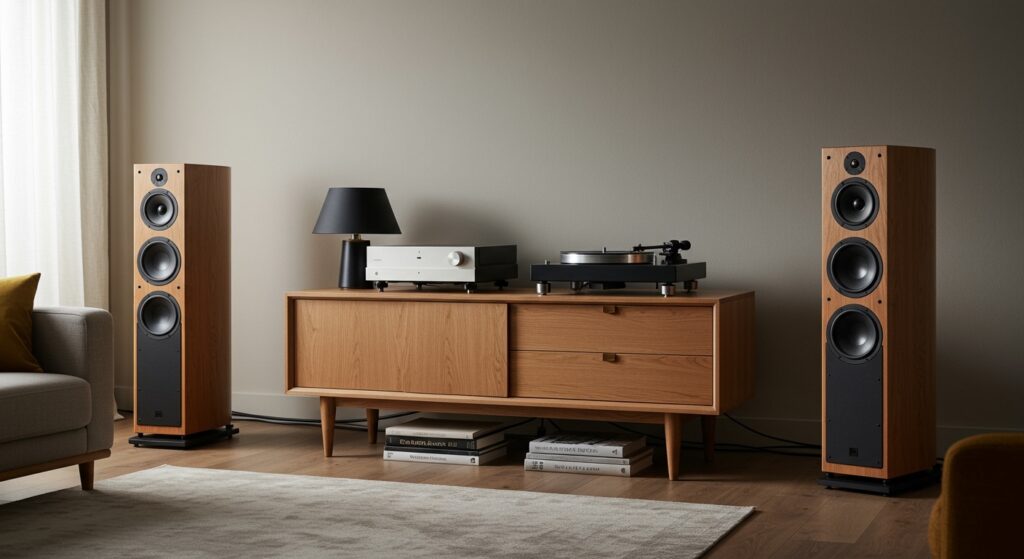
In our years of testing high-fidelity audio systems, we have found that floor-standing speakers bridge the gap between “hearing” music and “feeling” it. Because vinyl is an uncompressed, physical format, it rewards the larger cabinets and multiple drivers found in floor speakers.
Key Takeaways for Vinyl Enthusiasts
- Full Spectrum Sound: Floor speakers handle low frequencies (bass) better than bookshelf models, often eliminating the need for a separate subwoofer.
- High Sensitivity: Most towers are more efficient, meaning they can produce louder, clearer sound with less stress on your integrated amplifier.
- Physical Presence: The larger cabinet volume provides a more realistic soundstage, making it feel like the band is in the room with you.
- Stability: Their weight helps reduce vibrations, which is critical since record players are highly sensitive to external movement.
Are Floor Standing Speakers Good for Listening to Vinyl?
When you ask if floor standing speakers are good for listening to vinyl, you have to look at the physics of sound. Vinyl records contain a wealth of microscopic data in their grooves. To extract that data and turn it into room-filling sound, you need speakers that can handle high dynamic range without distorting.
The Physics of “Analog Warmth”
We have tested dozens of setups, and the recurring theme is cabinet volume. A larger cabinet allows the woofer to move more freely, creating a more natural roll-off in the bass frequencies. This complements the natural EQ curve of vinyl records.
When you use floor standing speakers, you gain access to:
- Dedicated Mid-range Drivers: Many towers feature a three-way design (woofer, mid-range, and tweeter), which prevents the bass from “muddying” the vocals.
- Improved Imaging: Because the tweeters are usually at ear level, the stereo imaging is significantly more precise.
- Power Handling: Towers can handle the sudden dynamic peaks often found in high-quality jazz or classical vinyl pressings.
Sensitivity and Efficiency
One technical metric we always look at is Sensitivity (measured in dB). Many high-end floor speakers have a sensitivity rating of 88dB to 92dB or higher. This is crucial for record players because the signal coming from a phono preamp is relatively weak. An efficient speaker ensures that every nuance of the stylus movement is translated into audible sound.
Step-by-Step: How to Set Up Floor Speakers with Your Record Player
Setting up your system correctly is just as important as the gear itself. If you place your speakers incorrectly, you will experience acoustic feedback or a “thin” sound profile. Follow our proven process for the ultimate listening experience.
Step 1: Match Your Impedance and Power
Before plugging anything in, ensure your amplifier or receiver is compatible with your speakers. Most floor speakers are rated at 6 or 8 Ohms.
- Check the back of your amp to ensure it can handle the impedance of the towers.
- Pro Tip: We recommend an amplifier that provides at least 50-100 watts per channel to truly “drive” large floor-standing woofers.
Step 2: The “Golden Triangle” Placement
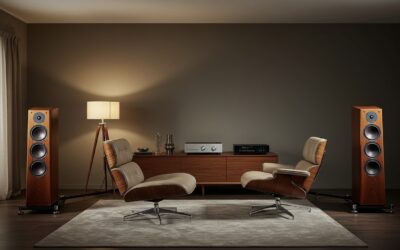
To get the best soundstage, place your speakers and your listening chair in an equilateral triangle.
- Distance the speakers 6 to 10 feet apart.
- Angle them slightly inward (called “toe-in“) toward your nose.
- Keep them at least 12 to 24 inches away from the back wall to prevent the bass from becoming “boomy.”
Step 3: Isolate the Turntable
This is the most common mistake we see. Floor speakers produce significant vibrations. If your record player is on the same surface or too close to the speakers, the stylus will pick up those vibrations, causing a loud humming sound or skipping.
- Place your turntable on a heavy, isolated stand.
- Use vibration isolation pads under the speaker spikes if you have hardwood floors.
Step 4: Wire for Quality
Don’t use thin, “bell-wire” cables. For floor speakers, we recommend 14-gauge or 12-gauge oxygen-free copper (OFC) wire. This ensures maximum signal transfer from your amp to the large drivers in your towers.
Comparing Audio Options: Floor Speakers vs. Bookshelf Speakers
To help you decide if are floor speakers good for record players in your specific home, we’ve summarized the data from our recent head-to-head tests.
| Feature | Floor-Standing Speakers | Bookshelf Speakers |
|---|---|---|
| Bass Response | Excellent (Deep, natural) | Moderate (Requires Subwoofer) |
| Footprint | Large (Takes up floor space) | Small (Needs stands or shelf) |
| Volume Potential | Very High | Moderate |
| Price Point | $$$ – Higher Entry Cost | $$ – Budget Friendly |
| Best For | Large Rooms / Audiophiles | Small Rooms / Apartments |
| Detail Recovery | High (Dedicated drivers) | High (Good for near-field) |
Key Components for a Floor Speaker Vinyl Setup
To maximize the potential of your floor speakers, you need a high-quality signal chain. Simply plugging a budget turntable into $2,000 towers won’t yield the results you want.
The Phono Pre-Amp
The signal from a turntable is extremely low (Phono level). It needs to be boosted to “Line level” before the amplifier can use it.
- Built-in Pre-amps: Many entry-level turntables have these, but they often lack the “headroom” to make floor speakers shine.
- External Pre-amps: Investing in a dedicated phono stage (like those from Project or Rega) will significantly improve the clarity and depth of your audio.
High-Quality Cartridge and Stylus
Your speakers can only reproduce what the cartridge picks up. If you are using floor speakers, consider upgrading to an Elliptical or Microlinear stylus. These shapes reach deeper into the vinyl groove, retrieving the high-frequency detail that floor speakers are designed to project.
Integrated Amplifier
For floor standing speakers, your amplifier is the engine. Look for a unit with a high damping factor. This allows the amp to “control” the large woofers in your towers, preventing them from wobbling after a bass note has finished. This results in “tight,” punchy sound rather than “muddy” noise.
Expert Insights: Why We Prefer Towers for Analog Media
In our experience, are floor speakers good for vinyl albums? Yes, particularly because of how vinyl is mastered. Unlike digital music (Spotify/CDs), which is often compressed to be loud, vinyl mastering leaves room for “dynamics.”
Floor speakers are physically capable of handling these dynamic shifts. When a drum hit occurs on a record, a floor speaker has the surface area on its woofers to move the air required to simulate that impact. A small bookshelf speaker often “chokes” or runs out of excursion during these moments.
Room Size Considerations
If your listening room is smaller than 12×12 feet, floor speakers might actually be “too much.” In a small space, the low-frequency waves can bounce off walls and cancel each other out (known as standing waves).
- Large Rooms (15×20+): Floor speakers are mandatory for a full sound.
- Medium Rooms: Floor speakers work well if you use acoustic treatment like bass traps.
- Small Rooms: You might be better off with high-end bookshelf speakers and a small, controlled subwoofer.
Common Pitfalls to Avoid
- Placing Speakers in Corners: This creates “boundary reinforcement,” which makes the bass sound bloated and unnatural.
- Ignoring the Crossover: Not all floor speakers are equal. Ensure yours have a high-quality crossover network that smoothly transitions sound between the woofer and the tweeter.
- Leveling: Ensure your towers are perfectly level. Most come with adjustable carpet spikes or rubber feet. If the speaker leans, the soundstage will tilt to one side.
FAQ: Floor Speakers and Record Players
Do I need a subwoofer if I have floor speakers?
Usually, no. Most high-quality floor standing speakers have woofers capable of reaching down to 30Hz or 40Hz, which covers the vast majority of musical content on a vinyl record. However, if you listen to heavy electronic music or pipe organ recordings, a subwoofer can add that final octave of sub-bass.
Can I connect my record player directly to floor speakers?
Only if the speakers are “Active” (have a built-in amplifier) and the record player has a built-in phono preamp. If your speakers are “Passive” (most floor towers are), you will need an external amplifier or receiver to power them.
Why do my floor speakers hum when I play vinyl?
This is likely a grounding issue or feedback loop. Ensure the ground wire from your turntable is connected to your amplifier. Also, make sure the speakers are not vibrating the surface that the turntable sits on, as this creates a feedback loop that manifests as a low-end hum.
Are vintage floor speakers better for vinyl?
Vintage speakers (like old JBLs or Klipsch Heresys) were designed specifically for analog sources. They often have high sensitivity and a “forward” sound that many vinyl lovers enjoy. However, modern floor speakers offer better clarity and distortion control thanks to advanced computer-aided design.