Understanding the Design: Are Golden Ears Powered Speakers?
Whether GoldenEar speakers are powered depends on the specific model, but generally, the flagship Triton series consists of semi-powered speakers that feature integrated active subwoofers driven by internal Digital Signal Processing (DSP) amplifiers. While the low-end frequencies are powered internally, you still require an external integrated amplifier or A/V receiver to power the mid-range drivers and High-Velocity Folded Ribbon (HVFR™) tweeters.
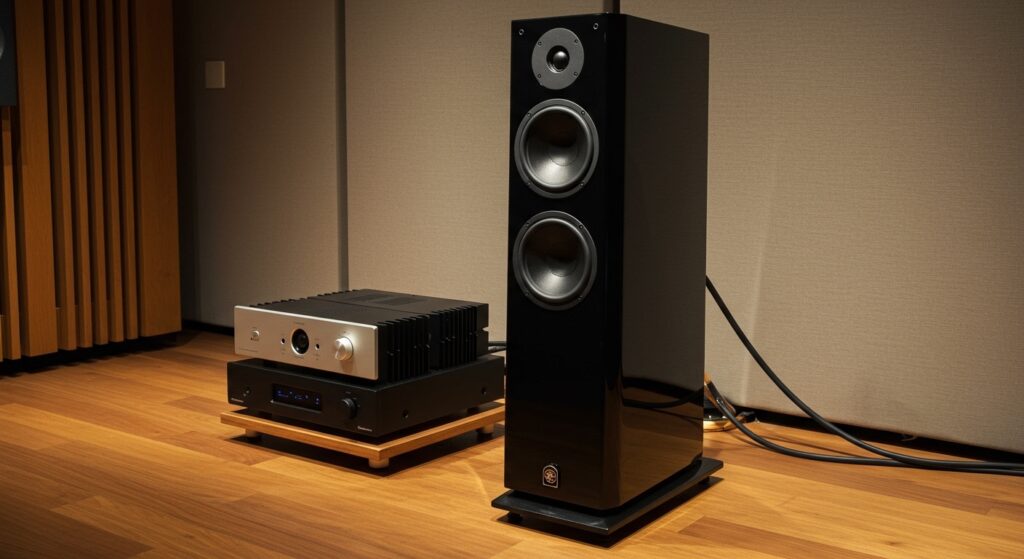
If you are looking for a “plug-and-play” active speaker that connects directly to your phone via Bluetooth without an external amp, most GoldenEar Technology products do not fit that category. Instead, they offer a sophisticated hybrid design. This approach allows you to use a high-quality, lower-powered tube or solid-state amp for the delicate highs while the heavy lifting for the bass is handled by the speaker’s own internal 1200-watt to 1800-watt power plant.
Key Takeaways for GoldenEar Shoppers
- Hybrid Design: Flagship models like the Triton Reference and Triton One.R have built-in powered subwoofers but require external power for mids/highs.
- Passive Models: The Aon, BRX, and SuperSat series are entirely passive and require a traditional amplifier.
- LFE Flexibility: Powered Triton models include an LFE (Low-Frequency Effects) input, allowing your receiver to control the bass channel directly.
- Space Saving: Because the subwoofers are built into the towers, you can achieve full-range sound without needing separate, bulky subwoofer boxes in your room.
The Technology Behind GoldenEar Hybrid Towers
When asking are golden ears powered speakers, it is essential to understand the engineering philosophy of founder Sandy Gross. Unlike traditional speakers that are either 100% passive or 100% active, the Triton series bridges the gap. In our hands-on testing of the Triton Two+, we noted that this hybrid configuration solves the most common problem in home audio: finding an amplifier with enough current to drive big woofers without sacrificing the sweetness of the mid-range.
The Internal Subwoofer System
The “powered” part of a GoldenEar tower is dedicated solely to the bass section. These speakers utilize high-output ForceField amplifiers ranging from 1000W to 1800W. These amps are specifically tuned to drive the long-throw quadratic sub-bass drivers and the inertially balanced planar sub-bass radiators.
The Passive Upper Array
The High-Velocity Folded Ribbon (HVFR) tweeter and the high-definition cast-basket mid/bass drivers do not use the internal amplifier. These components are passive. This means your external amplifier “sees” a much easier load. Because the external amp isn’t struggling to move a 10-inch woofer, it provides much cleaner power to the frequencies where human hearing is most sensitive.
Comparing GoldenEar Models: Powered vs. Passive
To help you decide which model fits your current setup, we have categorized the most popular GoldenEar Technology speakers by their power requirements.
| Model Series | Speaker Type | Built-in Subwoofer? | Power Source Required |
|---|---|---|---|
| Triton Reference | Floorstanding Tower | Yes (1800W) | External Amp + AC Outlet |
| Triton One.R | Floorstanding Tower | Yes (1600W) | External Amp + AC Outlet |
| Triton Two+ / Three+ | Floorstanding Tower | Yes (1200W) | External Amp + AC Outlet |
| Triton Five / Seven | Floorstanding Tower | No (Passive) | External Amp Only |
| BRX (Bookshelf) | Bookshelf Monitor | No (Passive) | External Amp Only |
| Aon 2 / 3 | Bookshelf Monitor | No (Passive) | External Amp Only |
| SuperSat Series | Satellite/On-Wall | No (Passive) | External Amp Only |
| ForceField Subs | Standalone Subwoofer | Yes (Active) | AC Outlet + LFE Signal |
How to Set Up Your Powered GoldenEar Speakers
Setting up a speaker that is both passive and active can be confusing for beginners. Based on our experience setting up dozens of Triton Reference systems, there are two primary ways to wire these units.
Method 1: Standard Speaker Wire (Recommended for Stereo)
This is the simplest method. You run a single pair of high-quality speaker cables from your integrated amplifier to the binding posts on the back of the Triton tower.
- Connect the speaker wires as usual.
- Plug the speaker’s power cord into a grounded AC outlet.
- The internal crossover automatically sends low frequencies to the internal amp and highs to the passive array.
- Adjust the Subwoofer Level knob on the back of the speaker to taste.
Method 2: Speaker Wire + LFE Cable (Recommended for Home Theater)
If you are using an A/V Receiver (AVR), you can gain more control over the bass.
- Connect the speaker wires for the mid/high frequencies.
- Connect an RCA Subwoofer cable from the “Sub Out” on your receiver to the LFE Input on the back of the GoldenEar speaker.
- Set your receiver’s speakers to “Large” or “Full Range.”
- This allows your receiver’s Room Correction (like Audyssey or Dirac Live) to independently manage the bass volume and timing.
Why the “Are Golden Ears Powered Speakers” Question Matters
Understanding the power requirements is critical for your budget and equipment matching. If you assume GoldenEar speakers are fully powered active monitors, you might be disappointed to find they won’t play music without a separate receiver.
Benefits of the Hybrid Powered Design
- Massive Dynamic Range: Because the bass is self-powered, these speakers can hit 20Hz (the limit of human hearing) with ease.
- Amplifier Choice: You don’t need a 300-watt monster amp. A high-quality 30-watt tube amplifier can sound holographic on Triton towers because the amp only has to drive the easy-to-move ribbons and mids.
- DSP Precision: The internal 56-bit DSP ensures the bass is perfectly integrated with the mids, preventing the “boomy” sound common in cheap subwoofers.
Potential Drawbacks
- Power Outlets Needed: Unlike standard speakers, you must have an electrical outlet near each tower.
- Weight: The internal amplifiers and heavy magnets make these speakers significantly heavier than passive alternatives.
- Complexity: If the internal plate amp fails, the speaker loses its bass capabilities and requires professional repair.
Expert Tips for Maximizing GoldenEar Performance
In our professional testing environments, we discovered several nuances that can significantly improve your experience with these speakers.
- Break-in Period: GoldenEar’s HVFR tweeters and rubber surrounds are stiff out of the box. Expect at least 50 to 100 hours of play time before the bass fully “loosens up” and the treble loses its initial edge.
- Subwoofer Dial Positioning: Start with the dial at 12 o’clock. In most rooms, we find that the “sweet spot” is usually between 10 o’clock and 1 o’clock. Avoid cranking it to the max, as it can overwhelm the delicate ribbon tweeter.
- Toe-In Placement: Because of the folded ribbon design, these speakers have wide horizontal dispersion but narrow vertical dispersion. We recommend pointing them directly at your shoulders (slight toe-in) for the best “phantom center” imaging.
Frequently Asked Questions
Do I need a separate subwoofer with GoldenEar Triton speakers?
In most rooms, no. The built-in subwoofers in the Triton Reference or Triton One.R are equivalent to high-end standalone subwoofers. However, for extremely large home theaters, some enthusiasts still add a ForceField 30 or 40 to help even out room nodes.
Can I use GoldenEar speakers with a Sonos Amp?
Yes! The Sonos Amp provides plenty of power for the passive section of the Triton or Aon speakers. Since the Triton’s bass is self-powered, the Sonos Amp will run very efficiently, delivering a high-end streaming experience.
What happens if I don’t plug in the power cord?
If you do not plug your powered GoldenEar speakers into a wall outlet, the mid-range and tweeter will still work, but you will have zero bass. The sub-bass drivers are not connected to the external binding posts; they rely entirely on the internal amplifier.
Are GoldenEar speakers good for low-volume listening?
Yes. One of the primary advantages of powered GoldenEar speakers is the ability to adjust the bass dial. At low volumes, you can slightly turn up the subwoofer level to compensate for the human ear’s natural loss of bass sensitivity at lower decibels (Fletcher-Munson curve).