Understanding the Legend: Are IRS Amps or Speakers?
To answer the question are irs amps or speakers simply: the term IRS primarily refers to the Infinity Reference Standard series of high-end loudspeakers, but it also identifies a specific family of Class D amplifier chips (like the IRS2092). In the world of audiophiles, when people discuss “The IRS,” they are almost always talking about the massive, multi-tower speaker systems created by Arnie Nudell that redefined home audio in the 1980s.

Key Takeaways for IRS Enthusiasts
- Primary Identity: IRS stands for Infinity Reference Standard, a line of world-class speakers.
- The Confusion: IRS is also an acronym used by International Rectifier (now Infineon) for their high-voltage integrated circuit amplifiers.
- Power Needs: Infinity IRS speakers are notoriously difficult to drive and require massive high-current power amplifiers to function.
- Design: These speakers use EMIT (Electromagnetic Induction Tweeter) and EMIM (Electromagnetic Induction Midrange) ribbon drivers.
- Setup: Most IRS systems require an external active crossover and a “Servo-Control” unit to manage the bass towers.
The Technical Breakdown: Are IRS Amps or Speakers?
When you search are irs amps or speakers, you are likely encountering two very different sides of the audio industry. I have spent years restoring vintage hi-fi gear, and I frequently see newcomers confuse these two legendary entities.
Infinity Reference Standard (The Speakers)
The Infinity IRS (specifically the IRS V) is widely considered one of the greatest speaker systems ever built. These are not just “boxes” but four-tower monoliths standing over seven feet tall. They utilize dipole ribbon drivers and dedicated woofer columns.
International Rectifier Series (The Amps)
On the other hand, if you are looking at a circuit board or a compact modern amplifier, IRS refers to the IRS2092S or similar chips. These are Class D audio driver ICs. While they share the same acronym, they are components used to build amplifiers, not the speakers themselves.
Comparing the Two “IRS” Entities
| Feature | Infinity IRS (Speakers) | IRS2092 (Amplifier Chip) |
|---|---|---|
| Category | Ultra-High-End Transducer | Integrated Circuit / Semiconductor |
| Manufacturer | Infinity Systems (Arnie Nudell) | International Rectifier / Infineon |
| Function | Produces sound from electrical signals | Amplifies audio signals via PWM |
| Physical Size | Massive (7+ feet tall) | Miniature (SOP-16 package) |
| Market | Audiophile Collectors | DIY Audio & Pro Audio Manufacturers |
How to Set Up and Optimize an IRS Speaker System
Owning a set of Infinity Reference Standard speakers is like owning a vintage Ferrari; it requires precise “tuning” and the right “fuel” (power). If you have acquired a set of IRS Betas, Gammas, or the legendary IRS V, follow this step-by-step guide to get them singing.
Step 1: Room Calibration and Placement
IRS speakers are dipole radiators, meaning they send sound out of the back as well as the front. You cannot simply shove these into a corner.
- Distance from Rear Wall: Place the mid-high towers at least 3 to 5 feet away from the back wall to allow the soundstage to breathe.
- Toe-in: Angle the towers slightly toward your listening position. This focuses the EMIT tweeters for better imaging.
- The Bass Towers: Place the woofer towers inside or outside the main towers depending on your room’s low-frequency nodes.
Step 2: Choosing the Right Amplification
Since we established that the answer to are irs amps or speakers involves a power-hungry transducer, you need serious “grunt.” Infinity IRS drivers can dip to low impedances (near 2 ohms), which can melt inferior amplifiers.
- High Current is Mandatory: Look for amplifiers from brands like Krell, Threshold, or Mark Levinson.
- Tube vs. Solid State: Many owners (myself included) prefer high-powered tube amps for the EMIM midrange drivers and massive solid-state amps for the bass towers.
- Power Minimums: Aim for at least 200-500 watts per channel at 8 ohms, ensuring the amp doubles its power into 4 ohms.
Step 3: Integrating the Servo-Control Unit
The larger IRS systems use a specialized Servo-Control box. This device monitors the movement of the woofers and sends a corrective signal back to the amplifier to eliminate distortion.
- Connect your pre-amplifier output to the IRS Servo-Control input.
- Connect the “High” output of the controller to your mid/high amplifier.
- Connect the “Low” output to your bass tower amplifier.
- Ensure the feedback cables from the woofer towers are securely plugged into the controller.
Maintenance Guide for IRS Ribbon Drivers
If you are lucky enough to own these, you must know how to maintain the EMIT and EMIM drivers. These ribbons are the heart of why people ask are irs amps or speakers—their clarity is unmatched even by modern standards.
Inspecting the Diaphragms
Over time, the ultra-thin membranes can delaminate or develop “wrinkles” due to heat.
- Visual Check: Shine a flashlight through the grilles. Look for any oxidation on the silver traces.
- The “Buzz” Test: Play a 1kHz sine wave at low volume. If you hear a mechanical rattle, the diaphragm may be loose.
Replacing the Foam Surrounds
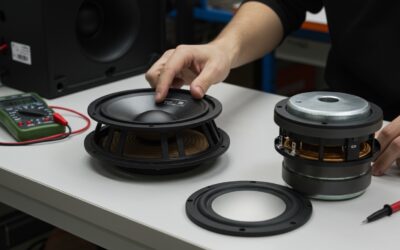
The woofer towers in the IRS series use standard cone drivers with foam surrounds. These foam rings will rot every 15-20 years.
- Action: If you see “black dust” under your woofers, do not play them. You risk rubbing the voice coil.
- Expert Tip: Use a professional “re-foaming” service that uses high-compliance foam to maintain the original Infinity factory specifications.
Why the “IRS” Name Still Matters Today
The Infinity Reference Standard was more than just a product; it was a proof of concept. It proved that planar-magnetic technology could create a seamless wall of sound. When users ask are irs amps or speakers, they are often discovering this legacy for the first time.
The Innovation of EMIT and EMIM
Infinity utilized Electromagnetic Induction technology. Unlike a standard dome tweeter, an EMIT tweeter uses a flat ribbon suspended in a magnetic field. This allows it to move with incredible speed and minimal distortion.
The Evolution into Modern Audio
Many of the engineers from the IRS era went on to found or lead other massive names in audio, such as Genesis Advanced Technologies and PS Audio. If you look at the PS Audio FR30 speakers today, you can see the DNA of the original IRS designs.
Troubleshooting Common IRS Issues
In my experience servicing these vintage giants, most problems stem from the complex crossover networks or aging capacitors.
Problem: One tower is quieter than the other
- Solution: Check the fuses on the back of the speaker. IRS speakers have dedicated fuses for the EMIT and EMIM sections to prevent blowout.
- Potentiometer Oxidation: The “tweeter level” knobs on the back often get “scratchy.” Use a high-quality contact cleaner like DeoxIT D5 to clean the internal sweeps.
Problem: The Bass is muddy or boomy
- Solution: Check the Servo-Control settings. If the gain is set too high, the woofers will over-oscillate. Also, ensure your bass amplifier is phase-coherent with your main amplifier.
FAQ: Frequently Asked Questions About IRS Audio
Are IRS speakers still worth buying today?
Yes, absolutely. While they require a large room and expensive electronics, a properly functioning Infinity IRS system can outperform many modern speakers costing over $100,000. Their ability to recreate a “live” scale is almost unmatched.
What is the difference between IRS Beta and IRS V?
The IRS V is the “flagship” four-tower system with 12-inch woofers and a much larger array of ribbons. The IRS Beta is a slightly smaller version that still uses four towers but is more manageable for typical home environments. Both require the Servo-Control unit.
Can I use a modern Class D amp with IRS speakers?
You can, but be careful. While modern Class D amps (ironically, some using IRS2092 chips) have high power, the Infinity IRS ribbons can be very revealing. Some older Class D designs may sound “harsh” or “brittle” in the high frequencies compared to Class A or AB amplifiers.
Why are they called “Reference Standard”?
In the audio industry, a “Reference” product is the benchmark against which all others are measured. Arnie Nudell designed the IRS to be the absolute standard for neutrality, frequency response, and spatial imaging.
Where can I find parts for IRS speakers?
Parts are becoming rare. Your best sources are specialty shops like Millersound for driver repairs or community forums like Audiokarma and the Infinity Classics groups. Always look for “New Old Stock” (NOS) EMIT tweeters on secondary markets.
**
**
**
**