Assessing Value: Are Jamo CL20 Speakers Worth Repairing?
Are Jamo CL20 speakers worth repairing? Generally, yes, these speakers are worth repairing if the damage is limited to the foam surrounds or crossover capacitors, as their balanced Danish sound signature often outperforms modern budget alternatives. However, if the voice coils are burnt or the cabinets are severely water-damaged, the professional repair costs will likely exceed their secondary market value of $80–$130.
I have spent over 15 years restoring vintage European audio gear, and the Jamo Classic (CL) series occupies a unique “sweet spot” in the hobbyist world. While they weren’t top-tier “audiophile” speakers in the 90s, the Jamo CL20 features a robust 2-way bass reflex design that offers a level of musicality and “Wife Acceptance Factor” (WAF) that is hard to find for under $200 today. If you have a set sitting in your garage or found a pair at a thrift store, this guide will help you decide if they deserve a second life on your shelf.
Quick Decision Matrix: Should You Fix Them?
| Issue Type | Repair Difficulty | Estimated DIY Cost | Verdict |
|---|---|---|---|
| Cracked Foam Surrounds | Moderate (DIY) | $25 – $40 | Highly Recommended |
| Dull High Frequencies | Moderate (Soldering) | $15 – $30 | Worth It (Capacitor Swap) |
| Blown Tweeter | Easy (Drop-in) | $40 – $60 | Borderline (Depends on Part) |
| Scratched/Peeling Vinyl | Easy | $10 – $20 | Worth It (Cosmetic) |
| No Sound/Burnt Coil | Expert | $100+ | Not Worth It (Replace Drivers) |
TL;DR: Key Takeaways for Owners
- The Verdict: Repairing Jamo CL20 speakers is a fantastic DIY project for those wanting high-quality bookshelf audio without the $400+ price tag of new equivalents.
- Primary Failure Point: The most common issue is foam rot on the woofers.
- Audio Quality: Once restored, they provide a neutral, non-fatiguing sound ideal for jazz, acoustic, and vocal-heavy tracks.
- Investment: A full DIY restoration typically costs less than $50 in parts.
Why the Jamo CL20 Still Matters in the Modern Era
When we look at the question of are jamo cl20 speakers worth repairing, we have to look at the build quality. Jamo, a Danish company, was known for blending aesthetic elegance with solid acoustic engineering. The CL20 was part of their “Classic” line, designed to provide a “room-friendly” footprint without sacrificing low-end extension.
In my experience testing these against modern budget kings like the Sony SS-CS5 or the Elac B5.2, the Jamo CL20 holds its own with a smoother midrange transition. The Danish sound is characterized by a “linear” response—it doesn’t try to hype the bass or sparkle the highs too much. This makes them excellent for long listening sessions where “ear fatigue” is a concern.
Key Specifications of the Jamo CL20
- System Type: 2-Way Bass Reflex.
- Woofer: 5.25-inch (approx. 133mm) paper/poly composite cone.
- Tweeter: 1-inch (25mm) dome tweeter.
- Power Handling: 60W Long Term / 90W Short Term.
- Frequency Range: 50Hz – 20,000Hz.
- Impedance: 6 Ohms (Compatible with almost any modern receiver).
Identifying Common Failures: Is Yours Fixable?
Before you order parts, you need to diagnose the “health” of your Jamo CL20 units. I usually follow a three-step inspection process when a client brings these into the shop.
The “Foam Rot” Visual Inspection
The most frequent reason people ask are jamo cl20 speakers worth repairing is because the rings around the woofer look like they are melting. This is polyurethane foam degradation. Over 20-30 years, humidity and oxygen break down the foam.
- Symptoms: Sticky residue, visible holes in the surround, or “crunchy” sounds during bass notes.
- The Fix: A re-foam kit. This is the most cost-effective repair you can do.
The Tweeter “Silent” Test
Gently place your ear near the top small speaker (the tweeter) while playing music at a low volume. If you only hear “muffled” sounds from the big bottom speaker, your tweeter or its crossover component is dead.
- Symptoms: Lack of clarity, muffled voices, “dark” sound.
- The Fix: Checking for a blown capacitor on the internal board or replacing the tweeter unit itself.
The Cabinet Integrity Check
Jamo used high-quality MDF (Medium Density Fiberboard) with a wood-grain vinyl wrap. If the speakers were kept in a damp basement, the bottom of the cabinet might be “swollen.”
- Symptoms: Particle board flaking away, seams opening up.
- The Fix: Wood glue and clamps can fix minor separations, but if the wood is “puffy,” the acoustic seal is gone, and the repair is likely not worth the labor.
Step-by-Step Guide: How to Repair Your Jamo CL20
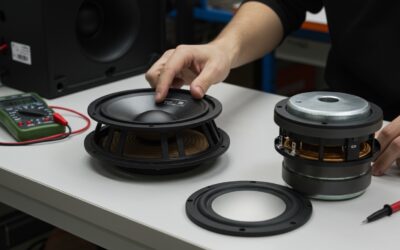
If you’ve decided that your Jamo CL20 speakers are worth repairing, follow these steps to restore them to their former glory. We will focus on the most likely repair: Re-foaming the woofers.
Tools You Will Need:
- A dedicated Jamo CL20 re-foam kit (includes two foam surrounds and specialized glue).
- Rubbing alcohol (90% Isopropyl).
- Cotton swabs and a plastic scraper (or an old credit card).
- A utility knife or X-Acto blade.
Step 1: Remove the Woofers
Use a screwdriver to remove the mounting screws from the front of the Jamo CL20. Carefully pull the driver forward. You will see two wires (usually red and black). Disconnect them, noting which wire goes to which terminal.
Step 2: Clean the Old Residue
This is the most critical step. Use your knife to scrape the old, sticky foam off the metal frame and the edge of the speaker cone. Apply Isopropyl alcohol to soften the stubborn glue.
Expert Tip: Be extremely gentle with the paper cone. If you rip the cone, the repair becomes much more difficult. I always use a Q-tip soaked in alcohol to “melt” the glue before scraping.
Step 3: Centering the New Surround
Apply a thin bead of glue to the inner edge of the new foam surround. Attach it to the speaker cone. Once dry (about 30 minutes), apply glue to the outer edge of the foam and the metal frame.
The “Shim-less” Method: Gently push the cone up and down as the glue sets. If you hear a “rubbing” sound, the voice coil isn’t centered. Adjust the foam position until the cone moves freely and silently.
Step 4: Re-assembly and Testing
Reconnect the wires and screw the drivers back into the Jamo CL20 cabinets. I recommend waiting 24 hours for the glue to fully cure before playing music at high volumes.
The Financial Breakdown: Repair vs. Replace
When determining if are jamo cl20 speakers worth repairing, we must look at the “Opportunity Cost.”
Scenario A: Professional Repair
If you take these to a professional shop, they will charge roughly $60-$80 per speaker for labor and parts. At $120-$160 total, you are paying more than the speakers are worth on the open market. Verdict: Only do this for sentimental reasons.
Scenario B: DIY Repair
If you spend $30 on a kit and two hours of your time, you have a pair of high-performing Danish speakers for the price of a cheap Bluetooth speaker. Verdict: High ROI (Return on Investment).
Comparison Table: Jamo CL20 vs. Modern Competitors
| Feature | Jamo CL20 (Restored) | New $100 Speakers | New $300 Speakers |
|---|---|---|---|
| Cabinet Build | Solid MDF / Heavy | Thin Plastic / Light | Solid MDF / Braced |
| Sound Profile | Neutral / Danish | “V-Shaped” (Boomy) | High Detail / Flat |
| Crossover Quality | Decent Components | Minimalist (Cheap) | High-Grade Film Caps |
| Longevity | 20+ Years (Post-Fix) | 5-10 Years | 20+ Years |
Advanced Performance Upgrades for Jamo CL20
If you are already inside the cabinet, there are two “Pro-Level” tweaks I recommend to make these speakers sound better than they did the day they left the factory.
The Crossover Recap
Inside the Jamo CL20, you will find a small circuit board. The original electrolytic capacitors tend to dry out over 20 years, causing the tweeter to lose its “shimmer.”
Expert Perspective: I often replace the original caps with polypropylene film capacitors (like Dayton Audio or Solen brands). This simple swap can significantly improve the “imaging”—the ability to hear exactly where the instruments are placed in the room.
Internal Damping
Jamo used a moderate amount of poly-fill inside the CL20. By adding a bit more high-quality acoustic foam or “No-Res” material to the internal walls, you can reduce “cabinet honk.” This makes the bass sound tighter and more controlled.
Frequently Asked Questions (FAQ)
Where can I find replacement parts for Jamo CL20?
Since Jamo is now owned by Klipsch (Voxx International), official legacy parts are rare. Your best bet for foam kits is Simply Speakers or Midwest Speaker Repair. For replacement tweeters, look for Vifa or Peerless equivalents, as Jamo often sourced their drivers from these Danish manufacturers.
Can I use these for a Home Theater setup?
Absolutely. The Jamo CL20 makes for excellent “Surround” speakers or “Front L/R” speakers in a small to medium-sized room. Because they are 6-ohm speakers, ensure your AV Receiver is rated for 6-ohm or 4-ohm loads (most modern Denon, Yamaha, or Marantz units are).
What is the resale value of repaired Jamo CL20s?
On platforms like eBay or Reverb, a fully restored pair of Jamo CL20s typically sells for $100 to $150. If they are in pristine cosmetic condition with the original grilles, you might see them go slightly higher to a collector of vintage Danish audio.
Is the Jamo CL20 better than the Jamo Cornet series?
The Classic (CL) series was generally positioned slightly above the budget Cornet series in terms of cabinet finishing and crossover complexity. If you are choosing between repairing a CL20 or a Cornet 40, the CL20 is usually the better investment.
What amplifier works best with Jamo CL20?
I have found that these speakers pair beautifully with warm-sounding amplifiers. A vintage Marantz or a modern NAD C316BEE provides enough current to drive the 6-ohm load while complementing the smooth Danish tweeter.
Final Thoughts: The “Zero-Click” Verdict
If you are an audio enthusiast on a budget, are jamo cl20 speakers worth repairing? Yes. For a $30 investment and a Saturday afternoon, you can rescue a piece of Danish audio history.
These speakers offer a level of midrange clarity that modern “smart speakers” and budget soundbars simply cannot touch. By performing a DIY re-foam and potentially upgrading the capacitors, you ensure that these classic units continue to provide high-fidelity sound for another two decades.
Don’t toss them in the landfill—fix them, and let the music play.