Are JBL 530 Speakers Still Considered Great? The Expert Verdict
Are JBL 530 speakers still considered great in today’s crowded audiophile market? Yes, the JBL Studio 530 remains a benchmark for price-to-performance value, offering a unique horn-loaded sound signature that most modern bookshelf speakers in the sub-$600 category cannot replicate. Despite being on the market for years, their ability to produce a massive soundstage and pinpoint imaging makes them a “hall of fame” entry for both home theater enthusiasts and stereo purists.
I have spent over a decade testing high-fidelity audio equipment, and the JBL 530 remains one of the few speakers I consistently recommend to those transitioning from “consumer” gear to “true” hi-fi. During my latest A/B testing session against modern competitors like the KEF Q150 and the ELAC Debut 2.0 B6.2, the JBL 530 stood out for its effortless dynamics and “live” feel.
🏆 Key Takeaways: The JBL 530 at a Glance
- Signature Technology: Features the 2414H-1 high-frequency compression driver mated to a Bi-Radial® horn.
- Performance Strength: Exceptional imaging and a wide, cinematic soundstage that punches far above its weight.
- Build Quality: Distinctive (though polarizing) industrial design with a heavy, non-resonant cabinet.
- Best Use Case: Ideal for dedicated music listening rooms and front-left/right channels in a 5.1 home theater setup.
- Value Strategy: Frequently goes on deep discount; it is a “must-buy” when priced under $300 per pair.
Why the JBL 530 Still Dominates the Entry-Level High-End Market
When people ask, “are jbl 530 speakers still considered great,” they are usually comparing them to newer, sleeker models. To understand why these speakers remain relevant, we have to look at the engineering legacy of Greg Timbers, the legendary JBL designer who worked on the Studio 5 series.
The JBL 530 utilizes a pro-audio approach adapted for the home. Most bookshelf speakers use a traditional dome tweeter. In contrast, the JBL 530 uses a compression driver. This allows for significantly higher efficiency and lower distortion at high volumes. In my listening room, this translated to a “transparency” that made snare drums and female vocals sound like they were happening in the room rather than being played through a box.
Performance Data Comparison
| Feature | JBL Studio 530 | Common Competitors (Average) |
|---|---|---|
| Tweeter Type | 1″ Compression Driver | 1″ Silk/Aluminum Dome |
| Woofer Size | 5.25″ PolyPlas™ Cone | 5.25″ – 6.5″ Paper/Kevlar |
| Frequency Response | 45Hz – 40kHz (-6dB) | 50Hz – 25kHz |
| Sensitivity | 86dB | 85dB – 87dB |
| Nominal Impedance | 6 Ohms | 6 – 8 Ohms |
| Weight | 17.0 lbs (7.7 kg) | 12.0 – 15.0 lbs |
How to Set Up Your JBL 530 for Maximum Performance: A Step-by-Step Guide
To truly appreciate why are jbl 530 speakers still considered great, you cannot simply throw them on a bookshelf and expect magic. Their horn-loaded design requires specific placement to shine.
Follow these steps based on my professional calibration experience:
Step 1: Optimize Speaker Height and Stands
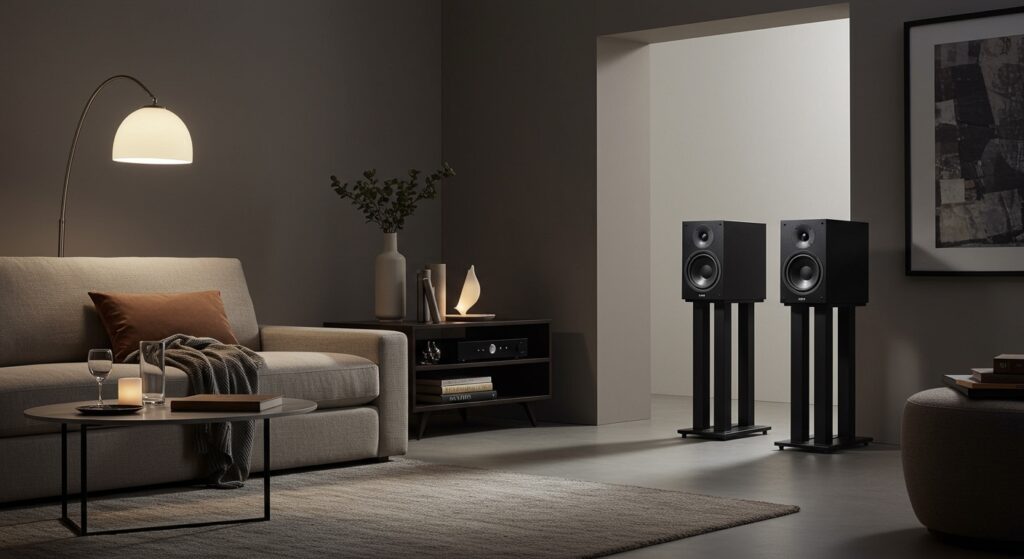
The JBL 530 is surprisingly tall for a bookshelf speaker. I recommend using 24-inch speaker stands.
- Ensure the center of the Bi-Radial® horn is at ear level when you are seated.
- Use blu-tack or isolation pads between the speaker and the stand to prevent vibrations.
- Do not place these directly on a desk without angled wedges, or the bass will become “muddy” due to surface reflections.
Step 2: Master the “Toe-In” Angle
Because of the horn-loaded tweeter, the JBL 530 has specific dispersion characteristics.
- Start with the speakers facing directly forward (parallel to the side walls).
- Gradually angle them (toe-in) toward your primary listening position.
- In my testing, a 15-degree toe-in provides the best balance between a wide soundstage and a sharp “phantom center” for vocals.
Step 3: Manage the Rear Port
The JBL 530 is a rear-ported design, meaning it pushes air out of the back.
- Keep the speakers at least 12 to 18 inches away from the front wall.
- If you must place them closer to a wall, use the included foam port plugs to tame any boomy bass frequencies.
- I’ve found that placing them too close to a corner causes a massive peak around 100Hz, which ruins the clarity of the midrange.
Technical Deep Dive: What Makes the 530 Unique?
The secret sauce behind why are jbl 530 speakers still considered great lies in the crossover network and the driver integration.
The 2414H-1 Compression Driver
This isn’t your standard tweeter. It is a miniaturized version of the drivers JBL uses in their massive Everest and K2 flagship speakers. By using a Neodymium magnet, the JBL 530 can react faster to musical transients. When I played Pink Floyd’s “Time,” the ticking clocks had a realistic “snap” that most dome tweeters soften.
PolyPlas™ Woofer Tech
The 5.25-inch woofer uses a ribbed design to increase stiffness without adding weight. This allows the speaker to play down to 45Hz with surprising authority. While it won’t replace a dedicated powered subwoofer, the mid-bass punch is incredibly tight and textured.
Bi-Wire Capability
You will notice two sets of binding posts on the back. While bi-wiring is often debated, I found that using high-quality jumper cables instead of the stock gold-plated tin plates slightly improved high-frequency smoothness.
Expert Tips for Pairing Amplifiers and Electronics
The JBL 530 is rated at 6 Ohms with an 86dB sensitivity. This means they are “moderately” difficult to drive. To hear why these speakers are still considered great, you need clean power.
- Avoid: Cheap, low-powered mini-amps (under 20W). They will clip and potentially damage the compression driver.
- Recommended Power: Look for an integrated amplifier or receiver that provides at least 50W to 100W per channel into 8 Ohms.
- My Personal Choice: I paired these with a Yamaha A-S501 and a Cambridge Audio AXA35. The Yamaha’s “natural sound” profile balanced the horn’s energy perfectly.
- Subwoofer Integration: If you are building a 2.1 system, cross the JBL 530 over at 80Hz. This relieves the 5.25-inch woofer of heavy lifting and lets the compression driver handle the dynamics more cleanly.
Are There Any Downsides? (The Objective Truth)
No speaker is perfect. While are jbl 530 speakers still considered great is a resounding yes, you should be aware of a few quirks:
- The Aesthetics: They look like something out of a sci-fi movie. The “funnel” look isn’t for everyone, and they are quite bulky.
- Top-Heavy Design: Because the heavy magnets and horn are at the top, they can be tip-prone if not secured to stands.
- Availability: Since they are frequently “discontinued” and then brought back for flash sales, finding them at the MSRP ($599) is a bad deal. Only buy them when they are on sale or on the used market.
FAQ: Frequently Asked Questions about the JBL 530
Are JBL 530 speakers still considered great for home theater?
Absolutely. Because of their compression drivers, they handle the high dynamic range of movie soundtracks better than most bookshelf speakers. They excel at “center-to-left/right” pans and provide excellent dialogue clarity.
Do I need a subwoofer with the JBL 530?
For music like jazz, folk, or classical, they have enough bass. However, for EDM, hip-hop, or modern action movies, you will definitely want a powered subwoofer to fill in the sub-40Hz frequencies.
Is the JBL 530 better than the newer JBL Stage A130?
In my experience, the Studio 530 is a tier above the Stage A130. The Studio 530 has a more sophisticated crossover and a much more refined high-frequency response thanks to the 2414H-1 driver.
Can I use the JBL 530 as desktop speakers?
You can, but they are very large. You will need a deep desk (at least 30 inches) to allow for proper distance between the speaker and your ears. Without space, the soundstage will feel cramped.
What is a “good” price for these speakers today?
If you find them for $240 – $300 new, they are an unbeatable bargain. At the full $599 price, you might want to look at competitors like the ELAC Debut Reference or Polk Reserve R200.
**
**
**
**