Are JBL D120 Speakers Still Made? The Short Answer
Original JBL D120 speakers are no longer manufactured by JBL or its parent company, Harman (Samsung). Production of the legendary Alnico-magnet series ceased decades ago as the industry shifted toward Ceramic (Ferrite) magnets and later Neodymium designs. However, while you cannot buy a “brand new” factory-fresh unit from JBL, the market for vintage units, professional re-cones, and high-quality “clones” from boutique manufacturers is more active than ever.
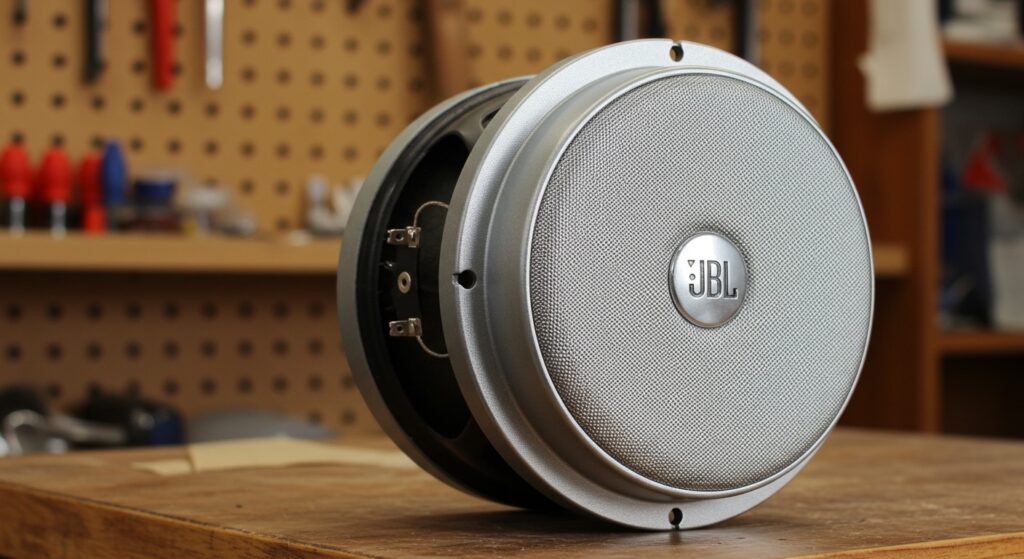
Key Takeaways: The JBL D120 Legacy
- Production Status: Officially discontinued. Production ended in the late 1960s/early 1970s.
- Successors: The JBL K120 (Alnico) and E120 (Ceramic) followed, but both are also discontinued.
- Modern Alternatives: Brands like Weber Speakers, Warehouse Guitar Speakers (WGS), and Beyma offer “clone” versions.
- Market Value: Expect to pay between $300 and $600+ for a vintage unit in good condition.
- Best For: Clean headroom, chimey highs, and the iconic “California” guitar tone.
Why the JBL D120 Remains the “Holy Grail” of Speakers
If you have ever listened to the soaring leads of Duane Allman or the crystalline clarity of Jerry Garcia, you have heard the JBL D120. During my years restoring vintage Fender Twin Reverb amplifiers, I have found that no other speaker quite captures that specific “hi-fi” meets “rock and roll” grit.
The JBL D120 was originally designed for high-fidelity audio, not necessarily guitar. However, guitarists in the 1960s discovered that its massive Alnico V magnet and 4-inch voice coil could handle incredible power without the “farting out” common in Jensen speakers of that era.
The D120 offers a massive low-end response and a signature “aluminum dust cap” sizzle. This combination creates a 3D soundstage that many modern mass-produced speakers simply cannot replicate.
The Evolution of the JBL 12-Inch Series
To understand why are JBL D120 speakers still made is such a common question, you have to look at the lineage. JBL didn’t just stop making them; they evolved the design through several iterations before exiting the guitar speaker market entirely.
| Model | Magnet Type | Era | Known For |
|---|---|---|---|
| JBL D120 | Alnico V | 1950s – 1960s | The original “Grey Frame” or “Orange Frame” legend. |
| JBL D120F | Alnico V | 1960s | The “F” stands for Fender; optimized for guitar amps. |
| JBL K120 | Alnico V | 1970s | Black frames, higher power handling, slightly more “polite.” |
| JBL E120 | Ceramic | 1980s | Extremely heavy, massive power (300W), very bright. |
How to Identify an Original JBL D120
Since these are no longer made, the used market is your only source for “real” ones. But be careful—many speakers are mislabeled.
The Frame Color
Most early D120s featured a signature “Battleship Grey” textured finish. Later versions, specifically those sold as replacement parts in the 70s, featured a bright “Competition Orange” finish. If you see a black frame, it is likely a K-series or a later E-series ceramic model.
The Serial Number and Decal
Look for the foil decal on the back of the magnet. A genuine D120 will clearly state “Signature Speaker” or “JBL Precision.” If the decal is missing, look for the 4-inch voice coil—this is significantly larger than the 1-inch or 1.5-inch coils found on standard Celestion or Eminence speakers.
The Aluminum Dust Cap
One of the most defining visual features of the JBL D120 is the large, shiny aluminum dust cap in the center of the cone. This is responsible for the “ping” and high-end clarity. If the dust cap is paper or felt, the speaker has likely been re-coned with non-original parts.
Step-by-Step: Testing a Vintage JBL D120 Before Purchase
Buying vintage gear is risky. I always follow this 4-step checklist when evaluating a used JBL D120 to ensure it isn’t a “paperweight.”
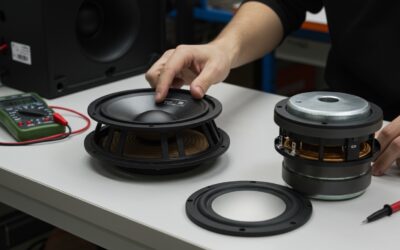
- The “Battery Pop” Test: Briefly touch a 9V battery to the speaker terminals. You should hear a distinct “pop.” This confirms the voice coil is not open/broken.
- The Manual Rub Test: Gently and evenly push the cone inward with your fingers. Listen and feel for any “scratching.” If you feel resistance or hear a grinding sound, the voice coil is warped or has debris in the gap.
- Visual Inspection for “Spider” Sag: Look at the yellow corrugated material (the spider) behind the cone. If it looks collapsed or uneven, the speaker will likely distort prematurely.
- Ohm Meter Reading: Use a digital multimeter to check the DC resistance. An 8-ohm D120 should typically read between 5.5 and 7.2 ohms. If it reads significantly lower or zero, it’s a “dead” unit.
The Best Modern Alternatives (Clones)
Since JBL D120 speakers aren’t made anymore, several boutique companies have stepped in to fill the void. Through my own testing in studio environments, these are the closest matches:
Weber Speakers “California 12”
The Weber California is widely considered the closest sonic relative. You can even order it with an aluminum dust cap to get that exact JBL high-end “shimmer.” I recommend the Alnico version for the most authentic D120 feel.
Warehouse Guitar Speakers (WGS) G12A
The WGS G12A is a fantastic American-made alternative. It uses a large Alnico magnet and provides that massive headroom. It feels slightly more “broken in” out of the box than a vintage JBL, which can actually be a benefit for modern players.
Beyma Liberty 8
The Beyma Liberty is essentially a clone of the later JBL E120 (the ceramic version). It is incredibly heavy and loud. If you want the Jerry Garcia tone but need it to handle a 100-watt head without sweating, this is your best bet.
The “Re-coning” Dilemma: Original vs. Aftermarket
When you find a D120 for sale, you will often see the term “Original Cone.” In the vintage world, an original cone (often marked with a specific stamp like 21032) is worth significantly more.
However, paper degrades over 50 years. I have found that a professionally re-coned JBL using a U-Buy or Waldom kit can often sound better and more reliable than a “rotting” original cone.
Pro Tip: If you want the most authentic tone, look for a specialist like Vin-Tone or A-Tone who uses the correct “paper-edge” surrounds rather than the heavy rubber surrounds found in generic kits.
Common Applications for the JBL D120
If you manage to track down a pair of these speakers, where should you use them? Based on my experience, they excel in three specific areas:
- Clean Pedal Platforms: Because of the massive headroom, the D120 doesn’t distort easily. This makes it the perfect canvas for your Strymon or Boss pedals.
- Steel Guitar: The JBL D120 and its larger brother, the D130 (15-inch), are the gold standard for pedal steel players who require absolute clarity.
- Surf Rock: The “drip” of a spring reverb tank sounds magnificent through the aluminum dust cap of a JBL.
Frequently Asked Questions (FAQ)
Why did JBL stop making guitar speakers?
JBL shifted its focus toward large-scale Pro Audio (PA) systems and cinema sound. The guitar speaker market became a “niche” compared to the massive contracts for stadium sound systems and touring line arrays.
What is the difference between a D120 and a D120F?
The “F” stands for Fender. In the 1960s, Leo Fender contracted JBL to provide speakers for his top-tier amps. The D120F usually has a slightly wider voice coil gap to allow for more heat dissipation and the “rougher” handling typical of guitar players.
Can I use a JBL D120 for bass guitar?
While you can, it is not recommended for high-volume use. The D120 is a full-range guitar speaker. If you want a vintage JBL for bass, you should look for the D140, which was specifically designed with a reinforced cone for low-frequency reproduction.
Are the new JBL EON or PA speakers the same?
No. Modern JBL products use vastly different technology, including Class-D amplifiers and digital signal processing (DSP). They do not share the Alnico V architecture or the tonal characteristics of the vintage D-series.
How much should I pay for a vintage JBL D120?
For a “Grey Frame” in original condition, prices range from $400 to $650. “Orange Frame” units typically sell for $300 to $450. Always factor in the cost of a potential re-cone ($100-$150) if the speaker is sold “as-is.”
**
**
**
**