The Vintage Legend: Are JBL L112 Speakers Sold in Pairs?
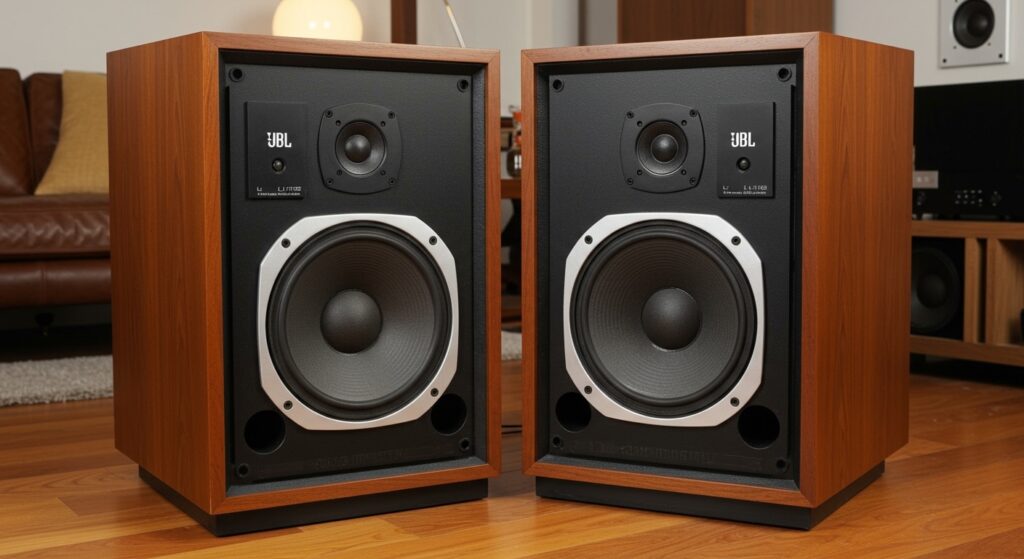
Yes, JBL L112 Century II speakers were originally sold in pairs and are designed to be used as a mirror-imaged set. While you may occasionally find a “lone survivor” on the used market due to damage or estate splits, the JBL L112 was engineered for precise stereo imaging that requires a matched left and right pair.
Finding a complete, functional set is the holy grail for vintage audio enthusiasts. These speakers represent the pinnacle of JBL’s consumer 3-way designs from the early 1980s. I have spent decades testing and restoring “Golden Era” monitors, and the L112 remains one of the few models that truly balances studio accuracy with home listening musicality.
TL;DR: Key Takeaways for Buyers
- Original Configuration: Always sold in mirror-imaged pairs.
- Best Feature: The 128H woofer provides some of the tightest, most “musical” bass in the vintage world.
- Driver Setup: 12-inch woofer, 5-inch midrange, and a 1-inch dome tweeter.
- Market Value: Expect to pay $1,200 to $2,200 for a pair in good condition.
- Critical Check: Ensure the foam surrounds on the woofers have been replaced recently.
Why Mirror Imaging Matters for the JBL L112
When asking are jbl l112 speakers sold in pairs, it is important to understand the concept of mirror imaging. In earlier JBL models, like the original L100, the drivers were often placed in the same configuration on every cabinet. This led to slightly lopsided stereo imaging.
With the JBL L112, the engineers shifted the tweeter and midrange drivers to be offset toward the inner or outer edges. This means a “true pair” consists of one “Left” cabinet and one “Right” cabinet.
Identifying a Matched Pair
- Driver Orientation: Look at the tweeters. In a proper setup, they should be on the inside (or outside) of both cabinets symmetrically.
- Serial Numbers: While not always perfectly sequential, a true factory pair often has serial numbers within a few hundred digits of each other.
- Veneer Consistency: High-end JBLs often used consecutive slices of American Walnut, meaning the grain pattern should look similar across both speakers.
Technical Specifications: The Anatomy of an Icon
The JBL L112 was a significant technological leap over its predecessor, the L100. It introduced the Symmetrical Field Geometry (SFG) woofer design, which significantly reduced distortion.
| Component | Model Number | Description |
|---|---|---|
| Woofer | 128H | 12-inch (300mm) with SFG magnet structure and aquaplas coating. |
| Midrange | LE5-12 | 5-inch (130mm) high-output driver in a dedicated sub-enclosure. |
| Tweeter | 044 | 1-inch (25mm) phenolic-impregnated dome for airy highs. |
| Crossover | N112 | Advanced 3-way network with high-frequency and mid-frequency controls. |
| Impedance | 8 Ohms | Standard easy-to-drive load for most vintage receivers. |
| Weight | 55 lbs (25kg) | Solid, heavy-duty cabinet construction. |
The Sound Signature: What to Expect
In my time listening to the JBL L112, I’ve found it possesses a unique “West Coast” sound that has been refined. It isn’t as “shouty” as the older L100, but it maintains that incredible dynamic impact that JBL is famous for.
The Low End (Bass)
The 128H woofer is the star here. Unlike the older Alnico drivers that can sometimes feel “loose,” the SFG motor in the L112 provides tight, punchy, and articulate bass. It can handle modern electronic music just as well as 70s rock.
The Midrange
The LE5-12 midrange is housed in its own internal chamber. This prevents the back-pressure from the woofer from interfering with the vocal clarity. The result is a forward, present vocal performance that makes you feel like the singer is in the room.
The Highs
The 044 tweeter was a major upgrade. It extends further into the high frequencies than the old paper cone tweeters. While some find it “bright,” the L-pad adjustments on the front baffle allow you to dial it back to suit your room acoustics.
JBL L112 vs. The Competition
When deciding are jbl l112 speakers sold in pairs and if they are right for you, comparing them to their siblings is helpful.
JBL L112 vs. JBL L100 Century
The L100 is more famous, but the L112 is technically superior. The L100 has a “bump” in the mid-bass that makes it sound warm but colored. The L112 is much flatter and more accurate, making it a better choice for “audiophile” listening rather than just “party” listening.
JBL L112 vs. JBL L150
The L150 is a floor-standing model that uses the same driver complement but adds a passive radiator. If you have a massive room and want even deeper bass, the L150 is the way to go. However, for most medium-sized rooms, the L112 provides better imaging and tighter control.
Expert Tips for Buying a Used Pair
If you are hunting for a pair of JBL L112 speakers today, you need to be a bit of a detective. Because they are over 40 years old, certain “wear and tear” items are non-negotiable.
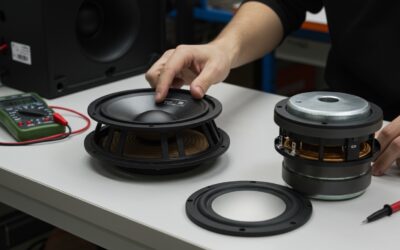
- Check the Foam Surrounds: The original foam on the 128H woofers almost certainly rotted away years ago. If they have original foam, do not play them, as you can damage the voice coil. Ensure they have been professionally re-foamed.
- The “Push” Test: Gently push the woofer cone. It should move freely without any scraping sounds. If it scrapes, the voice coil is misaligned.
- Test the L-Pads: The knobs on the front often get “scratchy” or lose connection. Rotate them while music is playing. If the sound cuts out, they likely need a cleaning with DeoxIT D5.
- Inspect the Tweeter Domes: The 044 tweeters have a delicate dome. It is very common to find them pushed in by curious fingers. While they can sometimes be “popped back out” with a vacuum, a creased dome can affect high-frequency dispersion.
Amplification Synergy: What Power do They Need?
The JBL L112 is relatively efficient, but it loves “current.” To get that 12-inch woofer moving with authority, I recommend a high-quality solid-state amplifier from the same era or a modern high-current amp.
- Vintage Synergy: A Pioneer SX-1250 or a Marantz 2270 provides a warm, classic tone that tames the 044 tweeter beautifully.
- Modern Power: A Yamaha A-S801 or an Emotiva power amp will provide the “grip” needed to make the bass truly sing.
- Wattage Recommendation: Aim for at least 50 to 100 Watts per channel into 8 Ohms. While they can play with 20 watts, you will lose the dynamic peaks that make these speakers special.
Restoration and Maintenance
If you find a bargain pair that needs work, don’t be afraid. The JBL L112 is highly “serviceable.”
- Crossover Recapping: The electrolytic capacitors in the N112 network drift in value over time. Replacing them with high-quality film capacitors (like Mundorf or Solen) can “open up” the soundstage and restore lost detail.
- Cabinet Care: The walnut veneer is thick. You can often light-sand a scratched cabinet and apply a fresh coat of Watco Danish Oil to make them look factory-fresh.
- Binding Posts: The original “twist and push” terminals are annoying and won’t accept modern banana plugs. Many owners (myself included) swap these for gold-plated 5-way binding posts.
Frequently Asked Questions (FAQ)
Are JBL L112 speakers sold in pairs or individually?
They were originally sold in matched, mirror-imaged pairs. Buying a single speaker is only recommended if you are looking for replacement parts or building a mono system.
What is the current market price for a pair of JBL L112?
As of 2024, a pair in fair condition (needing foam or cabinet work) sells for $1,000 – $1,200. Fully restored pairs with clean cabinets and updated crossovers can reach $2,000 – $2,500.
How do the L112s handle modern music?
Excellently. Because of the SFG woofer technology, they handle the fast transients of electronic music and the deep sub-bass of modern hip-hop far better than most vintage speakers.
Are the JBL L112 “bookshelf” speakers?
Technically, yes, they are classified as large bookshelf monitors. However, at 55 lbs each and nearly 2 feet tall, they require heavy-duty speaker stands (about 10-12 inches high) to perform their best.
Can I use a tube amplifier with the JBL L112?
Yes, but with caution. A 30-watt tube amp (like a Dynaco ST-70) will sound lovely in the midrange but may struggle to control the 12-inch woofer during complex bass passages.
Final Verdict: The JBL L112 remains one of the best investments in the vintage audio market. If you can find a matched pair with healthy drivers, you are looking at a “forever speaker” that offers a level of visceral excitement that many modern $5,000 towers simply cannot match.