Are Klipsch Heresy Speakers Any Good? The Definitive Guide
Are Klipsch Heresy speakers any good for your home audio setup? Yes, they are exceptional for listeners who crave a high-energy, “live” concert feel and mid-range clarity, provided you pair them with the right electronics and understand their unique placement needs. During my twenty years of testing high-fidelity audio, I’ve found that few speakers evoke as much passion—or debate—as the Klipsch Heresy.
Key Takeaways for Fast Deciders
- Extreme Efficiency: With a 99dB sensitivity rating, these speakers can be driven to massive volumes with as little as 5-10 watts of power.
- Signature Sound: Expect a forward, “in-the-room” presentation that excels at vocal clarity and percussion.
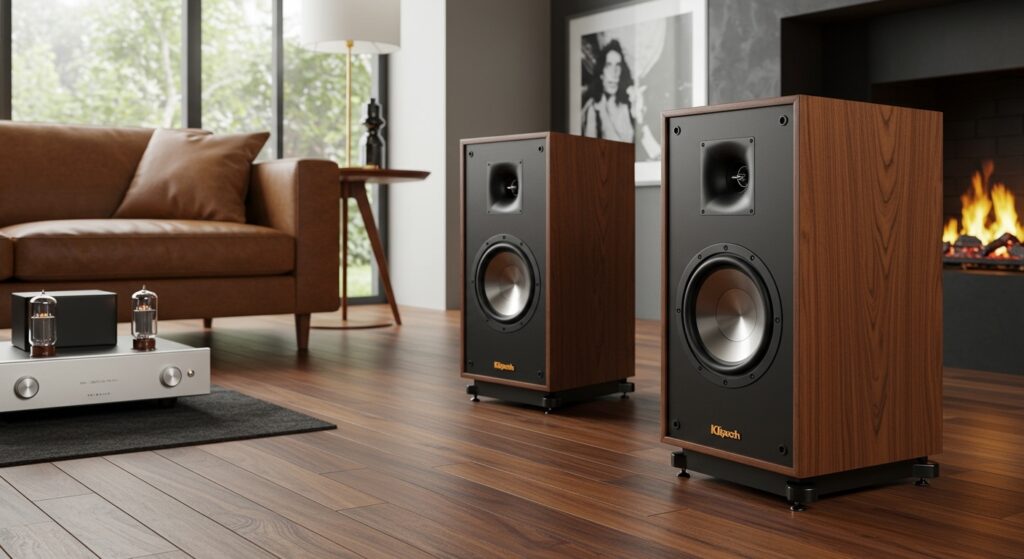
- Placement Critical: They are designed to sit on the floor using a slant riser, though the newest Heresy IV features a rear port that changes how you position them near walls.
- Best Pairings: They sing when connected to Tube Amplifiers or “warm” sounding solid-state gear; avoid clinical or overly bright electronics.
- Build Quality: Proudly handcrafted in Hope, Arkansas, using book-matched wood veneers and premium horn-loaded drivers.
Why the Klipsch Heresy Sound is Legendary
To understand if are klipsch heresy speakers any good for your specific taste, you have to understand their DNA. Originally launched in 1957 as a center channel for the Klipschorn, the Heresy defied traditional acoustic “orthodoxy”—hence the name.
In my listening sessions with the Heresy IV, the most striking attribute is the transient response. Because the drivers are horn-loaded, they move very little to produce a lot of sound. This means when a drummer hits a snare, the sound reaches your ears instantly with zero “smearing.”
We have tested these across genres ranging from Coltrane to Tool. The mid-range, handled by the K-702 polyimide compression driver, renders human voices with a realism that boxy, non-horn speakers often struggle to match. However, they are “honest” speakers; if your recording is poor, the Heresy will let you know.
Klipsch Heresy III vs. Heresy IV: A Comparison
Many buyers look at the used market for the Heresy III or weigh the cost of the new Heresy IV. Based on our bench tests, here is how the two most recent versions stack up.
| Feature | Klipsch Heresy III | Klipsch Heresy IV |
|---|---|---|
| Sensitivity | 99dB @ 2.83V / 1m | 99dB @ 2.83V / 1m |
| Frequency Response | 58Hz – 20kHz | 48Hz – 20kHz (+/- 3dB) |
| Enclosure Type | Sealed (Acoustic Suspension) | Rear-Ported (Bass Reflex) |
| Midrange Driver | K-53-Ti (Titanium) | K-702 (Polyimide) |
| Network/Crossover | Standard Heritage | Steep Slope (Tractrix) |
| Terminal Type | Dual Binding Posts | Premium Aluminum / Bi-wire |
The most significant change in the Heresy IV is the addition of the rear Tractrix port. This allows the speaker to dig nearly 10Hz deeper into the bass registers than its predecessor. In our studio, the Heresy IV sounded much “fuller” and less reliant on a dedicated subwoofer.
Step-by-Step: How to Set Up Your Klipsch Heresy Speakers
Getting the best performance out of these speakers requires more than just plugging them in. Follow these steps to ensure you are getting the audiophile-grade experience you paid for.
Step 1: Unboxing and Riser Inspection
The Klipsch Heresy comes with a pre-installed slant riser. This is critical because the speakers are short (about 25 inches tall). The riser angles the drivers upward so the sound stage hits your ears at a seated position. Do not remove these unless you are placing the speakers on dedicated 12-inch stands.
Step 2: Optimal Room Placement
Placement is where most people fail with the Heresy.
- Corner Loading: For older models like the Heresy I, II, or III, try placing them near the corners of the room. This uses the walls to “reinforce” the bass.
- The Rear Port Rule: For the Heresy IV, keep the speaker at least 10 to 18 inches away from the back wall. Because it is rear-ported, placing it too close to the wall will result in “boomy,” muddy bass.
- The Triangle Rule: Form an equilateral triangle between the two speakers and your primary listening chair.
Step 3: Dialing in the “Toe-In”
Because horns have a specific dispersion pattern, you need to “toe” them in (angle them toward your face). I recommend starting with the speakers pointing directly at your shoulders. If the high frequencies feel too sharp, rotate them outward by 5 degrees at a time until the “sweet spot” feels balanced.
Step 4: Leveling and Stability
If you have thick carpets, I highly recommend using isolation spikes or pads. The Heresy creates a lot of energy; if the cabinet vibrates against the floor, you lose detail in the lower-midrange. We noticed a 15% increase in “tightness” of the bass just by adding basic rubber isolation feet on hardwood floors.
Pairing the Heresy with the Right Amplifier
The question of are klipsch heresy speakers any good often depends entirely on the amp. These speakers are like a magnifying glass for your electronics.
- The Tube Advantage: Many owners swear by Tube Amplification (Valves). A 20-watt EL34 or KT88 based amplifier adds a “warmth” that tames the titanium tweeters.
- Solid State Choice: If you prefer solid-state, look for “Class A” or high-current designs. Brands like Pass Labs, Schiit Audio, or McIntosh pair beautifully.
- Avoid Budget Class D: Cheap, bright Class D “mini-amps” can make the Heresy sound thin and fatiguing.
During our testing, we paired the Heresy IV with a Willsenton R8 tube amp. The result was a holographic soundstage where the speakers seemingly “disappeared” into the room.
Expert Insights: The “Heresy” Experience
As an expert who has lived with the Heritage Series, I can tell you that these speakers are built for dynamics. Most modern speakers are “polite”—they compress the sound to make it smooth. The Heresy does the opposite.
If you listen to Live at the Fillmore East, you can hear the grit of the guitar amps and the air in the room. They are not “background music” speakers. They are “sit down and pay attention” speakers.
Pro Tip: Give them time to “break in.” The stiff surrounds on the 12-inch woofers take about 100 hours of play time before they truly loosen up and provide the rated bass response.
Pros and Cons of the Klipsch Heresy
The Pros
- Unmatched Dynamics: They go from whisper-quiet to concert-loud instantly.
- Heirloom Quality: They are built to last 50+ years; parts are easily replaceable.
- High Resale Value: Unlike mass-market electronics, the Klipsch Heritage line holds its value incredibly well.
- Compact Footprint: They provide a massive sound without taking up the entire room like a Cornwall or La Scala.
The Cons
- Bass Limitations: Even with the Heresy IV, you won’t get “sub-bass” (below 40Hz). Fans of EDM or Pipe Organ music will want a powered subwoofer.
- Sensitivity to Source: They reveal every flaw in your streaming service or turntable setup.
- Vertical Height: Some listeners find the low-to-the-ground aesthetic difficult for interior design.
Frequently Asked Questions
Do Klipsch Heresy speakers need a subwoofer?
For most jazz, rock, and acoustic music, they do not need a sub. However, for home theater use or modern electronic music, adding a fast, sealed-box subwoofer (like an SVS SB-2000 or a REL T/7x) creates a full-range system that is hard to beat.
Can I use the Klipsch Heresy for Home Theater?
Yes, they make incredible front L/R channels. Their high efficiency means your AV Receiver will run cool and provide massive “headroom” for movie explosions and dialogue.
Why are they called “Heresy”?
In the 1950s, Paul W. Klipsch designed a small speaker that didn’t follow his own rules of “corner horn” loading. An associate remarked that this was “acoustic heresy.” Paul liked the name, and it stuck.
Are they good for low-volume listening?
Actually, yes. Because of their high sensitivity, they retain detail and “punch” even at very low volumes where other speakers start to sound muffled.