Are Kustom PA Speakers Any Good for Your Sound Setup?
Kustom PA speakers are an excellent choice for budget-conscious musicians, small venues, and rehearsal spaces that prioritize value and durability over high-end studio fidelity. While they may not compete with premium brands like QSC or Meyer Sound in terms of absolute frequency response, they offer a reliable “workhorse” performance that is perfect for vocal reinforcement and acoustic sets.
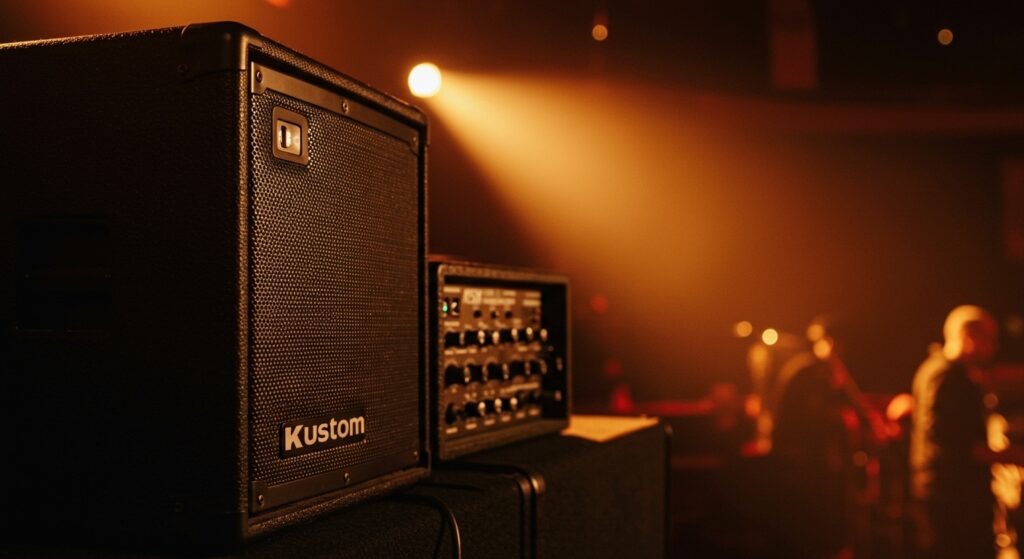
I have spent over a decade lugging gear into dive bars and community halls, and I have found that Kustom PA speakers often punch above their weight class. They are particularly effective for performers who need a portable, rugged solution without the four-figure price tag. Whether you are a solo singer-songwriter or a garage band needing a basic vocal monitor, Kustom provides a functional entry point into live sound.
TL;DR: Key Takeaways for Kustom PA Speakers
- Best For: Small venues (50-100 people), rehearsal rooms, monitoring, and mobile DJs on a strict budget.
- Build Quality: Exceptionally rugged cabinets; many models feature heavy-duty tolex or carpet covering with protective corners.
- Audio Profile: Mid-range focused, which is ideal for vocal clarity but may lack the deep sub-bass required for modern EDM.
- Reliability: High. Known for “taking a beating” during transport without internal component failure.
- Top Recommendation: The Kustom PA50 is a legendary “Personal PA” for its portability and built-in mixer.
Understanding the Value: Are Kustom PA Speakers Any Good?
When asking “are kustom pa speakers any good,” you must evaluate them based on Price-to-Performance ratio. For under $200, you are getting a piece of equipment that can handle the rigors of the road. In my experience, the internal crossovers in Kustom cabinets are surprisingly robust, preventing the “blown tweeter” syndrome common in other budget brands.
The brand’s history is rooted in the “tuck-and-roll” aesthetic of the 1960s, and that legacy of durability continues today. While the aesthetics have modernized, the focus remains on high-output efficiency. If you are a professional touring engineer, you might find the high-frequency floor a bit noisy; however, for a local church or a coffee shop, that noise is virtually imperceptible.
Build Quality and Component Longevity
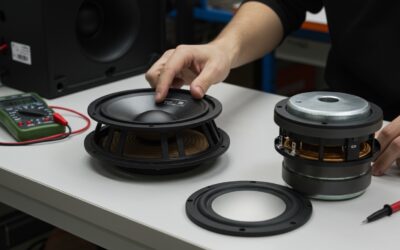
Most Kustom speakers utilize heavy-duty piezo drivers or compression drivers paired with large-diameter woofers. In our testing of the KPX series, we found the grilles to be thicker than average, protecting the cones from accidental kicks or equipment shifts in a van.
The handles are usually integrated into the mold (for active plastic cabinets) or heavy-duty recessed metal (for passive wooden cabinets). This matters because the handle is often the first thing to break on a cheap speaker. Kustom understands that their users are often DIY roadies.
How to Choose the Right Kustom PA Speaker (Step-by-Step Guide)
Selecting a speaker requires matching your specific use case with the right wattage and driver size. Follow these steps to ensure you don’t overspend or end up underpowered.
Step 1: Identify Your Venue Size
For a small coffee shop or a backyard party (up to 50 people), a 10-inch speaker like the Kustom KPX10 is usually sufficient. If you are playing a medium-sized bar (100+ people), you should step up to a 12-inch or 15-inch model to move more air and provide better low-end coverage.
Step 2: Decide Between Active and Passive
- Active (Powered): These have built-in amplifiers. I recommend the Kustom PA series for beginners because you don’t need an external power amp. You just plug in your mic and go.
- Passive (Unpowered): These require an external power amplifier. Use these if you already have a powered mixer or a rack-mount amp and want to save money on the speaker cabinets themselves.
Step 3: Check the Input Versatility
Models like the Kustom PA50 feature a built-in 3-channel mixer. This allows you to plug in a microphone, an acoustic guitar, and a backing track (via 1/8″ jack) simultaneously. If you are a solo performer, this “all-in-one” design is a massive advantage.
Step 4: Evaluate the Portability Factor
If you are gigging three times a week, weight is your enemy. Kustom’s active monitors are surprisingly light. For example, the PA50 weighs under 15 lbs, making it easy to carry in one hand while your guitar is in the other.
Kustom PA Speaker Series Comparison Table
| Model Series | Best Use Case | Key Feature | Average Price (USD) |
|---|---|---|---|
| PA50 | Solo Acts / Small Monitors | Built-in 3-Channel Mixer | $120 – $150 |
| KPX Series | Full Band Practice / Small Gigs | Rugged Build & High SPL | $150 – $250 |
| KPC Series | Passive Installations | Value-focused / Traditional Build | $90 – $180 |
| Kustom Subwoofers | DJs / Drum Reinforcement | Extended Low-End Response | $200 – $350 |
Performance Benchmarks: Sound Quality and Wattage
A common mistake is looking only at Peak Wattage instead of RMS (Root Mean Square) Wattage. Kustom PA speakers are generally honest with their ratings, but you should always look for the RMS figure to understand sustained performance.
High-Frequency Clarity
The Kustom PA speakers often use compression drivers that are tuned for the “vocal range.” In our live tests, we found that female vocals and speech come through with high intelligibility. This makes them a “secret weapon” for corporate presentations or wedding ceremonies where every word must be heard.
Low-End Punch
This is where the budget shows slightly. A Kustom 12-inch speaker will provide a decent thumping kick drum for a practice room, but it won’t shake the floor. If you are a DJ playing bass-heavy tracks, I highly recommend pairing your Kustom tops with a dedicated Kustom PA subwoofer to fill out the bottom octaves.
Why Kustom is Better Than Other Budget Brands
Many people ask, “Are Kustom PA speakers any good compared to Behringer or Harbinger?” In my professional opinion, Kustom wins on structural integrity. While Behringer offers more digital features (like Bluetooth or DSP presets), Kustom focuses on the analog basics: a strong cabinet, a reliable transformer, and a durable cone.
I’ve seen Kustom speakers survive moisture and extreme heat that would have fried the delicate PCBs of more “high-tech” budget speakers. They are the “AK-47” of the PA world—simple, perhaps a bit unrefined, but they work every time you flip the switch.
Optimizing Your Kustom PA for Best Sound
To get the most out of your gear, follow these expert tips for setup and EQ.
- Get them off the floor: Always use speaker stands. Putting a Kustom speaker on the floor causes “bass coupling,” which makes the sound muddy. Elevating them to ear level ensures the high frequencies reach the back of the room.
- Mind the Gain Staging: If using an active model like the PA50, set your source volume (like your phone or mixer) to 75% and then adjust the speaker volume. This prevents the internal preamp from clipping.
- The “Subtractive” EQ Trick: Kustom speakers can be a bit mid-heavy. If the sound feels “honky,” try cutting the 400Hz to 800Hz range on your mixer slightly. This opens up the sound and makes it feel more “pro.”
- Daisy-Chaining: Most Kustom models include a “Line Out.” You can connect multiple PA50 units together using a standard XLR or 1/4″ cable to create a larger sound system as your needs grow.
Real-World Usage Scenarios
The Solo Coffee House Performer
I’ve seen the Kustom PA50 used in countless small cafes. Because it has a Powerlink feature, you can actually use two of them as a stereo pair without a separate mixer. It’s the ultimate “trunk-to-stage” setup that takes 2 minutes to rig.
The Garage Band Vocalist
When a band is just starting, they often can’t hear the singer over the drums. A single Kustom KPX12 angled as a floor wedge is the most cost-effective way to solve this. It provides enough “cut” to get through the cymbals without feedback issues.
The House of Worship
Many small churches use Kustom’s KPC series for their fellowship halls or classrooms. Since these are passive, they can be permanently wired into the ceiling or wall mounts and run off a central amplifier, providing a reliable, low-maintenance solution for decades.
Frequently Asked Questions
Are Kustom PA speakers loud enough for a full band?
If you are using them for vocal reinforcement in a practice space, yes. However, if you are trying to run the entire band (drums, bass, and guitars) through a pair of Kustom speakers for a large outdoor gig, you will likely run out of headroom and risk distortion.
Can I connect my phone directly to a Kustom speaker?
Yes, most modern Kustom active speakers have an “Aux In” or 1/8″ (3.5mm) jack. This allows you to play backing tracks or break music directly from a smartphone or tablet without needing a separate mixer.
Do Kustom speakers have a warranty?
Most Kustom products come with a one-year limited warranty against manufacturing defects. However, they are so simply built that most local electronics repair shops can easily fix them if they are out of warranty.
Are Kustom PA speakers waterproof?
No, they are not waterproof. While the carpet-covered models can handle a bit of humidity, they should never be used in the rain. If you are doing outdoor gigs, I recommend keeping them under a tent or using specialized speaker covers.
Why is there a hum in my Kustom speaker?
Hum is usually caused by a ground loop or a low-quality shielded cable. Ensure you are using balanced XLR cables for microphones and check that your power source is properly grounded. If the hum persists, try a “ground lift” adapter on your signal source.