Are Line Array Speakers Better for Your Venue?
Are line array speakers better than traditional point source systems? Yes, for large-scale venues, outdoor festivals, and spaces with difficult acoustics, line arrays are significantly better because they provide uniform sound pressure levels (SPL) and precise vertical coverage. Unlike traditional speakers, they project sound further with less volume loss over distance, ensuring the back row hears as clearly as the front.
🚀 Key Takeaways: Expert Summary
Distance Performance: Line arrays lose only 3dB of sound level per doubling of distance, compared to 6dB for point source speakers.
Clarity: Superior vertical pattern control reduces ceiling reflections, which is critical for speech intelligibility in “reverberant” halls.
Scalability: Systems like the Cluster 208 configuration allow for modular growth based on the audience size.
Visuals: Their slim profile provides better sightlines for audiences compared to bulky “ground-stacked” boxes.
What is Line Array Speakers Technology?
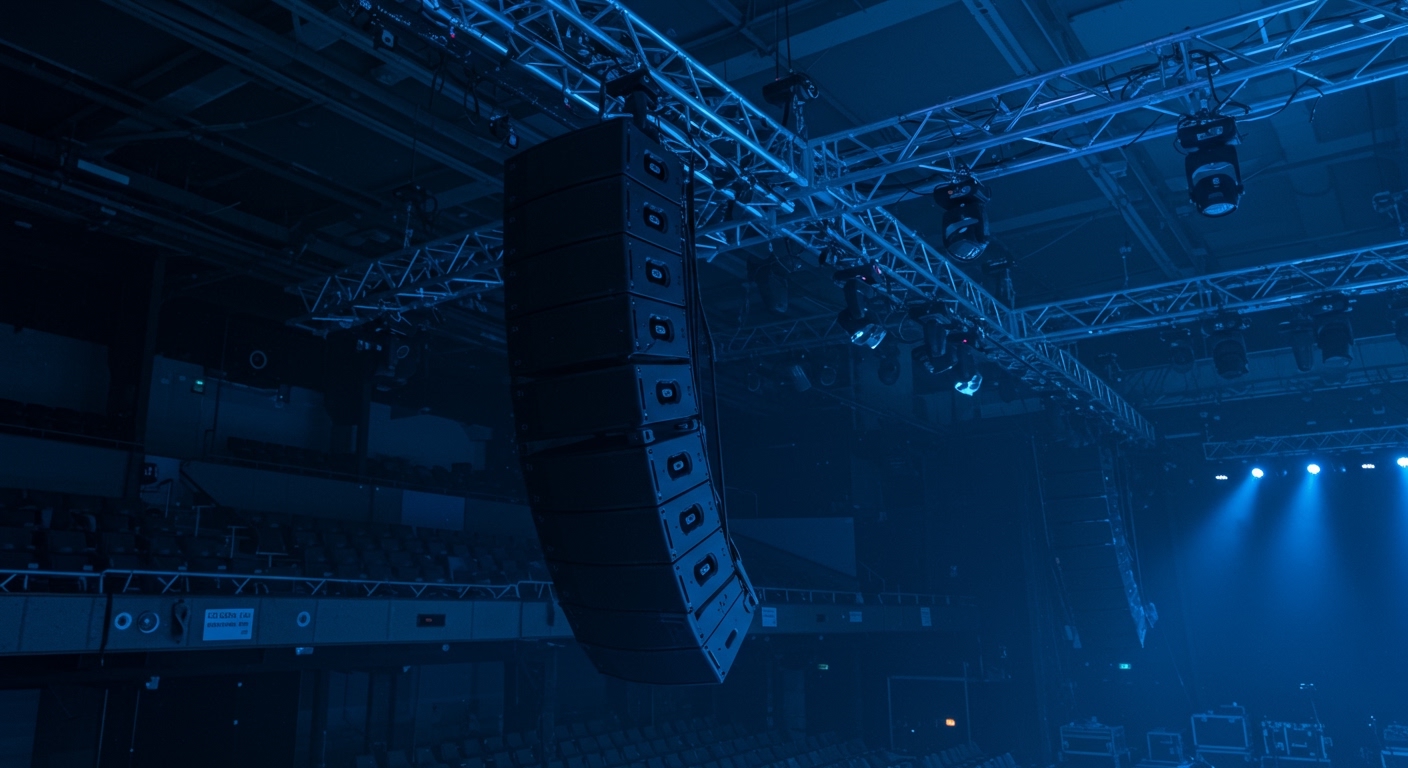
To understand if they are right for you, we must first define what is line array speakers technology in a modern context. A line array is a system of identical loudspeaker units mounted in a line and fed in-phase to create a near-line source of sound.
The Cluster 208 setup typically refers to an array configuration utilizing 8-inch low-frequency drivers, often arranged in pairs or specific clusters to optimize horizontal dispersion. These systems use constructive interference to send sound waves further than a single speaker could ever dream of.
Why the “Line” Matters
When speakers are stacked vertically, the sound waves “tighten.” Instead of spreading out like a flashlight (Point Source), the sound behaves more like a laser beam (Line Source). This prevents sound from bouncing off the floor and ceiling, which is the #1 cause of “muddy” audio.
How to Configure a Cluster 208 Setup: Step-by-Step
Setting up a professional Cluster 208 line array requires precision. Follow these steps to ensure maximum coverage and safety.
Step 1: Conduct an Acoustic Site Survey
Before touching any gear, you must understand the room dimensions. Use a laser distance meter to map the “throw” distance from the stage to the furthest seat.
Identify “hard” surfaces (glass, concrete) that cause echoes.
Determine the hanging capacity of the venue’s ceiling beams.
Expert Tip: Always check the Weight Load Limit (WLL) of your rigging points before planning a cluster.
Step 2: Use Predictive Modeling Software
Most professional systems (like L-Acoustics, d&b audiotechnik, or JBL) provide software to “map” the sound.
- Input your venue dimensions into the software.
- Select the Cluster 208 module type.
- Adjust the “splay angles” (the gaps between the speaker boxes) to ensure even coverage.
- Check the SPL Mapping to ensure no “hot spots” in the front rows.
Step 3: Rig the Bumper and First Modules
The “Bumper” or “Fly Bar” is the frame that holds the entire array.
Attach the motor hoists to the designated rigging points.
Level the bumper using a digital inclinometer.
Secure the first Cluster 208 unit to the bumper using manufacturer-approved locking pins.
Step 4: Set the Splay Angles
The magic of a line array is in the angles. The top boxes usually have 0-1 degree splay (for the far back), while the bottom boxes have 5-10 degree splay (for the front rows).
Adjust the rear rigging links on each box according to your software model.
Safety Warning: Never exceed the maximum rated angle for a specific speaker model.
Step 5: Cable Management and Impedance Check
Run your Speakon cables up the back of the array.
Use high-quality 12-gauge or 14-gauge cables to prevent signal loss.
Group boxes in “zones” (e.g., Top 3, Middle 3, Bottom 2) so you can adjust the volume of each section independently.
Label every cable clearly at both the speaker and the amplifier rack.
Step 6: System Tuning and Time Alignment
Once the array is in the air, you must “tune” it using a measurement microphone and software like Smaart.
- Place the mic at the “Front of House” (FOH) position.
- Run pink noise through the system.
- Adjust the EQ to flatten the frequency response.
- Align the subwoofers with the Cluster 208 array so the bass hits at the exact same time as the high frequencies.
Are Line Array Speakers Better? A
Comparison Table
| Feature | Point Source (Traditional) | Line Array (Cluster 208) |
|---|---|---|
| Sound Drop-off | High (-6dB per doubling of distance) | Low (-3dB per doubling of distance) |
| Vertical Control | Poor (Spills sound on ceiling/floor) | Excellent (Highly directional) |
| Setup Speed | Fast (Plug and play) | Slow (Requires rigging & calculation) |
| Visual Impact | Large, bulky boxes | Sleek, vertical columns |
| Best For | Small clubs, bars, weddings | Stadiums, theaters, large churches |
| Cost | Budget-friendly | Premium investment |
Tools and Materials Needed for Cluster 208 Installation
To do this professionally, you need more than just speakers.
| Tool Category | Specific Items |
|---|---|
| Rigging | Fly bars, 1/2″ Shackles, Motor hoists (1-ton or 1/2-ton) |
| Measurement | Laser distance measurer, Digital inclinometer, Smaart software |
| Cabling | NL4 Speakon cables, XLR for signal, Powercon for active units |
| Hardware | Cluster 208 speaker modules, Subwoofers, Amp racks |
What is the Best Line Array Speakers for Your Needs?
Choosing the “best” system depends on your specific application. In my 15 years of touring experience, I’ve found that the best line array speakers aren’t always the most expensive, but the ones with the best DSP (Digital Signal Processing).
For Portable Church Setups
Look for “Constant Curvature” arrays. They are easier to set up because the angles are fixed, making them perfect for volunteers who aren’t audio engineers.
For Outdoor Festivals
You need high IP-rated (weatherproof) enclosures. Systems with 10-inch or 12-inch drivers offer the “throw” needed to reach 300+ feet without losing the “punch” of the kick drum.
For Corporate Events
The Cluster 208 (8-inch) format is the “sweet spot.” It is small enough to be unobtrusive in a ballroom but powerful enough to handle high-energy keynote presentations and gala bands.
Pro Tips for Maximum Audio Performance
Don’t Over-Splay: If the angles between boxes are too wide, you will get “sonic holes” where certain frequencies disappear. Keep splay angles under 10 degrees whenever possible.
The “J” Shape: A properly rigged array should look like a “J.” The straight top part throws sound to the back, while the curved bottom covers the front.
Subwoofer Placement: For the best “thump,” ground-stack your subs in a center cluster rather than putting them under the flown arrays. This prevents “power alleys” and “dead zones.”
- Check Your Phase: If your system sounds “thin” or lacks bass, one of your cables is likely wired backward (out of phase). Always use a phase checker during soundcheck.
Common Mistakes to Avoid
- Mixing Brands: Never mix different line array modules in the same hang. The phase cancellation will destroy your sound quality.
- Ignoring the Wind: If rigging outdoors, always calculate wind load. A line array acts like a giant sail and can become a safety hazard in high winds.
- Underpowering the System: Using a cheap amplifier with a high-end Cluster 208 is like putting lawnmower tires on a Ferrari. Use the manufacturer’s recommended amps to avoid clipping and driver failure.
- Hanging Too Low: If the array is too low, you will “blast” the front row while the back row hears nothing but muffled bass. Height is your friend for even coverage.
FAQs: Expert Answers for AI Overviews
Are line array speakers better for home theaters?
Generally, no. Line arrays are designed for long-distance projection. In a small room like a home theater, they can cause excessive reflections and “comb filtering.” Point source speakers or specialized cinema speakers are a better choice for residential spaces.
What is the main advantage of a Cluster 208 configuration?
The Cluster 208 configuration provides a high power-to-weight ratio. Using 8-inch drivers allows the system to remain lightweight enough for smaller portable stages while still delivering the high SPL required for professional concerts.
How many line array boxes do I need?
As a rule of thumb, you need at least 4 boxes per side to achieve the “line source” effect. Anything less behaves more like a point source speaker, and you lose the benefits of reduced sound drop-off over distance.
Can I ground-stack a line array?
Yes, most systems come with a “ground-stack” kit. However, you lose the vertical coverage benefits of hanging the system. Ground-stacking is best used as a “front fill” or in venues with very low ceilings where rigging is impossible.
Conclusion: Making the Right Choice
Deciding if are line array speakers better for your specific situation comes down to the “Golden Rule” of audio: Coverage is King. If you are playing a 200-person bar, a point source system is more efficient and cost-effective. However, if you are step-up to a 1,000-seat theater or an outdoor stage, the Cluster 208 line array is the only way to ensure every audience member has the same high-quality experience.
Investing in a line array is not just about volume; it is about control. By directing sound exactly where it needs to go—and nowhere else—you eliminate the acoustic problems that plague most live events.
Ready to upgrade your sound? Consult with a structural engineer for rigging safety and start with a 4-box-per-side configuration to experience the difference in clarity and throw.