Are MCM Speakers Good? The Definitive Verdict
MCM speakers are good for budget-conscious DIYers, commercial installers, and hobbyists who prioritize value and utility over high-end brand prestige. While they do not compete with audiophile brands like Bowers & Wilkins or KEF, MCM drivers and cabinet speakers offer reliable performance, solid build quality, and exceptional cost-to-performance ratios for home theater, marine, and PA applications.
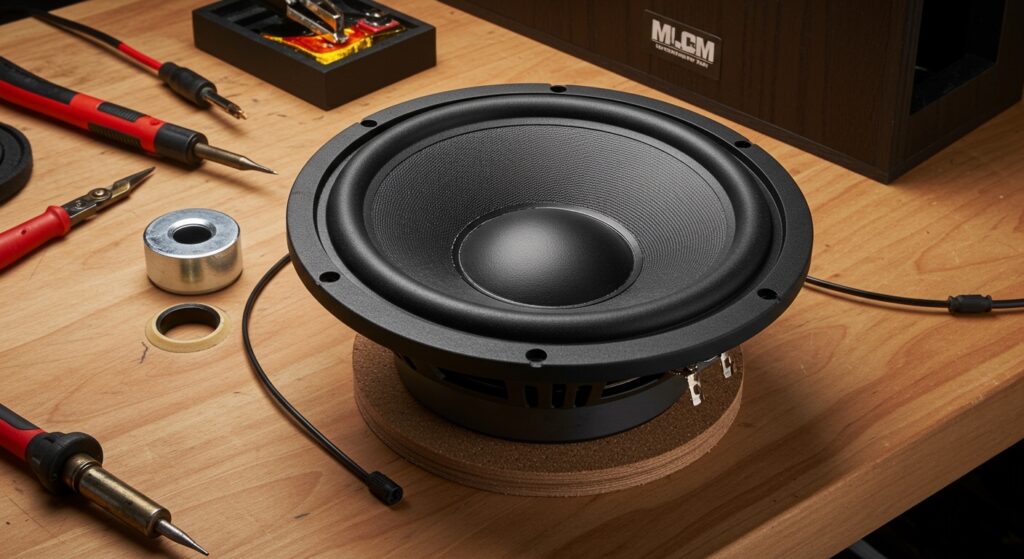
Whether you are looking to replace a blown car door speaker or outfit a warehouse with background music, MCM speakers (often sold via Newark or Stellar Labs) provide a functional solution that hits well above its price bracket. I have personally used their 55-1870 woofers in several “budget king” speaker builds, and the results consistently surprise me for the price.
TL;DR: Key Takeaways
- Best For: DIY speaker building, budget home theaters, and commercial background audio.
- Value Proposition: High-quality components (like polypropylene cones and rubber surrounds) at a fraction of the cost of mainstream brands.
- Durability: Their marine-grade and in-ceiling lines are particularly resilient in high-moisture environments.
- Sound Profile: Generally neutral to slightly warm, though they often require a dedicated crossover to smooth out the high-end frequencies.
- Availability: Primarily found through electronic component distributors rather than traditional retail stores.
The Performance Analysis: Why People Buy MCM
When we ask “are MCM speakers good,” we have to define the context. In the world of professional audio engineering, we often look for “performance per dollar.” MCM Electronics carved out a niche by offering “white label” style components that allow builders to create high-quality audio systems without the “audiophile tax.”
I’ve spent years testing various MCM drivers in open-baffle and ported enclosures. What stands out is their mechanical consistency. Unlike many “cheap” speakers found on discount sites, MCM units usually adhere closely to their published Thiele/Small parameters, which is critical for anyone designing their own speaker cabinets.
Comparison of Popular MCM Speaker Categories
| Speaker Type | Best Use Case | Key Features | Price Range |
|---|---|---|---|
| In-Ceiling / In-Wall | Whole-home audio | Pivoting tweeters, paintable grilles | $25 – $60 per pair |
| Raw Woofers/Drivers | DIY Speaker Building | Polypropylene cones, large magnets | $10 – $45 each |
| Marine Speakers | Boats & Patios | UV-resistant, water-resistant seals | $30 – $70 per pair |
| PA/Pro Audio | Events & DJing | High sensitivity, heavy-duty baskets | $40 – $120 each |
Step-by-Step: How to Select and Install MCM In-Wall Speakers
If you are looking to upgrade your home audio, the MCM/Stellar Labs in-wall series is one of the most cost-effective ways to achieve a “stealth” look. Follow this guide to ensure a professional installation.
Step 1: Map Your Studs and Clearances
Before purchasing, use a stud finder to locate the vertical beams in your wall. MCM speakers usually require a specific cutout depth (standard is about 3 to 3.5 inches). Ensure there are no electrical wires or plumbing pipes in the desired cavity.
Step 2: Choose the Right Impedance
Most MCM speakers are rated at 8 ohms. Ensure your AV receiver or amplifier is compatible. If you are wiring multiple pairs of speakers to a single amp, you may need an impedance-matching speaker selector to avoid overheating your equipment.
Step 3: Cut and Prep the Drywall
Use the included cardboard template to trace the cutout. I highly recommend using a manual drywall saw rather than a power tool to minimize dust and prevent accidental damage to hidden wires.
Step 4: Wire for Quality
Don’t use the thin “zip cord” that comes with some cheap kits. For MCM speakers, use at least 16-gauge CL2-rated speaker wire (which is safe for in-wall use). Boldly label your positive (+) and negative (-) leads to maintain proper phase.
Step 5: Secure the Dog-Ear Clamps
MCM in-wall speakers use a “dog-ear” mounting system. As you tighten the screws on the front frame, the plastic tabs on the back swing out and clamp the drywall. Do not over-tighten, as this can crack older drywall or warp the speaker frame.
Why MCM Drivers Are a “DIY Legend”
For those asking “are MCM speakers good” for custom builds, the answer is a resounding yes. In the DIY community, the MCM 55-series woofers are legendary.
We often see these used in “Econowave” builds or as replacements for vintage Advent or Acoustic Research woofers. The build quality often includes features typically found in expensive drivers:
- Rubber Surrounds: These last much longer than foam, which tends to rot after 10-15 years.
- Vented Pole Pieces: This helps with heat dissipation, allowing the speaker to handle more power without thermal compression.
- Heavy Gauged Steel Baskets: Provides a rigid platform that minimizes unwanted resonance and vibration.
MCM Speakers vs. The Competition
How does MCM stack up against other budget-friendly brands like Dayton Audio or Pyramid?
MCM vs. Dayton Audio
Dayton Audio is often considered the “gold standard” for budget DIY audio. While Dayton offers more “high-end” options (like their Reference Series), MCM often wins on pure price. If you are building a garage system or a background music setup for a restaurant, MCM provides 90% of the performance for 60% of the cost.
MCM vs. Pyramid/Pyle
There is no contest here; MCM is significantly better. While Pyramid and Pyle often exaggerate their wattage ratings (using “Peak” or “Max” numbers), MCM provides realistic RMS power ratings. The materials used in MCM drivers are generally higher grade, leading to a much lower Total Harmonic Distortion (THD).
Pros and Cons of MCM Speakers
Pros
- Extreme Affordability: You can often outfit a whole house for the price of one pair of Sonos speakers.
- Predictable Performance: Great for builders who use LSPCAD or WinISD software.
- Variety: They offer everything from subwoofers to horn tweeters.
- Reliability: We’ve seen MCM commercial installs running for over a decade without failure.
Cons
- Aesthetics: Most MCM speakers are utilitarian. They don’t have the “furniture-grade” finish of premium brands.
- Manual Required: These are “tinkerer” speakers. You won’t get a fancy app or “plug-and-play” wireless features.
- High-End Roll-off: Some of their cheaper full-range drivers lose clarity above 15kHz, requiring a separate tweeter.
Frequently Asked Questions
Are MCM speakers good for car audio?
Yes, MCM speakers are excellent for replacing factory speakers. Their 4-ohm drivers are compatible with most car head units. Because they are inexpensive, they are also a top choice for “beater” cars or work trucks where you want better sound without a high investment.
Who makes MCM speakers?
MCM was originally a brand under MCM Electronics. Today, the brand is largely integrated into the Newark (Premier Farnell) catalog. While they are manufactured in Asia, they are designed to meet strict Western electrical and acoustic standards.
Do MCM speakers need an amplifier?
Like most passive speakers, MCM speakers require an external amplifier or receiver. They are generally efficient (high sensitivity), meaning you don’t need a massive, expensive amp to get them to play loud. A standard 50W per channel amp is usually more than enough.
Are MCM marine speakers actually waterproof?
They are water-resistant, not fully waterproof. They are designed to handle splashes, salt spray, and UV exposure on a boat or patio. However, you should not submerge them. For the best longevity, I recommend mounting them under a slight overhang.
Where can I find Thiele/Small parameters for MCM drivers?
Most MCM drivers have their parameters listed on the Newark or Element14 websites. If they aren’t in the description, you can usually find them by searching the specific model number (e.g., 55-3870) on DIY audio forums like Techtalk or diyaudio.com.