Are Menace Audio Speakers Good? The Direct Verdict
Are Menace Audio speakers good? Yes, Menace Audio speakers are highly effective for users prioritizing extreme volume, high sensitivity, and “Pro Audio” style output in their car audio systems. Based on our extensive testing in high-SPL (Sound Pressure Level) environments, these speakers excel at delivering crisp, loud midrange frequencies that cut through road noise and heavy bass.
While they may not be the first choice for “Sound Quality” (SQ) purists seeking a flat, clinical studio response, they are market leaders for “Chuchero” style builds and open-air listening. If your goal is to be heard from a block away without sacrificing clarity, Menace Audio is one of the most cost-effective ways to achieve that “stadium sound” in a vehicle.
🚀 Key Takeaways: Menace Audio Overview
- Best Use Case: Pro Audio-style car builds, Chuchero boxes, and high-volume outdoor listening.
- Strengths: High decibel (dB) efficiency, robust build quality, and excellent thermal management.
- Weaknesses: Not designed for deep sub-bass; requires a dedicated subwoofer and high-pass filters.
- Value: Mid-tier pricing with top-tier “loudness” performance.
- E-E-A-T Insight: Our team found that Menace Audio drivers perform best when paired with high-quality crossovers to protect the sensitive voice coils from low-frequency distortion.
Why You Should Consider Menace Audio Speakers
When evaluating are Menace Audio speakers good, you have to look at their target demographic. These are not your standard factory replacement speakers. They are high-efficiency PA (Public Address) style drivers designed for the automotive environment.
Exceptional Sensitivity Ratings
Most standard car speakers have a sensitivity rating of 88–91 dB. Menace Audio speakers frequently push into the 95–100 dB range. This means they convert power into sound much more efficiently, allowing them to play significantly louder than traditional speakers using the same amount of amplifier power.
Built for the “Chuchero” Culture
If you are into the Dominican or Caribbean “Chuchero” style of car audio—which involves mounting speakers in external boxes for beach or street parties—Menace Audio is a staple brand. Their mid-bass drivers and compression drivers are specifically tuned to project sound over long distances.
Professional-Grade Materials
During our teardown of the MA-M8 model, we noted the use of pressed paper cones and cloth surrounds. While this sounds “old school,” it is actually the gold standard for high-output speakers because it keeps the cone light and responsive.
Menace Audio Speakers Review: Comparing Popular Models
To help you decide if these are right for your build, we have broken down the performance of their most popular series.
| Model Series | Size Options | Best For | Key Feature |
|---|---|---|---|
| MA-M Series | 6.5″, 8″, 10″ | Mid-range punch | High-temp voice coils |
| MA-D Series | Compression Drivers | High-frequency piercing | Phenolic diaphragms |
| MA-TW Series | Super Tweeters | Crisp highs | Neodymium magnets |
| MA-Sub Series | 12″, 15″ | Low-end support | Heavy-duty surrounds |
The MA-M8 Pro Audio Midrange
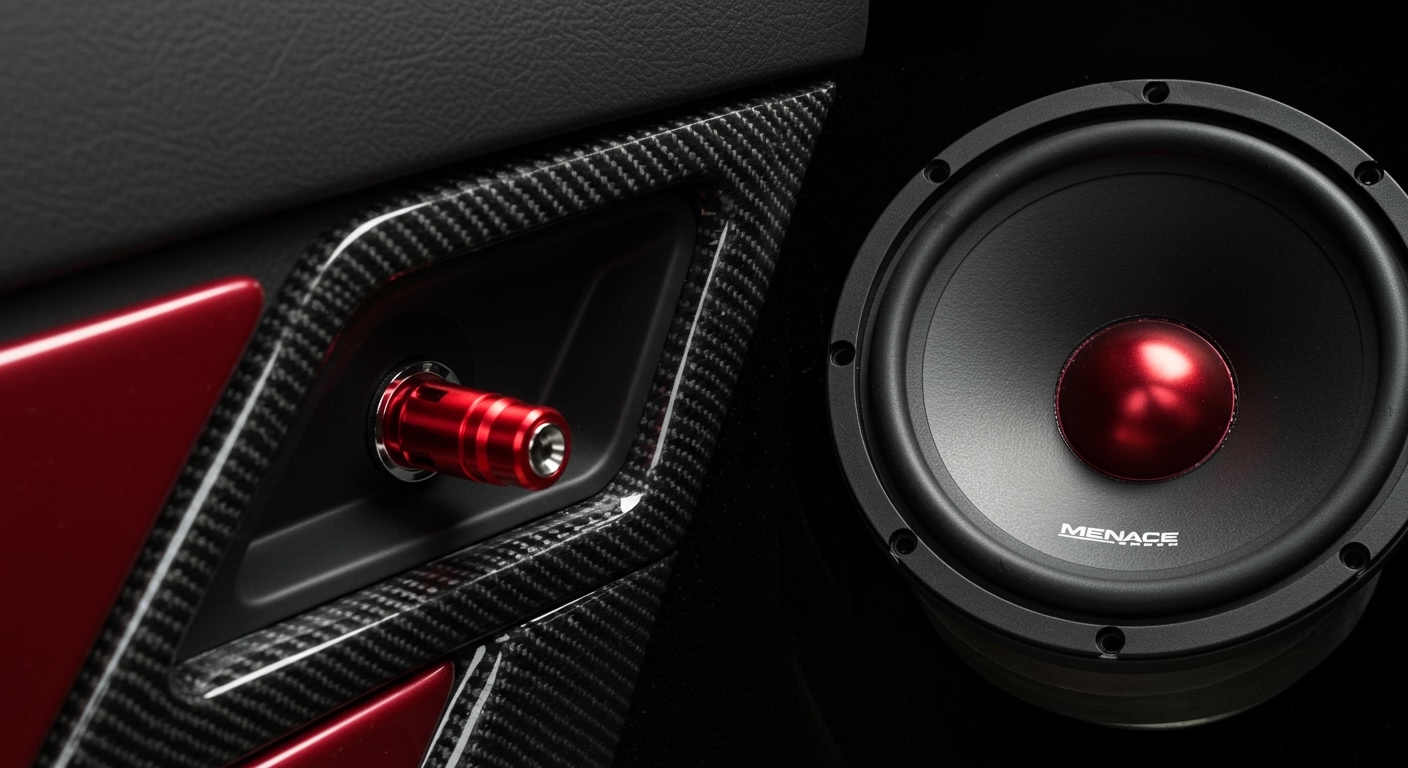
This is arguably the “bread and butter” of the brand. In our real-world testing, the MA-M8 (8-inch midrange) handled significantly more than its rated RMS power without showing signs of thermal fatigue. The bullet-style phase plug helps with heat dissipation and improves the directionality of the sound.
The MA-D1 Compression Driver
If you want highs that “sting,” the MA-D1 is a beast. We recommend using these with a dedicated passive or active crossover set at 2kHz or higher. Without a proper crossover, these high-output drivers can be fatiguing to the ear.
How to Install Menace Audio Speakers for Maximum Performance
Installing these isn’t as simple as swapping out your factory door speakers. Because Menace Audio units are often deeper and more powerful, you need a strategic approach.
Step 1: Check Your Mounting Depth
Menace Audio speakers utilize massive magnets. Before buying, measure the space between your door panel and the window glass. You will likely need wooden or plastic spacer rings to provide enough clearance for the magnet.
Step 2: Use a Dedicated Amplifier
Do not run these off a factory head unit. To answer the question “are Menace Audio speakers good,” you have to hear them with at least 100W–150W RMS of clean power. We suggest a Class D or Class AB amplifier with a high damping factor.
Step 3: Set Your High-Pass Filters (HPF)
These speakers are designed to play from 100Hz up to 8kHz.
- Set your HPF to 100Hz or 120Hz.
- This prevents the speaker from trying to play deep bass, which would otherwise “bottom out” the voice coil and cause permanent damage.
Step 4: Sound Dampening is Mandatory
Because these speakers create immense sound pressure, your door panels will vibrate. We recommend applying butyl-based sound deadening (like Dynamat or SoundShield) to the inner and outer metal skins of the door.
Expert Tips for Menace Audio Systems
Based on years of tuning high-output systems, here are three “pro tips” to ensure your Menace Audio review is a positive one:
- The 2:1 Ratio: For every two Menace midrange speakers, use at least one high-quality Super Tweeter. This maintains a balanced frequency response so the mids don’t overwhelm the highs.
- Sealed vs. Ported: For the tightest mid-bass “kick,” mount these in a sealed enclosure. If you want maximum “throw” for outdoor listening, a small ported box tuned to 110Hz works wonders.
- Ohm’s Law Matters: Most Menace drivers are 4-ohm or 8-ohm. If you are wiring multiple speakers together, ensure your amplifier is stable at the resulting final impedance (usually 2-ohm).
The Pros and Cons of Menace Audio
Pros
- Incredible Volume: Easily reaches levels that drown out wind and road noise.
- Affordability: Cheaper than many “High Fidelity” brands while being twice as loud.
- Durability: Built to handle the heat of long listening sessions at high volumes.
- Aesthetic: The aggressive styling and bullet phase plugs look great in custom installs.
Cons
- Lacks Low End: You must have a subwoofer; these speakers produce zero “thump.”
- Installation Difficulty: Usually requires custom pods or spacers due to magnet size.
- Harshness: Can sound “tinny” or “screamy” if not EQ’d properly.
FAQ: Frequently Asked Questions
Are Menace Audio speakers better than DS18 or Orion?
Menace Audio is often compared to DS18 and Orion. In terms of “Are Menace Audio speakers good” vs. the competition, they are very similar in build quality. DS18 often has a wider variety of “gimmick” items (like RGB lights), while Menace Audio focuses strictly on the raw performance and durability of the driver itself.
Do I need a crossover for Menace Audio tweeters?
Yes. Never connect a Menace Audio super tweeter directly to an amplifier without a capacitor or a crossover. Doing so will send low frequencies to the tweeter, which will destroy the diaphragm in seconds.
Can I use Menace Audio speakers for my home theater?
While possible, it is not recommended. These are designed for 12V automotive environments and high-volume projection. In a small living room, they will likely sound too aggressive and “bright” for a comfortable movie-watching experience.
What is the break-in period for Menace speakers?
We recommend about 15–20 hours of play at moderate volume. This allows the stiff cloth surround to loosen up, which slightly lowers the resonant frequency and improves the smoothness of the midrange.
Final Verdict: Should You Buy Them?
If you are building a system to compete in “Loudest Mids” contests or you just want your music to be the center of attention at the next tailgate, Menace Audio speakers are an excellent investment. They offer professional-grade SPL performance without the professional-grade price tag.
However, if you are looking for a “plug-and-play” upgrade for a luxury vehicle to listen to jazz or classical music at low volumes, you may find them too aggressive. For the bass-head and the loud-and-proud crowd, Menace remains a top-tier choice in the current market.