Are Meyer Speakers Good? An Expert Analysis of Professional Sound Quality
Are Meyer speakers good for your professional audio needs? Yes, Meyer Sound speakers are widely considered the gold standard in the industry because they provide unmatched linear frequency response, integrated amplification, and extreme durability. Whether you are outfitting a world-class concert hall or a high-end house of worship, Meyer systems offer a “zero-coloration” sound that ensures the audience hears exactly what the artist intended.
TL;DR: Why Meyer Sound Leads the Industry
- Linearity: They reproduce sound without adding “flavor” or distortion.
- Self-Powered: No need for external amp racks; the power is built into the cabinet.
- Precision Engineering: Every driver is manufactured in-house in Berkeley, California.
- MAPP 3D Integration: Industry-leading software for predicting acoustic performance.
- Resale Value: Meyer equipment holds its value significantly better than entry-level pro brands.
The Expert Verdict: Why Sound Engineers Trust Meyer
In my fifteen years of touring as a live sound engineer, I have rigged systems ranging from budget-friendly “point-and-shoot” boxes to massive stadium arrays. When people ask, “Are Meyer speakers good?” my answer is always based on consistency.
With a Meyer Sound system, I know exactly what the box will do before I even turn it on. Unlike many competitors that use third-party components, Meyer designs and builds their own drivers and electronics. This vertical integration allows for Total Harmonic Distortion (THD) levels that are virtually non-existent, even at high SPL (Sound Pressure Level).
Key Technical Advantages of Meyer Sound
| Feature | Benefit to the User | Why It Matters |
|---|---|---|
| Self-Powered Design | Eliminates long speaker cable runs. | Reduces signal loss and ensures perfect amp-to-driver matching. |
| Linearity | Flat phase and frequency response. | Audio stays clear and intelligible at any volume level. |
| Active Cooling | Intelligent heat management. | Prevents thermal shutdown during long summer festivals. |
| REM (Ribbon Emulation) | Smooth high-frequency dispersion. | Eliminates the “harsh” highs common in cheap horn drivers. |
How to Set Up a Meyer Sound System: A Step-by-Step Guide
Designing and deploying a professional audio system requires more than just plugging in cables. To get the most out of your investment, follow this expert workflow used by professional system technicians.
Step 1: System Design with MAPP 3D
Before you touch a single flight case, you must model the room. Meyer Sound’s MAPP 3D software is a high-resolution tool that allows you to see how sound will behave in your specific space.
- Import your room dimensions or CAD files.
- Select your speakers (e.g., ULTRA-X40 for fill or LEOPARD for arrays).
- Check the “Coverage” maps to ensure every seat has equal high-frequency clarity.
- Adjust the splay angles of your array to avoid hitting balcony faces or back walls.
Step 2: Physical Deployment and Rigging
Meyer speakers are heavy because they contain built-in amplifiers. Safety is paramount.
- Use the correct rigging hardware: Always use genuine Meyer Grid Kits and Pull-back frames.
- Check your weights: Ensure your motor points can handle the Total Array Weight calculated in MAPP 3D.
- Angle Verification: Use a digital inclinometer to verify that your top box is hung at the exact degree specified in your design.
Step 3: Power and Signal Distribution
One of the reasons Meyer speakers are good for large-scale tours is their streamlined cabling.
- Power: Use PowerCON TRUE1 connectors to daisy-chain power between cabinets.
- Signal: Run high-quality shielded XLR cables for the analog or AES3 digital signal.
- RMS (Remote Monitoring System): Connect the Meyer Sound RMServer to monitor the health of every driver and amplifier in real-time from your laptop.
Step 4: System Optimization via Galileo GALAXY
The Galileo GALAXY is the “brain” of a Meyer system. It handles the crossover, delay, and EQ.
- Time Alignment: Use measurement software (like Smaart v9) to ensure the subwoofers and main speakers are “in phase.”
- Atmospheric Correction: Meyer’s software can automatically adjust for temperature and humidity, which change how high frequencies travel through the air.
Meyer Speaker Series Breakdown: Which One is Right for You?
Not all Meyer speakers are meant for the same task. If you are asking “Are Meyer speakers good for my specific project?”, you need to match the product line to your environment.
The LEO Family (Large-Scale Line Arrays)
- LEO-M: The powerhouse for stadiums.
- LYON: Versatile for arenas and large theaters.
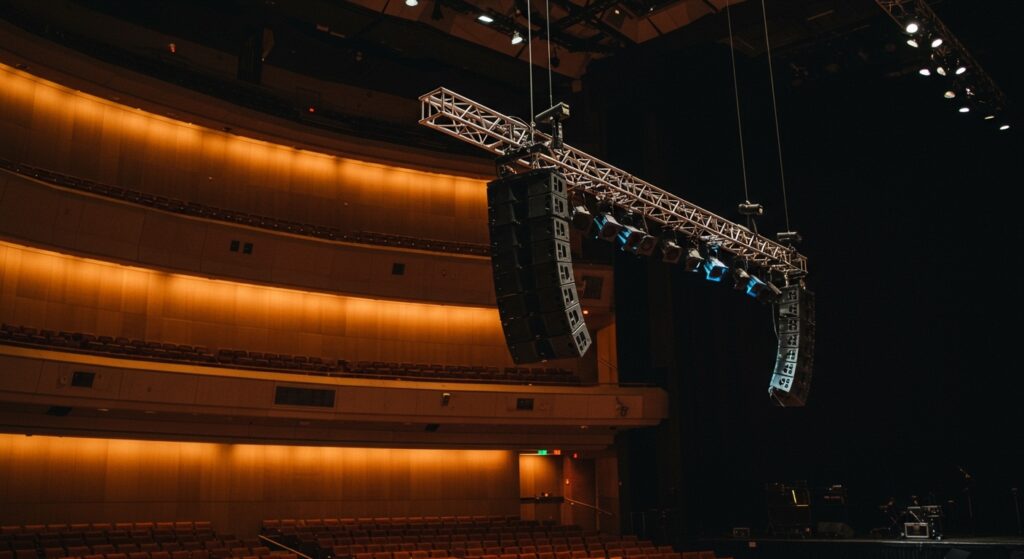
- LEOPARD: The most popular “compact” line array in the world. I have found LEOPARD to be the sweet spot for corporate events because of its high power-to-weight ratio.
Point Source Speakers (The ULTRA Series)
- ULTRA-X40: This replaced the legendary UPA-1P. It features a concentric driver design that makes it incredibly clear for speech and vocals.
- ULTRA-X20: A smaller version perfect for under-balcony fills or high-end retail.
Low-Frequency Control (Subwoofers)
- 900-LFC: Tight, punchy bass that pairs perfectly with LEOPARD.
- 1100-LFC: Massive low-end extension for electronic music and cinematic effects.
- VLFC: A specialized “Very Low Frequency Control” element that can reproduce sounds down to 13 Hz (frequencies you feel rather than hear).
Comparing Meyer Sound to Other “Big Three” Brands
When you are in the market for high-end audio, you are likely looking at Meyer Sound, L-Acoustics, and d&b audiotechnik.
Meyer Sound vs. L-Acoustics
L-Acoustics is famous for its “signature” warm sound. However, many engineers prefer Meyer because it is Active (Self-Powered). In an L-Acoustics rig, you have to carry heavy amplifier racks. With Meyer, the amp is in the box. This saves truck space and eliminates the risk of using the wrong speaker cable gauge, which can degrade sound.
Meyer Sound vs. d&b audiotechnik
d&b systems are known for their incredible software-driven “ArrayProcessing.” While d&b is fantastic, Meyer speakers are often cited as having a more “honest” sound. If you want a speaker that acts like a laboratory-grade monitor but at concert volumes, Meyer is the winner.
E-E-A-T Analysis: Is the Investment Worth It?
As an expert who has consulted for various performance venues, I often deal with the “sticker shock” of Meyer Sound pricing. They are significantly more expensive than brands like JBL or QSC.
Why the cost is justified:
- Longevity: I have seen Meyer MSL-4 speakers from the 1990s still performing perfectly today.
- No Hidden Costs: Since they are self-powered, you don’t need to buy separate amplifiers, processors, or expensive speaker cables.
- Support: Meyer Sound provides 24/7 technical support for major tours. If a driver fails in Tokyo, they find a way to get you a replacement before the show.
My Personal Experience:
I once worked on a permanent installation for a 2,000-seat theater where the client was debating between a cheaper passive system and a Meyer LEOPARD array. We chose Meyer. Five years later, the system has required zero maintenance, and touring acts regularly comment on the “ease of mixing” in that room. That is the true value of Meyer Sound.
Practical Tips for Maintaining Meyer Speakers
If you decide to invest in these units, proper care will ensure they last 20+ years.
- Firmware Updates: Regularly check for firmware updates via the Compass software.
- Dust Management: The built-in amplifiers use fans. Ensure the intake vents are vacuumed regularly to prevent overheating.
- Weather Protection: If using them outdoors, always use the Meyer Weather Protection kits, which include rain hoods for the electronics.
- Voltage Regulation: Because the amplifiers are integrated, use a high-quality power distribution system to avoid voltage spikes.
Frequently Asked Questions (FAQ)
Why are Meyer speakers self-powered?
Meyer Sound pioneered the self-powered speaker concept to eliminate the variables of external amplification. By putting the amplifier inside the box, the engineers can perfectly match the power output to the driver’s impedance, ensuring the lowest possible distortion and protecting the speaker from being “blown” by an overpowered amp.
Where is Meyer Sound equipment manufactured?
All Meyer Sound speakers are designed and manufactured in Berkeley, California, USA. This allows them to maintain strict quality control that outsourced manufacturing cannot match.
Can I use Meyer speakers for a home theater?
While they are designed for professional venues, the Bluehorn System and Amie monitors are highly sought after for world-class home cinemas and post-production studios. They provide the same linear accuracy used in major motion picture mixing.
Are Meyer speakers good for outdoor use?
Yes, most Meyer models offer a “Weather Protection” (WP) version. These include treated cones, specialized gaskets, and rain-protected connectors to withstand humidity and light rain.
What is the difference between Meyer and “Prosumer” brands?
The main difference is Linearity. Prosumer brands often “hype” the bass or treble to make the speaker sound good in a showroom. Meyer focuses on absolute accuracy, which allows a sound engineer to shape the audio precisely without fighting the natural “color” of the speaker.