The Great Debate: Choosing Your Sound Architecture
Deciding whether are modern speakers better than vintage depends entirely on your priority: clinical precision or musical character. While modern engineering utilizes Computer-Aided Design (CAD) and Laser Interferometry to eliminate distortion, many enthusiasts argue that vintage gear possesses a “soul” that modern silicon cannot replicate. This guide will walk you through the technical and emotional factors to determine which era of audio engineering belongs in your living room.
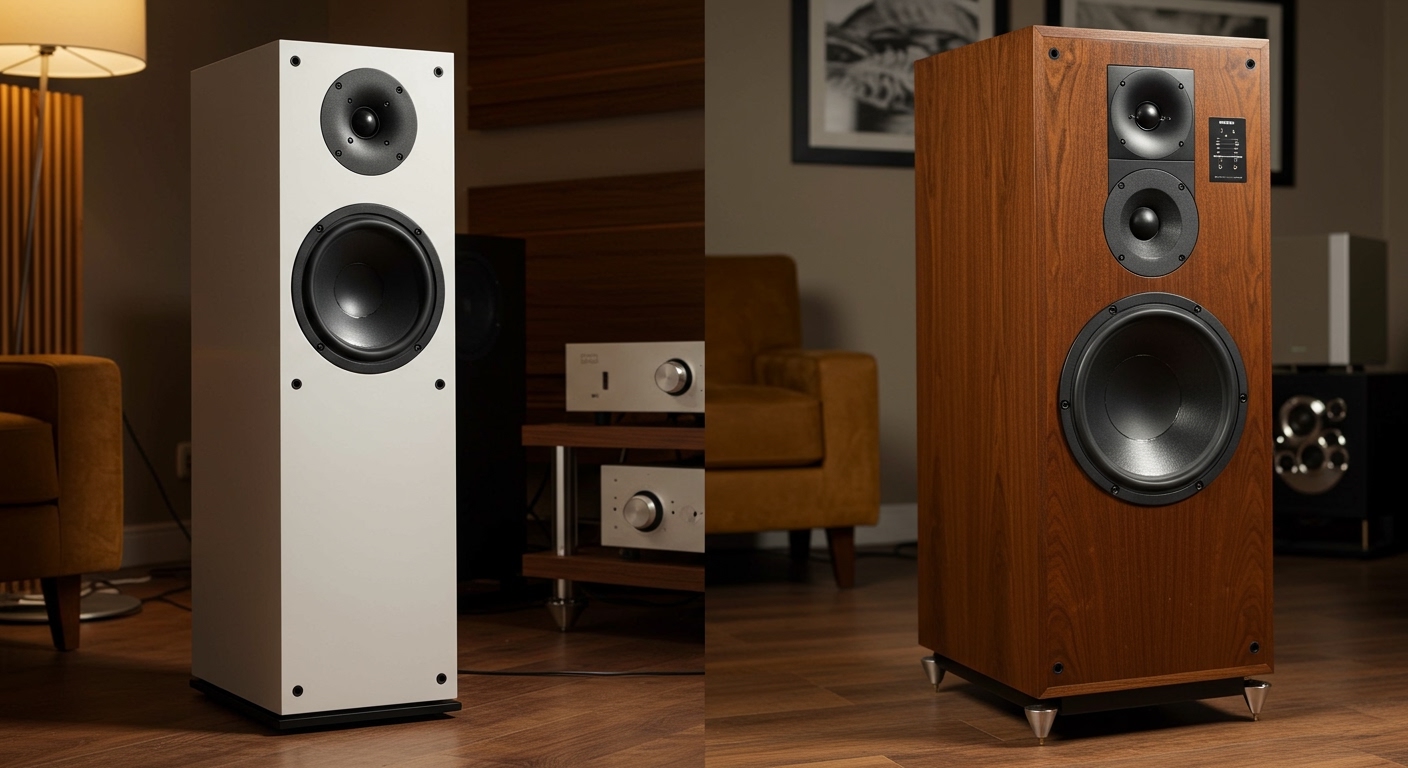
Expert Summary: Modern vs. Vintage Audio
Modern Advantages: Superior imaging, wider frequency response, and Digital Signal Processing (DSP) for room correction.
Vintage Advantages: Exceptional build quality (real wood veneers), “warm” harmonic distortion, and high resale value.
The Verdict: If you want “plug-and-play” accuracy, go modern; if you enjoy the “hobbyist” aspect of maintenance and a colored, nostalgic sound, go vintage.
Step 1: Evaluate Your Acoustic Priorities
Before spending a dime, you must define what “better” means to your ears. This is the first step in deciding if are modern speakers better than vintage for your specific needs.
Determine if you value “Accuracy” or “Warmth”
Modern speakers are designed to be “transparent.” Brands like KEF, Revel, and Genelec use advanced materials like Beryllium or Carbon Fiber to ensure the speaker adds zero character to the music. In contrast, vintage speakers from the 1970s often have a “mid-range bloom” that makes vocals sound intimate and lush.
Assess your room size and placement
Are new speakers better than old for small spaces? Generally, yes. Modern bookshelf speakers utilize high-excursion drivers and sophisticated porting (like KEF’s Metamaterial Absorption Technology) to produce massive sound from tiny boxes. Large vintage floor-standers often require massive rooms to “breathe” and avoid muddy bass.
Step 2: Inspect Technical Integrity (The “Are Old Speakers Still Good?” Test)
If you are considering an older pair, you must verify if they have survived the decades. Are old speakers still good? Only if the internal components haven’t degraded.
Check for “Foam Rot”
Vintage speakers often use foam surrounds to connect the cone to the basket. Over 20-30 years, this foam turns to dust.
Action: Gently press the edge of the woofer. If it feels brittle or cracks, the speakers require a “re-foam” kit.
Impact: Rotated foam causes the voice coil to rub, eventually destroying the speaker.
Listen for Capacitor Drift
The crossover inside a speaker uses capacitors to send high frequencies to the tweeter and lows to the woofer. Electrolytic capacitors in vintage gear dry out over time.
The Sign: If the speakers sound “muffled” or “dark,” the capacitors likely need replacing.
The Solution: High-quality modern film capacitors can actually make old speakers better than new ones in some specific high-end vintage models.
Step 3: Compare Material Science and Engineering
To answer if are old speakers better than new ones, we have to look at how they are built.
| Feature | Modern Speakers | Vintage Speakers (1960s-1980s) |
|---|---|---|
| Cabinet Material | MDF, Composite, Carbon Fiber | High-density Plywood, Solid Walnut |
| Driver Tech | Neodymium magnets, Ribbons | Alnico magnets, Paper cones |
| Crossover | Computer-optimized, high-order | Simple, point-to-point wiring |
| Connectivity | Bi-wiring, Wireless, HDMI ARC | Standard copper binding posts |
| Weight | Often lighter (engineered rigidity) | Extremely heavy (mass loading) |
The “Alnico” Factor
Many purists believe old speakers are worth keeping specifically for Alnico V magnets. These magnets provide a very smooth transition into distortion, which many find more musical than the sudden “clipping” of modern ceramic or neodymium magnets.
Step 4: Determine Market Value and Investment Potential
You might be wondering: are old speakers worth anything? The market for “Golden Era” hi-fi is currently exploding.
Identify “Blue Chip” Vintage Brands
If you find these brands at a garage sale, they are almost always worth anything and often outperform modern budget gear:
JBL (Century L100, 4311 monitors)
Tannoy (Dual Concentric drivers)
Klipsch (Heritage series like the Heresy or La Scala)
Acoustic Research (AR-3a)
Calculate the “Resale” vs. “Depreciation”
Modern speakers, like most electronics, lose 30-50% of their value the moment you leave the store. Conversely, are old stereo speakers worth anything? Yes—high-end vintage gear often appreciates. A pair of JBL L100s bought for $500 ten years ago might sell for $1,500 today.
Step 5: Integrate with Modern Technology
The best setup often involves a hybrid approach. You can take old speakers worth keeping and pair them with modern power.
Use Modern Amplification
Vintage speakers are often “efficient” (they don’t need much power). However, pairing a 1975 Pioneer speaker with a modern Class D amplifier featuring Room EQ (like a WiiM Amp or Sonos Amp) can fix the acoustic flaws of the old design.
Add a Subwoofer
Vintage speakers were rarely designed to hit frequencies below 40Hz. To make old speakers better than new ones, simply add a modern powered subwoofer (like an SVS SB-1000) to handle the “sub-bass” that 1970s technology couldn’t reach.
Essential Tools for Speaker Evaluation
If you are hunting for vintage gear or setting up a modern system, keep these tools handy:
| Tool | Purpose |
|---|---|
| Multimeter | To check the Ohmic resistance of the voice coils. |
| Flashlight | To inspect the spider and surrounds for cracks. |
| Reference Track | A song you know perfectly to test for “imaging.” |
| DeoxIT D5 | To clean oxidized wire terminals on old gear. |
Pro Tips for the Audiophile Journey
Trust your ears, not the spec sheet: A modern speaker might have a frequency response up to 40kHz, but if you’re over 40, you likely can’t hear above 14kHz.
Check the “WAF” (Wife Acceptance Factor): Modern speakers are often slimmer and more décor-friendly. Vintage “monoliths” can cause domestic friction.
Avoid “Black Plastic Crap” (BPC): In the late 80s and 90s, speaker quality plummeted. If it’s light, made of thin plastic, and has “1000W” written on it, it’s not worth keeping.
Room Treatment is King: A $500 modern speaker in a treated room will beat a $5,000 vintage speaker in a room with echoes every time.
Common Mistakes to Avoid
Buying sight-unseen: Never buy vintage speakers online without seeing a video of them playing. Shipping heavy speakers is expensive and they are easily damaged.
Ignoring the “Capacitor Leak”: Many people think their old speakers are worth nothing because they sound “dull.” Often, a $20 capacitor replacement brings them back to life.
Underpowering: Modern speakers often have low sensitivity (84-87dB). Using a weak vintage receiver to drive them can cause clipping, which destroys tweeters.
FAQs: Modern vs. Vintage Speakers
Are old speakers worth anything if they have holes in the foam?
Yes! “Re-foaming” is a standard maintenance task. As long as the voice coil isn’t burnt out, a speaker with rotted foam can be restored to 100% functionality for about $30 in parts.
Why do people say vintage speakers sound “warmer”?
“Warmth” is actually a slight boost in the lower-midrange frequencies and a roll-off in the high-end. Vintage paper cones and tube-era crossovers naturally created this sound profile, which masks the “harshness” of early digital recordings.
Are new speakers better than old for home theater?
Absolutely. Modern speakers are designed for dynamic range and timbre matching. For a 5.1 or Dolby Atmos setup, modern speakers offer much better integration and “steering” of sound effects between channels.
Are old stereo speakers worth anything if they are “unbranded”?
Generally, no. The value in vintage audio lies in the engineering pedigree of specific brands. Unbranded “department store” speakers from the 70s were often made of cheap particle board and are not worth the cost of restoration.
Can I use vintage speakers with a Bluetooth adapter?
Yes. You can connect any vintage speaker to a modern receiver or a small Bluetooth amplifier. This is the most common way people keep their old speakers worth keeping while enjoying modern streaming services like Spotify or Tidal.
The Great Debate: Choosing Your Sound Architecture
Deciding whether are modern speakers better than vintage depends entirely on your priority: clinical precision or musical character. While modern engineering utilizes Computer-Aided Design (CAD) and Laser Interferometry to eliminate distortion, many enthusiasts argue that vintage gear possesses a “soul” that modern silicon cannot replicate. This guide will walk you through the technical and emotional factors to determine which era of audio engineering belongs in your living room.
Expert Summary: Modern vs. Vintage Audio
Modern Advantages: Superior imaging, wider frequency response, and Digital Signal Processing (DSP) for room correction.
Vintage Advantages: Exceptional build quality (real wood veneers), “warm” harmonic distortion, and high resale value.
The Verdict: If you want “plug-and-play” accuracy, go modern; if you enjoy the “hobbyist” aspect of maintenance and a colored, nostalgic sound, go vintage.
Step 1: Evaluate Your Acoustic Priorities
Before spending a dime, you must define what “better” means to your ears. This is the first step in deciding if are modern speakers better than vintage for your specific needs.
Determine if you value “Accuracy” or “Warmth”
Modern speakers are designed to be “transparent.” Brands like KEF, Revel, and Genelec use advanced materials like Beryllium or Carbon Fiber to ensure the speaker adds zero character to the music. In contrast, vintage speakers from the 1970s often have a “mid-range bloom” that makes vocals sound intimate and lush.
Assess your room size and placement
Are new speakers better than old for small spaces? Generally, yes. Modern bookshelf speakers utilize high-excursion drivers and sophisticated porting (like KEF’s Metamaterial Absorption Technology) to produce massive sound from tiny boxes. Large vintage floor-standers often require massive rooms to “breathe” and avoid muddy bass.
Step 2: Inspect Technical Integrity (The “Are Old Speakers Still Good?” Test)
If you are considering an older pair, you must verify if they have survived the decades. Are old speakers still good? Only if the internal components haven’t degraded.
Check for “Foam Rot”
Vintage speakers often use foam surrounds to connect the cone to the basket. Over 20-30 years, this foam turns to dust.
Action: Gently press the edge of the woofer. If it feels brittle or cracks, the speakers require a “re-foam” kit.
Impact: Rotated foam causes the voice coil to rub, eventually destroying the speaker.
Listen for Capacitor Drift
The crossover inside a speaker uses capacitors to send high frequencies to the tweeter and lows to the woofer. Electrolytic capacitors in vintage gear dry out over time.
The Sign: If the speakers sound “muffled” or “dark,” the capacitors likely need replacing.
The Solution: High-quality modern film capacitors can actually make old speakers better than new ones in some specific high-end vintage models.
Step 3: Compare Material Science and Engineering
To answer if are old speakers better than new ones, we have to look at how they are built.
| Feature | Modern Speakers | Vintage Speakers (1960s-1980s) |
|---|---|---|
| Cabinet Material | MDF, Composite, Carbon Fiber | High-density Plywood, Solid Walnut |
| Driver Tech | Neodymium magnets, Ribbons | Alnico magnets, Paper cones |
| Crossover | Computer-optimized, high-order | Simple, point-to-point wiring |
| Connectivity | Bi-wiring, Wireless, HDMI ARC | Standard copper binding posts |
| Weight | Often lighter (engineered rigidity) | Extremely heavy (mass loading) |
The “Alnico” Factor
Many purists believe old speakers are worth keeping specifically for Alnico V magnets. These magnets provide a very smooth transition into distortion, which many find more musical than the sudden “clipping” of modern ceramic or neodymium magnets.
Step 4: Determine Market Value and Investment Potential
You might be wondering: are old speakers worth anything? The market for “Golden Era” hi-fi is currently exploding.
Identify “Blue Chip” Vintage Brands
If you find these brands at a garage sale, they are almost always worth anything and often outperform modern budget gear:
JBL (Century L100, 4311 monitors)
Tannoy (Dual Concentric drivers)
Klipsch (Heritage series like the Heresy or La Scala)
Acoustic Research (AR-3a)
Calculate the “Resale” vs. “Depreciation”
Modern speakers, like most electronics, lose 30-50% of their value the moment you leave the store. Conversely, are old stereo speakers worth anything? Yes—high-end vintage gear often appreciates. A pair of JBL L100s bought for $500 ten years ago might sell for $1,500 today.
Step 5: Integrate with Modern Technology
The best setup often involves a hybrid approach. You can take old speakers worth keeping and pair them with modern power.
Use Modern Amplification
Vintage speakers are often “efficient” (they don’t need much power). However, pairing a 1975 Pioneer speaker with a modern Class D amplifier featuring Room EQ (like a WiiM Amp or Sonos Amp) can fix the acoustic flaws of the old design.
Add a Subwoofer
Vintage speakers were rarely designed to hit frequencies below 40Hz. To make old speakers better than new ones, simply add a modern powered subwoofer (like an SVS SB-1000) to handle the “sub-bass” that 1970s technology couldn’t reach.
Essential Tools for Speaker Evaluation
If you are hunting for vintage gear or setting up a modern system, keep these tools handy:
| Tool | Purpose |
|---|---|
| Multimeter | To check the Ohmic resistance of the voice coils. |
| Flashlight | To inspect the spider and surrounds for cracks. |
| Reference Track | A song you know perfectly to test for “imaging.” |
| DeoxIT D5 | To clean oxidized wire terminals on old gear. |
Pro Tips for the Audiophile Journey
Trust your ears, not the spec sheet: A modern speaker might have a frequency response up to 40kHz, but if you’re over 40, you likely can’t hear above 14kHz.
Check the “WAF” (Wife Acceptance Factor): Modern speakers are often slimmer and more décor-friendly. Vintage “monoliths” can cause domestic friction.
Avoid “Black Plastic Crap” (BPC): In the late 80s and 90s, speaker quality plummeted. If it’s light, made of thin plastic, and has “1000W” written on it, it’s not worth keeping.
Room Treatment is King: A $500 modern speaker in a treated room will beat a $5,000 vintage speaker in a room with echoes every time.
Common Mistakes to Avoid
Buying sight-unseen: Never buy vintage speakers online without seeing a video of them playing. Shipping heavy speakers is expensive and they are easily damaged.
Ignoring the “Capacitor Leak”: Many people think their old speakers are worth nothing because they sound “dull.” Often, a $20 capacitor replacement brings them back to life.
Underpowering: Modern speakers often have low sensitivity (84-87dB). Using a weak vintage receiver to drive them can cause clipping, which destroys tweeters.
FAQs: Modern vs. Vintage Speakers
Are old speakers worth anything if they have holes in the foam?
Yes! “Re-foaming” is a standard maintenance task. As long as the voice coil isn’t burnt out, a speaker with rotted foam can be restored to 100% functionality for about $30 in parts.
Why do people say vintage speakers sound “warmer”?
“Warmth” is actually a slight boost in the lower-midrange frequencies and a roll-off in the high-end. Vintage paper cones and tube-era crossovers naturally created this sound profile, which masks the “harshness” of early digital recordings.
Are new speakers better than old for home theater?
Absolutely. Modern speakers are designed for dynamic range and timbre matching. For a 5.1 or Dolby Atmos setup, modern speakers offer much better integration and “steering” of sound effects between channels.
Are old stereo speakers worth anything if they are “unbranded”?
Generally, no. The value in vintage audio lies in the engineering pedigree of specific brands. Unbranded “department store” speakers from the 70s were often made of cheap particle board and are not worth the cost of restoration.
Can I use vintage speakers with a Bluetooth adapter?
Yes. You can connect any vintage speaker to a modern receiver or a small Bluetooth amplifier. This is the most common way people keep their old speakers worth keeping while enjoying modern streaming services like Spotify or Tidal.
Conclusion: Which Should You Choose?
In the debate of are modern speakers better than vintage, the answer is a matter of “purpose.”
If you want a Home Theater or a high-resolution desk setup for editing, modern speakers are objectively superior due to their precision and compact footprints. However, if you are building a dedicated Vinyl listening station and want a piece of furniture that doubles as a conversation starter, vintage speakers offer a tactile and emotional experience that modern gear struggles to match.
Your Next Step: Go to a local Hi-Fi shop and listen to a pair of modern KEF LS50s, then find a local vintage seller and listen to a pair of Advent Loudspeakers. Your ears will tell you which “better” is right for you.