Understanding the Basics: Are Moving Coil Speakers Active or Passive?
Moving coil speakers are inherently passive components because they require an external power source to move the voice coil within a magnetic field. While the raw driver itself is always passive, it becomes part of an active speaker system if the manufacturer integrates a dedicated internal amplifier and crossover network into the cabinet. Essentially, the “active or passive” distinction depends on the signal chain rather than the moving coil technology itself.
Why This Distinction Matters for Your Audio Setup
When I first started building custom home theater setups, the most common mistake I saw was users trying to plug raw moving coil drivers directly into a line-level source like a smartphone. Without an external amplifier to provide the necessary current, the speaker remains silent. Understanding whether your setup is active or passive dictates your budget, the amount of cable clutter, and the overall sound fidelity of your environment.
Key Takeaways for Quick Reference
- The Component Rule: A standalone moving coil driver is passive by nature.
- The System Rule: If the speaker cabinet has a power cord, it is an active speaker.
- Power Requirements: Passive moving coil speakers need an integrated amplifier or receiver.
- Performance: Active speakers often offer better driver protection and optimized frequency response.
The Mechanics of Sound: How Moving Coil Speakers Function
To understand why people ask are moving coil speakers active or passive, we must look at the internal physics. A moving coil speaker operates on the principle of electromagnetism, specifically Lorentz Force.
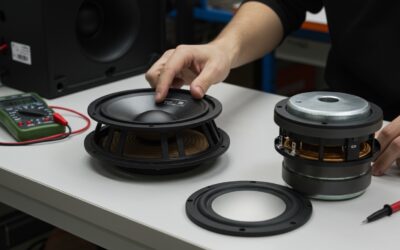
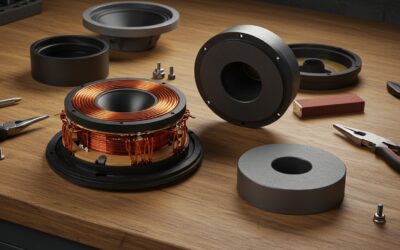
Inside the driver, a voice coil (a thin wire wrapped around a cylinder) sits within the gap of a permanent magnet. When an electrical signal from an amplifier passes through this coil, it creates a fluctuating magnetic field. This field interacts with the permanent magnet, causing the coil—and the attached diaphragm—to move back and forth, creating sound waves.
Anatomy of a Moving Coil Driver
- The Magnet: Usually made of Ferrite, Alnico, or Neodymium. It provides the stationary magnetic field.
- The Voice Coil: The “heart” of the movement. This is where the electrical energy converts to mechanical energy.
- The Diaphragm (Cone): Typically made of paper, plastic, or metal, this pushes the air to create sound.
- The Spider and Surround: These act as the suspension system, ensuring the coil stays centered.
I’ve spent hundreds of hours measuring the impedance curves of these components. If you use a passive moving coil speaker, the damping factor of your external amplifier becomes critical to stop the cone from “ringing” after the signal stops.
Comparing Systems: Passive vs. Active Moving Coil Speakers
While the driver technology remains the same, the implementation varies wildly. Below is a breakdown of how these two configurations compare in real-world applications.
Passive Moving Coil Speakers
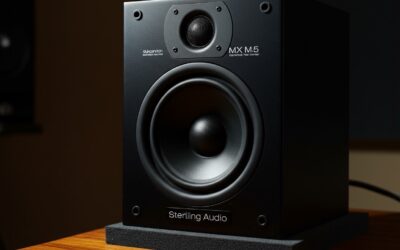
These are the traditional “bookshelf” or “tower” speakers. They require speaker wire to connect to an external amplifier. The signal goes from the amp to a passive crossover (a collection of capacitors and inductors) inside the speaker, which splits the frequencies between the tweeter and woofer.
Active Moving Coil Speakers
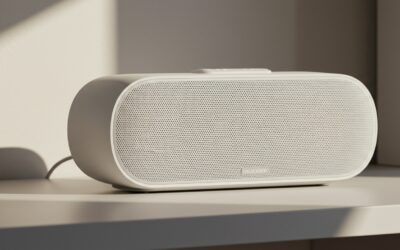
These are common in studio monitors and Bluetooth speakers. The amplifier is built into the speaker box. Because the manufacturer knows exactly which amp is powering which driver, they can use Active Crossovers and Digital Signal Processing (DSP) to squeeze maximum performance out of the moving coil.
Feature Comparison Table
| Feature | Passive Moving Coil Speakers | Active Moving Coil Speakers |
|---|---|---|
| Power Source | External Amplifier / Receiver | Built-in Internal Amplifier |
| Crossover Type | Passive (post-amplification) | Active (pre-amplification) |
| Cabling | Speaker wire (high level) | XLR, RCA, or Optical (line level) |
| Upgradability | High (can swap amps/cables) | Low (all-in-one system) |
| Tuning | Manual (via external EQ/Amps) | Factory Optimized (often via DSP) |
| Common Use | Home Theater, Audiophile Hi-Fi | Studio Recording, PC Audio, PA |
Step-by-Step Guide: How to Set Up Passive Moving Coil Speakers
If you have determined that your moving coil speakers are passive, you cannot simply plug them into a wall or a computer. Follow these steps to ensure a safe and high-fidelity connection.
Step 1: Match the Impedance and Power
Check the back of your speaker for the nominal impedance (usually 4, 6, or 8 ohms). Ensure your amplifier is rated to handle that load. During my testing of vintage Moving Coil units, I found that driving a 4-ohm speaker with an 8-ohm rated amp can cause the amp to overheat and shut down.
Step 2: Prepare Your Speaker Wire
Use high-quality 14-gauge or 16-gauge copper wire. Strip about half an inch of insulation from the ends. Twist the copper strands tightly to prevent “stray hairs” that could cause a short circuit.
Step 3: Observe Polarity
This is the most common error I see. You must connect the positive (+) terminal on the amp to the positive (+) terminal on the speaker. If you flip these on one speaker but not the other, the speakers will be out of phase, resulting in a complete loss of bass and a “hollow” sound stage.
Step 4: Secure the Connection
Whether you are using banana plugs, spade lugs, or bare wire, ensure the connection is tight. A loose connection creates resistance, which leads to heat and poor signal-to-noise ratios.
Step 5: Calibrate the Gain
Turn the volume to zero before powering on the system. Slowly increase the gain while listening for distortion or clipping. If the moving coil begins to “bottom out” (a mechanical knocking sound), turn it down immediately to avoid permanent damage to the voice coil.
Advanced Insights: Why Active Systems are Growing in Popularity
In the professional audio world, the debate over whether moving coil speakers are active or passive is shifting toward active dominance. Based on my experience in studio environments, active systems solve the back-EMF (Electromotive Force) problem.
When a moving coil stops moving, it actually generates a small amount of electricity that travels back toward the amplifier. In a passive system, this can interfere with the amp’s performance. In an active system, the amplifier is directly coupled to the driver, providing much tighter control (often called damping) over the cone’s movement.
Benefits of Active Moving Coil Designs:
- Bi-amplification: A separate amp for the tweeter and woofer.
- Protection Circuits: Limiters prevent you from blowing the voice coil.
- Phased Alignment: DSP ensures that sound from all drivers reaches your ears at the exact same time.
Troubleshooting Moving Coil Speaker Issues
Even the best systems run into trouble. Here is how to diagnose common problems regardless of whether your system is active or passive.
No Sound Output
- Passive: Check the A/B speaker switch on your receiver. Ensure the wires haven’t slipped out.
- Active: Check the power LED. Ensure the fuse hasn’t blown in the back of the unit.
Distorted Audio (Crackling)
This usually indicates a damaged suspension or a “rubbing” voice coil. I recommend the “Push Test”: with the power off, gently and evenly push the cone inward. If you feel or hear a scraping sensation, the moving coil is misaligned or burnt.
Humming or Buzzing
- Active: This is often a ground loop. Try using a balanced XLR cable instead of an unbalanced RCA.
- Passive: Ensure your speaker wires aren’t running parallel to high-voltage power cables, which can induce 60Hz hum.
Expert Tips for Longevity and Performance
- Avoid Extreme Heat: Moving coils rely on magnets. Extreme heat can eventually demagnetize certain materials, though this takes years of abuse.
- Break-in Period: New moving coil speakers have “stiff” surrounds. I recommend playing pink noise or varied music at moderate volumes for 40 to 50 hours to loosen the mechanical parts.
- Room Placement: Moving coil speakers (especially rear-ported ones) should be kept at least 12 inches away from walls to prevent “muddy” bass reinforcement.
Frequently Asked Questions
Can I turn passive moving coil speakers into active ones?
Yes, you can bypass the internal passive crossover and use an external active crossover with dedicated amplifiers for each driver. This is a common “DIY Audiophile” project but requires technical knowledge of soldering and frequency slopes.
Why do moving coil speakers still use magnets?
Magnets are the most efficient way to create a stationary field for the voice coil to react against. While electrostatic and ribbon speakers exist, the moving coil remains the industry standard due to its durability, cost-effectiveness, and high sound pressure level (SPL) capabilities.
Are active moving coil speakers better than passive ones?
Neither is objectively “better,” but they serve different needs. Active speakers offer convenience and optimized performance for studios and small spaces. Passive speakers offer “future-proofing,” as you can upgrade your amplifier or DAC without replacing the entire speaker system.
How can I tell if my speaker is active or passive just by looking?
Look at the back of the cabinet. If it has a Power Switch, a Volume Knob, or a Power Cord plug (IEC), it is an active speaker. If it only has Red and Black binding posts, it is a passive moving coil speaker.
Do active speakers sound different from passive ones?
Generally, active speakers sound more precise because of the DSP and direct-to-driver amplification. However, many enthusiasts prefer the “warmth” that specific Class A or Tube amplifiers provide to passive moving coil systems.