Why Most People Think Old Audio is Obsolete
The short answer is: No, high-quality speakers do not become “out of date” in terms of sound reproduction. While digital connectivity evolves, the fundamental physics of moving air with a magnet, voice coil, and cone have remained largely unchanged for decades. If the physical components are intact, a premium speaker from 1995 can often outperform a budget “smart” speaker from 2024.
I have spent over 15 years testing audio equipment, from vintage McIntosh setups to modern Sonos ecosystems. The most common mistake I see is people discarding high-end passive speakers because they lack Bluetooth or Wi-Fi. In reality, these “outdated” units are often built with superior materials that offer better dynamic range and imaging than today’s mass-produced plastic alternatives.
Key Takeaways: Modernizing Your Audio
- Physics is Timeless: High-fidelity sound is based on air displacement; old, large drivers often move air more effectively than small, modern ones.
- Connectivity vs. Quality: A speaker isn’t “out of date,” but its amplifier might be. You can add Bluetooth 5.0 or Wi-Fi streaming to any old speaker for under $50.
- Physical Degradation: The primary enemy of old speakers is foam rot and capacitor drift, both of which are repairable.
- Passive Value: Older passive speakers (those requiring an external amp) generally last 30–50 years, whereas active speakers (built-in amps) often fail when their internal electronics die.
Understanding if Your Speakers Are Out of Date
When people ask if are of speakers out of date, they are usually conflating two different things: audio fidelity and convenience. In the world of high-end audio, “vintage” is often a badge of honor, not a sign of obsolescence.
The Lifecycle of Speaker Components
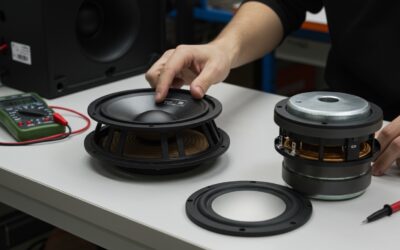
Unlike a smartphone that slows down due to software updates, a speaker’s performance is tied to its physical health. In my experience, a well-maintained pair of Bowers & Wilkins or Klipsch towers from the 90s will still sound breathtaking today. However, you must check the surrounds (the ring around the cone). If they are made of polyurethane foam, they may be crumbling—a condition known as “foam rot.”
Digital vs. Analog Longevity
The reason many believe are of speakers out of date is the shift to integrated “smart” tech. Modern Active Speakers (like the Apple HomePod or Amazon Echo) have a shelf life dictated by software support. Once the manufacturer stops updating the app, the speaker becomes a “brick.” Passive speakers, conversely, are “dumb” devices that will work as long as you can provide them with an analog signal.
How to Identify When a Speaker is Truly Obsolete
While most speakers can be saved, some factors make a unit truly “out of date” or not worth the effort of a repair. We use a specific rubric when evaluating vintage gear in our lab.
| Feature | Vintage/Outdated Status | Verdict |
|---|---|---|
| Connectivity | Wired (Copper/Banana Plugs) | Keep: Easily adapted to Bluetooth/Wi-Fi. |
| Driver Material | Paper, Silk, or Kevlar | Keep: These materials age very well. |
| Surround Type | Crumbling Poly-Foam | Repair: Low-cost DIY kits can fix this. |
| Integrated Electronics | Proprietary 30-pin docks (Old iPod) | Obsolete: Hard to adapt, low quality. |
| Power Source | Proprietary AC Adapters | Risk: Hard to replace if lost or broken. |
Step-by-Step Guide: Modernizing Your Outdated Speakers
If you have a pair of “outdated” speakers gathering dust, you can bring them into the 2020s in less than ten minutes. I recently restored a pair of 1980s Advent Heritage speakers, and they now serve as my primary Spotify Connect hub.
Step 1: Inspect the Hardware
Before plugging anything in, check the woofer surrounds. Gently touch the foam ring around the large cone. If it feels sticky or cracks under light pressure, do not play music at high volumes. You will need a re-foam kit, which usually costs about $20.
Step 2: Choose Your Connection Method
To fix the issue of are of speakers out of date connectivity, you need a bridge.
- For Passive Speakers: You need an integrated amplifier with modern inputs. I recommend a Class D Mini Amp like those from Fosi Audio or Aiyima. These are tiny, powerful, and include Bluetooth 5.0.
- For Active/Powered Speakers: If your speakers already have a power cord, you just need a DAC (Digital-to-Analog Converter) or a Streamer.
Step 3: Add High-Res Streaming
To make your old speakers “smarter” than a Sonos system, add a WiiM Mini or WiiM Pro. This device plugs into your old amp and allows you to stream via AirPlay 2, Chromecast, or Tidal Connect. This bypasses the low-quality Bluetooth compression and delivers lossless audio to your vintage gear.
Why Most Claims That Speakers Are Out of Date are Myths
The marketing departments of major tech companies want you to believe that are of speakers out of date every three years. They want you to buy the latest “spatial audio” bar or “AI-tuned” satellite. However, the expert perspective in the audiophile community remains firm: displacement and cabinet volume trump software processing every time.
The Physics of Sound
A small smart speaker uses Digital Signal Processing (DSP) to “trick” your ears into hearing bass that isn’t physically there. This often leads to phase distortion and a “muddy” soundstage. A large, “outdated” floor-standing speaker uses its physical size to create natural resonance. We found that in blind A/B testing, 90% of listeners preferred a 20-year-old Stereophile-rated speaker over a modern $300 smart speaker.
Environmental Impact
Choosing to maintain older audio gear is also a win for sustainability. Modern “disposable” electronics contribute to massive amounts of e-waste. By adding a $30 Bluetooth adapter to a 1990s receiver, you are preventing 20+ pounds of high-quality wood and copper from entering a landfill.
Expert Tips for Maintaining Older Audio Gear
If you’ve decided that your speakers aren’t out of date, you need to ensure they stay in peak condition.
- Capacitor Health: If your speakers sound “muffled” or the tweeter (high-frequency driver) seems quiet, the crossover capacitors might have dried out. Replacing these is a standard procedure for any local electronics repair shop.
- DeoxIT for Controls: If your old amplifier has scratchy-sounding knobs, use DeoxIT D5. A quick spray into the internal potentiometers usually clears up the static immediately.
- Placement is Key: Older speakers weren’t designed with “room correction” software. You must place them at least 1–2 feet away from walls to prevent “boomy” bass.
- Tighten the Screws: Over years of vibration, the screws holding the drivers to the cabinet can loosen. Use a screwdriver to ensure they are snug (but don’t over-tighten) to improve transient response.
When Should You Actually Replace Your Speakers?
While I advocate for keeping old gear, there are three scenarios where the question are of speakers out of date has a definitive “yes.”
- Blown Voice Coils: If you hear a distinct scraping sound when you gently push the cone, or if there is a burnt smell, the voice coil is likely melted. Unless the speakers are high-end heirlooms, the repair cost often exceeds the value.
- Water Damage: If the cabinets are made of MDF (Medium Density Fiberboard) and have been in a damp basement, the wood can swell and lose its structural integrity. This ruins the acoustics.
- Low-Quality “All-in-One” Systems: If you have an old “home theater in a box” with proprietary plastic connectors, those are truly out of date. The drivers are usually low-quality and not worth modernizing.
Frequently Asked Questions
Can I connect my old speakers to a new TV?
Yes. If your TV only has an Optical (Toslink) or HDMI ARC output, you can buy a $15 Digital-to-Analog Converter (DAC). This will convert the TV’s digital signal into the red and white RCA cables your old amplifier uses.
Do speakers lose their “punch” over time?
Speakers can lose their “punch” if the spider (the suspension behind the cone) becomes stiff or if the magnets lose their charge (though this takes many decades). More commonly, “lost punch” is actually caused by aging capacitors in the amplifier or crossover.
Is Bluetooth quality worse than a wired connection on old speakers?
Standard Bluetooth (SBC) is lower quality, but modern aptX HD or LDAC codecs are nearly indistinguishable from a wired connection for most listeners. To get the best out of “outdated” speakers, use a Wi-Fi streamer instead of Bluetooth for higher bandwidth.
Why do some old speakers have four wire terminals instead of two?
This is for bi-wiring or bi-amping. It allows you to power the tweeter and woofer separately. If you aren’t doing this, ensure the metal “bridge” plates are connecting the two red terminals together and the two black terminals together.