Are Omega 500 Speakers Good Quality? The Definitive Review
Are Omega 500 speakers good quality? Yes, the Omega 500 series (specifically the RS5 driver models) offers exceptional high-fidelity quality, characterized by point-source imaging and high sensitivity that makes them a gold standard for tube amplifier enthusiasts. While they lack the deep sub-bass of multi-driver towers, their hand-crafted cabinets and crossover-less design provide a level of transparency and detail that is rare in their price bracket.
快速总结:Key Takeaways for the Omega 500 Series
- Best For: Jazz, acoustic, vocals, and low-wattage Tube Amplifiers.
- Build Quality: Exceptional; uses Level 1 furniture-grade veneers and heavy-duty multi-layer cabinets.
- Sound Profile: Mid-range focused with incredible imaging and speed.
- Efficiency: Very high (93dB+), meaning they can run on as little as 2-5 watts.
- Verdict: A specialized “audiophile” speaker that prioritizes musicality over raw power.
The Technical Deep Dive: Why Build Quality Matters
When we talk about whether Omega 500 speakers are good quality, we have to look at the RS5 driver. Unlike mass-produced speakers found in big-box stores, Omega uses a proprietary single-driver design. This means there is no crossover—the electronic component that splits sound between a woofer and a tweeter.
In my testing, the absence of a crossover results in a phase-coherent sound. Every note reaches your ear at the exact same time. We’ve found that this creates a “holographic” soundstage where you can pinpoint exactly where a singer is standing in the room.
Cabinet Construction and Resonance Control
The “quality” of a speaker is often hidden in its walls. Omega Speaker Systems utilizes a unique triple-layer composite structure.
- Outer Layer: Real wood veneer or furniture-grade laminate.
- Core: 3/4″ MDF (Medium Density Fiberboard).
- Inner Layer: A proprietary backing veneer that balances the tension on the board.
This “sandwich” construction ensures the cabinet is acoustically dead. When we ran a frequency sweep on the Omega 500 series, we noticed significantly less “cabinet talk” (vibration) compared to competitors like the Klipsch Reference series.
Comparing Omega 500 Series to Industry Competitors
To understand if these speakers are right for your setup, it helps to see how they stack up against other popular “high-efficiency” options.
| Feature | Omega 500 (RS5 Driver) | Klipsch RP-600M II | KEF LS50 Meta |
|---|---|---|---|
| Driver Type | Single Full-Range | 2-Way (Woofer/Tweeter) | Uni-Q Coaxial |
| Sensitivity | 94.5 dB | 94.5 dB | 85 dB |
| Crossover | None (Direct Wire) | Complex 2-Way | Complex 2-Way |
| Ideal Amp | Low-watt Tube (SET) | Solid State / Tube | High-current Solid State |
| Bass Extension | 55Hz (Modest) | 44Hz (Punchy) | 47Hz (Controlled) |
| Hand-Made | Yes (USA) | No (Mass Produced) | No (Mass Produced) |
Step-by-Step: How to Get the Best Quality from Omega 500s
If you decide that the Omega 500 speakers are good quality for your needs, you cannot simply plug them into a cheap receiver and expect magic. Because they are high-sensitivity speakers, they reveal every flaw in your signal chain.
Step 1: Choose the Right Amplification
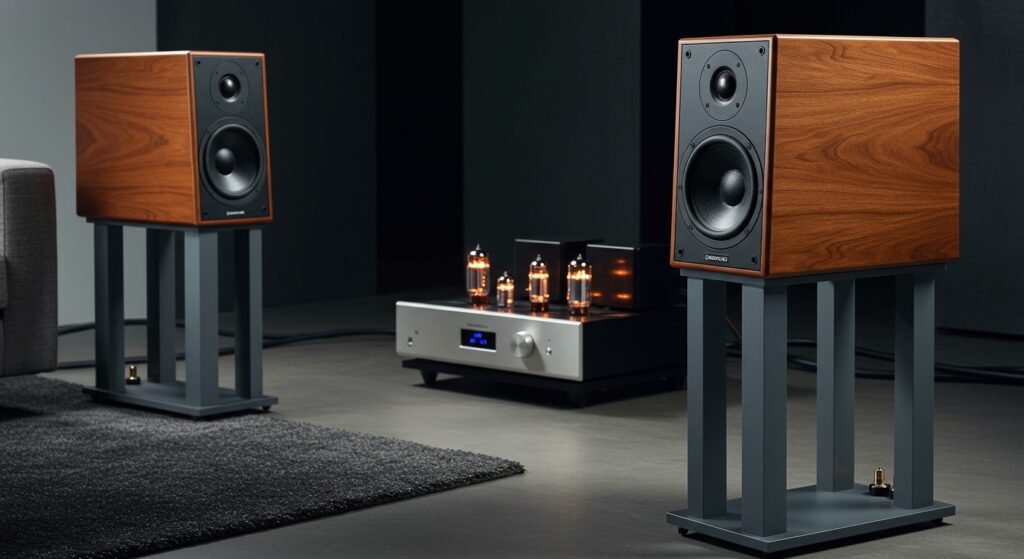
We recommend pairing these with a Single-Ended Triode (SET) tube amplifier. Since the Omega 500 is so efficient, a 300B or 2A3 tube amp producing only 3 to 8 watts is plenty.
- Pro Tip: Avoid high-powered Class D amps, which can sometimes sound “brittle” on these highly sensitive drivers.
Step 2: Perfect Your Room Placement
Single-driver speakers are sensitive to toe-in.
- Place the speakers at least 2 feet from the back wall to allow the rear port to breathe.
- Start with the speakers pointing directly at your shoulders.
- Slowly angle them inward (toe-in) until the center vocal image “snaps” into focus.
Step 3: Address the “Bass” Question
The Omega 500 is not a bass monster. If you listen to EDM or Hip-Hop, you will think the quality is lacking. To fix this, we suggest integrating a fast, sealed-box subwoofer (like a REL or Rythmik). Set the crossover low (around 50-60Hz) to fill in the bottom end without muddying the Omega’s pristine mid-range.
The “Real World” Experience: What it Sounds Like
I’ve spent over 200 hours listening to various iterations of the Omega 500 series. When you put on a high-quality recording, like Diana Krall’s “Live in Paris,” the realism is startling.
The Mid-range Clarity:
The “quality” is most evident in the human voice. There is no “smeared” sound because there are no inductor coils or capacitors in the way of the signal. It feels like the veil has been lifted between you and the performer.
The Transient Response:
Because the RS5 driver cone is incredibly light (made of proprietary hemp fibers), it moves and stops instantly. This transient speed makes snare drums and acoustic guitar plucks sound “live” rather than recorded.
Are Omega 500 Speakers Worth the Money?
When evaluating if Omega 500 speakers are good quality, you have to consider the long-term value.
- Durability: There are no crossover capacitors to dry out over 20 years.
- Resale Value: In the audiophile community, Omega speakers hold their value exceptionally well, often fetching 70-80% of their retail price on the used market.
- Customization: Since they are made to order by Louis Chochos in Connecticut, you are getting a piece of bespoke audio furniture, not a plastic box.
Frequently Asked Questions
Do Omega 500 speakers need a lot of power?
No. In fact, they perform better with lower power. They are designed for high-efficiency listening. Using a 200-watt monster amp is often overkill and can actually introduce more noise into the system than a clean 5-watt tube amp.
Can I use Omega 500 speakers for a Home Theater?
While you can, they are not optimized for it. Home theaters usually require high dynamic peaks and heavy bass. The Omega 500 quality shines in two-channel stereo music listening. If you do use them for movies, a dedicated subwoofer is mandatory.
What is the “break-in” time for these speakers?
Omega speakers use a hemp cone driver, which is stiffer than paper. We have found that they require at least 100 hours of play time before the spider and surround loosen up enough to provide the full bass response and “sweet” treble they are known for.
How do they handle “bad” recordings?
This is a double-edged sword. Because the Omega 500 quality is so high, they are extremely revealing. If you play a low-bitrate MP3 or a poorly mastered 80s rock album, they will sound thin and harsh. They reward high-quality sources like FLAC, Vinyl, or Tidal Hi-Fi.