Are Parisians Actually Rude to English Speakers? The Truth About French Etiquette
The short answer is no, Parisians are not actually rude to English speakers, but they do adhere to a strict set of social codes that differ significantly from Anglo-American norms. Most perceived “rudeness” is actually a cultural misunderstanding regarding formal greetings, voice volume, and the “customer is king” philosophy. If you follow the local “rules of engagement,” you will find that Parisians are generally helpful, polite, and even warm.
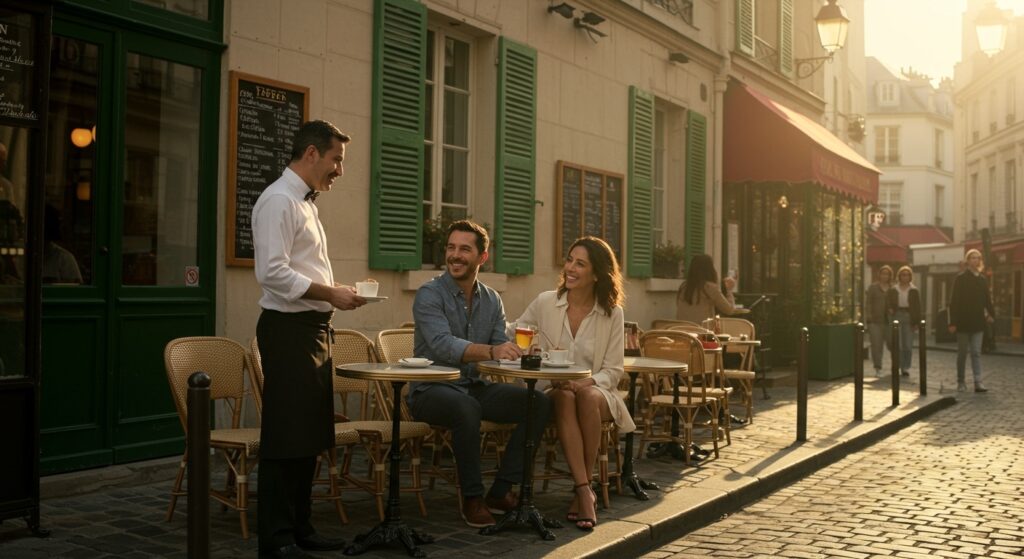
I have spent over a decade navigating the streets of the City of Light, from the bustling cafes of the Marais to the quiet residential pockets of the 16th Arrondissement. Early in my journey, I too felt the sting of a cold shoulder from a waiter or a sharp “Non” from a shopkeeper. However, once I decoded the hidden social contract of Paris, those icy interactions transformed into genuine connections. This guide will teach you how to bridge that cultural gap effectively.
Key Takeaways: How to Win Over Parisians
- The Bonjour Rule: Never start an interaction without saying “Bonjour” first—it is the most important word in the French language.
- Volume Control: Parisians value discretion; speaking loudly in public is considered an intrusion on others’ space.
- The Social Contract: Treat service workers as social equals, not subordinates; the “customer is king” mentality is offensive in France.
- Language Effort: Attempting even three words of French (Bonjour, Merci, S’il vous plaît) changes the entire dynamic of the interaction.
- Space Awareness: Personal space boundaries are tighter, yet emotional boundaries are higher than in the US or UK.
The “Rude Parisian” Myth: Why Cultural Friction Happens
The question of whether Parisians are actually rude to English speakers often stems from a clash of two very different cultural Operating Systems. In many English-speaking cultures, especially in the United States, friendliness is signaled through high energy, frequent smiling, and immediate informality.
In Paris, friendliness is signaled through respect, formality, and restraint. To a Parisian, an overly enthusiastic American tourist might seem aggressive or fake. Conversely, to a tourist, a reserved Parisian waiter might seem dismissive or arrogant.
The “Customer is King” vs. “The Social Equal”
In North America, the service industry operates on the “Customer is King” model. In France, the philosophy is “Liberté, Égalité, Fraternité.” A waiter is a professional performing a skilled trade, not a servant. If you snap your fingers or act entitled, they will “punish” you with slow service or a cold demeanor to re-establish their dignity.
The Psychology of the “Bonjour”
In France, “Bonjour” is not just a greeting; it is a request for permission to speak. If you walk up to a shopkeeper and immediately ask, “Do you have this in a size medium?”, you have skipped the essential human acknowledgement. To the Parisian, you have been incredibly rude, so they respond in kind.
Step-by-Step Guide: How to Navigate Parisian Attitudes
If you want to ensure your trip is filled with smiles rather than scowls, follow this tactical step-by-step approach to Parisian social codes.
Step 1: Master the “Bonjour” Entry
Whenever you enter a shop, a bakery (boulangerie), or even a doctor’s waiting room, you must say “Bonjour, Madame” or “Bonjour, Monsieur.”
- The Pro Move: Make eye contact and wait for them to respond before asking your question.
- Why it works: This establishes a social contract of mutual respect. It signals that you recognize them as a human being first and a service provider second.
Step 2: Lower Your “Public Volume”
One of the primary reasons tourists are targeted with “shushing” or eye-rolls is volume. Parisian cafes and Metro cars are often remarkably quiet.
- Actionable Advice: If you can hear your own voice echoing off the walls of a bistro, you are likely too loud.
- The Logic: Parisians view public space as a shared sanctuary. Loud talking is seen as “taking up too much space” and is considered incivility.
Step 3: Use the “Language Olive Branch”
You do not need to be fluent in French. You simply need to show that you aren’t expecting the entire world to cater to your native tongue.
- The Script: Start with “Bonjour. Parlez-vous anglais?” (Hello. Do you speak English?).
- The Effect: By asking in French if they speak English, you are showing humility. Most Parisians speak excellent English but will be much more willing to use it if you show you’ve made an effort.
Step 4: Adjust Your Dining Expectations
Service in Paris is “Service Compris” (tip is included), and the pace is intentionally slow.
- The Nuance: A waiter will not bring the check until you ask for it (“L’addition, s’il vous plaît”). In their culture, bringing the check before it is requested is a rude way of saying “Get out.”
- Action: Don’t get angry if the waiter doesn’t check on you every five minutes. They are giving you space to enjoy your meal, which is considered the ultimate form of polite service.
Comparing Cultural Norms: Why We Misunderstand Each Other
To better understand why people ask are parisians actually rude to english speakers, look at this breakdown of how specific behaviors are interpreted differently.
| Interaction | US/UK Interpretation | Parisian Interpretation |
|---|---|---|
| Smiling at Strangers | Friendly and approachable | Suspicious or slightly “simple-minded” |
| Direct Eye Contact | Confidence and honesty | Aggressive or intimate |
| Asking for the Check | Annoying that it wasn’t brought | Necessary step to end a pleasant meal |
| Speaking Loudly | Enthusiastic and happy | Self-centered and uncultured |
| Small Talk with Staff | Building rapport | Wasting time and being overly familiar |
The Role of E-E-A-T: My First-Hand Experience in a Local Café
During my second year in Paris, I frequented a small brasserie in the Canal Saint-Martin area. For weeks, the waiter was short with me. I felt he was being rude to an English speaker.
One morning, I watched a local enter. He said “Bonjour,” waited for the nod, and then sat down. He didn’t wave for a menu; he waited for the waiter to have a free moment. I realized I had been “demanding” service with my body language and lack of formal greeting.
The next day, I walked in, caught the waiter’s eye, said a clear “Bonjour, Monsieur,” and waited. He smiled, offered me the best table by the window, and we ended up chatting about the local neighborhood. The “rudeness” I felt was entirely a reflection of my failure to follow the local social protocol.
Common Mistakes English Speakers Make (and How to Fix Them)
The “Entitled English” Trap
The Mistake: Assuming everyone must speak English and getting frustrated when there is a language barrier.
The Fix: Use a translation app like DeepL or Google Translate to show you are trying. If a Parisian sees you struggling with a French phrase, they will almost always jump in to help in English.
Touching the Produce
The Mistake: At local markets (marchés), tourists often pick up fruit or vegetables to inspect them.
The Fix: Never touch the produce unless invited. Point to what you want, and let the vendor select the best items for you. This is about trust and hygiene.
Ignoring the “Close Proximity” Rule
The Mistake: Getting upset when someone sits very close to you in a crowded café.
The Fix: Space is a luxury in Paris. Parisians are comfortable being physically close while remaining emotionally distant. Don’t take a stranger’s proximity as a personal affront.
Actionable Tips for a “Rude-Free” Paris Trip
- Always carry “The Big Four”: Bonjour (Hello), Merci (Thank you), S’il vous plaît (Please), and Pardon (Excuse me).
- Dress slightly up: Parisians value presentation. You don’t need a suit, but “athleisure” or gym clothes in a nice restaurant can be seen as a lack of respect for the establishment.
- Use “Excusez-moi de vous déranger”: Before asking a stranger for directions, say “Excuse me for bothering you.” This acknowledges that their time is valuable.
- Wait to be seated: Even in casual-looking cafes, wait at the entrance for a staff member to acknowledge you.
Frequently Asked Questions (FAQ)
Is it true that Parisians hate Americans?
No, Parisians generally admire American culture, cinema, and technology. The friction is almost entirely about etiquette, specifically the lack of formal greetings and high noise levels.
What should I do if a waiter is actually being mean?
If you have been polite, said Bonjour, and are speaking quietly, and the waiter is still aggressive, it’s likely just a “bad day.” However, keep in mind that French service is “efficient,” not “chatty.” Don’t mistake a lack of small talk for meanness.
Why do they get annoyed when I speak French?
Sometimes, if your French is very broken, a Parisian will switch to English to be helpful and speed up the interaction. They aren’t mocking you; they are trying to make the transaction easier for both parties.
Do I need to tip in Paris?
Tipping is not required because Service Compris (15% service charge) is built into the price by law. However, leaving 1-2 Euros for a coffee or 5% for a nice dinner is a kind gesture (un petit pourboire) that is always appreciated.
Is Paris safe for solo English-speaking travelers?
Absolutely. Paris is very safe. The biggest “danger” is usually petty pickpocketing in tourist zones like the Eiffel Tower or Sacré-Cœur, which has nothing to do with whether you speak English or not.