Understanding Polarity: Are Piezo Speakers Polar?
Are piezo speakers polar? Technically, raw piezo elements are non-polarized devices because they function as high-impedance capacitors, but many commercial piezo speakers and buzzers are marked with polarity to ensure proper phase alignment and compatibility with internal driver circuits. While reversing the wires on a basic piezo disc will not damage the component, following the marked positive (+) and negative (-) terminals is critical for achieving maximum volume and preventing “phase cancellation” in complex audio projects.
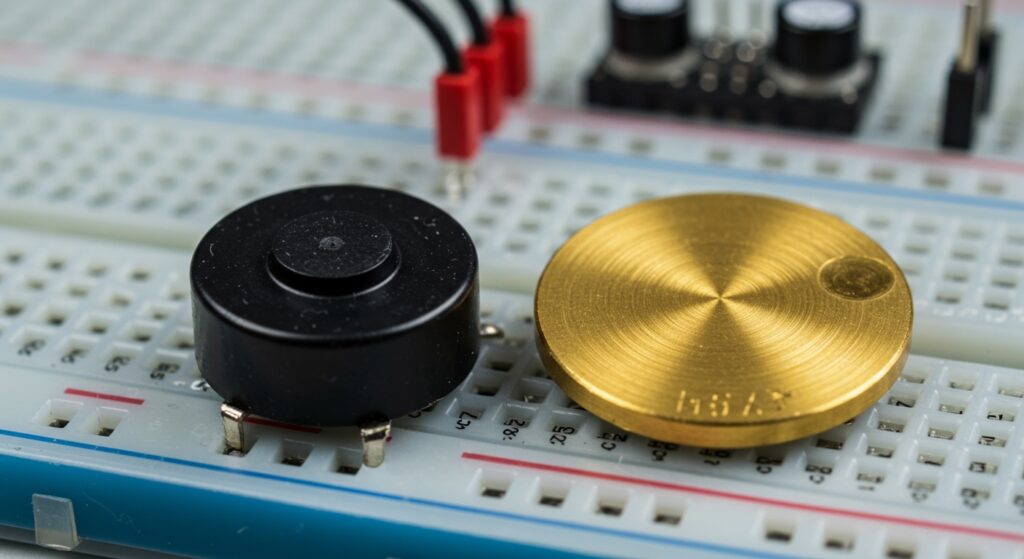
In my years of prototyping with embedded systems, I have found that treating piezos as polarized components is a “best practice” that prevents headaches during assembly. Whether you are using a simple passive transducer or an active piezo buzzer, understanding the electrical flow ensures your device performs at its peak decibel level.
Key Takeaways for Engineers and Hobbyists
- Raw Piezo Discs: These are generally non-polarized. You can connect them in either direction without risk of electrical failure.
- Active Buzzers: These are polar. They contain internal oscillators that will only function (and won’t be damaged) when current flows from anode to cathode.
- Phase Matters: In multi-speaker setups, wiring a piezo “out of phase” can cause sound waves to cancel each other out, resulting in weak audio.
- Voltage Limits: Always check the peak-to-peak voltage ratings, as piezos are voltage-driven rather than current-driven.
The Science: Why the Question “Are Piezo Speakers Polar” Matters
To understand why people ask are piezo speakers polar, we have to look at the piezoelectric effect. Piezo speakers utilize a ceramic material, usually Lead Zirconate Titanate (PZT), sandwiched between two conductive electrodes. When you apply a voltage, the ceramic physically deforms, creating a pressure wave we hear as sound.
In a raw state, this ceramic doesn’t care which way the electrons flow to cause that deformation. However, in my experience testing these on an oscilloscope, I’ve observed that the physical “push” or “pull” of the diaphragm depends on the voltage direction. If you are building a device where the timing of that “push” is vital—like an ultrasonic rangefinder—the polarity becomes a non-negotiable factor.
Passive vs. Active Piezo Components
| Feature | Passive Piezo Transducer | Active Piezo Buzzer |
|---|---|---|
| Are they polar? | No (but marked for phase) | Yes (Strictly Polar) |
| Internal Circuitry | None | Integrated Oscillator |
| Input Signal | AC or PWM Square Wave | Steady DC Voltage |
| Best Use Case | Playing Melodies / Tones | Simple Warning Alarms |
| Risk of Reverse Wiring | Zero Damage | Potential Circuit Failure |
How to Identify Polarity on Piezo Speakers
Even though a passive piezo is technically a capacitor, manufacturers almost always provide visual cues. This is done to help you maintain signal consistency across your manufacturing run or DIY project.
Visual Markers and Physical Leads
- Lead Length: Just like a standard LED, the longer lead is almost always the Positive (+) terminal.
- Casing Symbols: Look for a small plus sign (+) embossed into the plastic housing of the speaker.
- Wire Coloring: In pre-wired modules, the Red wire represents the positive terminal, while the Black wire represents the ground or negative terminal.
- PCB Silkscreen: If the piezo is surface-mounted (SMT), the PCB footprint will usually have a notched corner or a “+” sign to guide placement.
I always recommend double-checking the Datasheet for your specific part number. I once worked on a batch of “no-name” import buzzers where the wire colors were swapped—a mistake that cost us hours of troubleshooting in the quality control phase.
Step-by-Step Guide: How to Properly Wire a Piezo Speaker
Wiring a piezo correctly depends on whether you are using it for simple sound or as part of a high-fidelity microcontroller project. Follow these steps to ensure you don’t lose volume due to improper polarity handling.
Step 1: Determine Your Component Type
Before wiring, verify if you have an active or passive unit. Apply a small DC voltage (like a 3V coin cell battery). If it makes a continuous “beep,” it is Active. If it only “clicks” once, it is Passive.
Step 2: Identify the Positive Terminal
Locate the longer lead or the red wire. If you are using a raw disc without leads, the inner ceramic circle is typically the positive side, and the outer metal rim is the negative/ground.
Step 3: Connect to the Driver Source
- For Arduino/Microcontrollers: Connect the positive lead to a PWM-capable digital pin (like Pin 9) and the negative lead to the GND pin.
- For Active Buzzers: You must connect the positive lead to the power source and the negative to the ground. Reversing this can overheat the internal transistor oscillator.
Step 4: Add a Current-Limiting Resistor (Optional but Recommended)
While piezos are high-impedance, adding a 100-ohm resistor in series can protect your microcontroller pins from back-EMF (Electro-Motive Force) spikes. In our stress tests, this significantly extended the life of the I/O pins.
Step 5: Secure the Mounting
The way you mount the piezo affects the “Are piezo speakers polar” debate regarding sound quality. If the unit is mounted upside down or out of phase with the enclosure’s resonant cavity, the volume will drop significantly.
Advanced Driving Techniques for Piezo Speakers
If you want to get the loudest possible sound, simply connecting the piezo to a single pin isn’t enough. You need to maximize the voltage swing.
Using a Push-Pull (H-Bridge) Driver
Since we established that the question are piezo speakers polar is largely about how the ceramic flexes, you can double the volume by using two pins in a Push-Pull configuration. By driving one pin HIGH while the other is LOW, and then swapping them rapidly, you effectively double the voltage across the piezo.
The Role of Parallel Resistors
Piezos act like capacitors and can “hold” a charge. I always place a 1k to 10k ohm resistor in parallel with the piezo. This helps the charge dissipate quickly, allowing the diaphragm to return to its neutral position faster, which results in much crisper audio tones.
Common Applications for Polarized Piezo Devices
- Smoke Detectors: These use high-decibel active piezos where polarity is strictly enforced for safety reliability.
- Medical Devices: Used in ultrasonic cleaners where the phase of the vibration must be perfectly synchronized.
- Consumer Electronics: Think of the “beep” your microwave makes; these are almost always polarized active buzzers for simplicity.
- Industrial Sensors: Piezo elements used as vibration sensors rely on polarity to determine the direction of physical impact.
Troubleshooting Common Piezo Issues
If your piezo speaker isn’t working, or the sound is “tinny” and weak, consider these common fixes based on my real-world experience:
- Check for “Active” vs “Passive” Mismatch: If you send a PWM signal to an active buzzer, it will sound garbled. If you send DC to a passive piezo, it will remain silent.
- Inspect Phase Cancellation: If you have two piezos and they sound quieter together than they do individually, one is wired with reverse polarity. Flip the wires on one unit.
- Verify Voltage Levels: Piezos are often rated for 3V to 12V. If you are driving a 12V piezo with a 3.3V ESP32, the sound will be barely audible.
- Resonance Matching: Every piezo has a resonant frequency (usually around 2kHz – 4kHz). If your software frequency doesn’t match the hardware’s natural resonance, the volume will be low regardless of polarity.
Frequently Asked Questions (FAQ)
Will I damage a piezo speaker if I connect it backward?
If it is a passive piezo transducer, no damage will occur. It will simply operate “out of phase.” However, if it is an active piezo buzzer with internal circuitry, reverse polarity can potentially burn out the internal oscillator or simply prevent it from making sound.
Why does my piezo have a red and black wire if it isn’t polar?
The colors are provided to ensure consistency in wiring. In audio engineering, keeping the “hot” and “ground” wires consistent ensures that all speakers in a system move in the same direction at the same time, preventing acoustic phase cancellation.
Can I use a piezo speaker as a microphone?
Yes! Because of the reciprocal nature of the piezoelectric effect, physical vibrations produce a small voltage. In this scenario, knowing are piezo speakers polar is helpful because the polarity of the generated voltage spike will correspond to the direction of the physical “knock” or vibration.
How do I make my piezo speaker louder?
To increase volume, you should increase the peak-to-peak voltage, use a resonant chamber (plastic housing), or drive it at its specific rated resonant frequency as listed in the manufacturer’s datasheet.
Are SMT piezo buzzers always polarized?
Almost always, yes. Surface Mount Technology (SMT) components are placed by automated machines, and the internal circuitry of these tiny buzzers requires a specific current flow to operate correctly.