The Truth About Emergency Vehicle Audio: Are Police Speakers Tweeters?
When you hear a patrol car clearing an intersection, you aren’t just hearing a loud radio—you are hearing a specialized piece of acoustic engineering. Are police speakers tweeters? The short answer is no; while they handle high frequencies similar to a tweeter, they are actually high-output compression drivers designed to project sound over massive distances through a horn-loaded assembly.
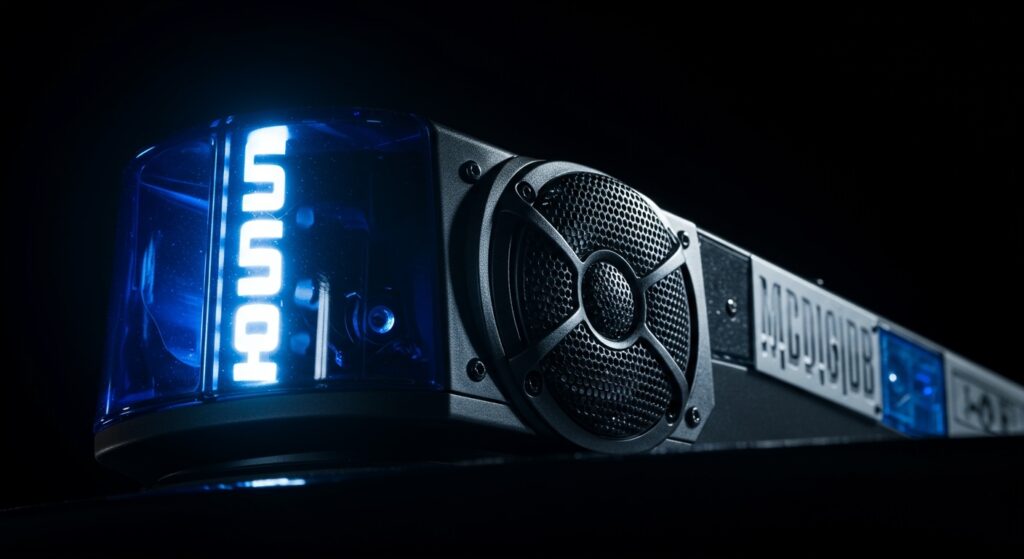
In my years of outfitting emergency vehicles and testing siren systems, I’ve found that while a tweeter is built for musical nuance, a police speaker is built for pure, raw decibel penetration. These devices focus on the 300 Hz to 10,000 Hz range, which is where the human ear is most sensitive and where siren tones (like wail and yelp) are most effective.
Key Takeaways: Police Speakers vs. Tweeters
- Technology: Police speakers use compression drivers, whereas home audio uses dome or ribbon tweeters.
- Durability: Siren speakers are weatherproof and built to withstand road salt, heat, and vibration.
- Power: Most standard units are 100 Watts, significantly higher than a standard car tweeter.
- Impedance: They typically run at 11 ohms, which is unique to emergency vehicle sirens.
- Purpose: They are designed for projection and clarity, not high-fidelity music reproduction.
Why People Ask: Are Police Speakers Tweeters or Something Else?
The confusion stems from how these speakers look and sound. If you take the “bell” or “horn” off a Whelen or Federal Signal unit, you’re left with a small, heavy circular device. To a hobbyist, this looks exactly like a large super tweeter used in “pro-audio” style car stereo builds.
The Anatomy of a Siren Driver
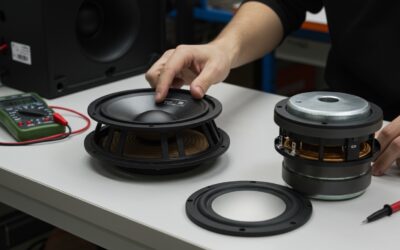
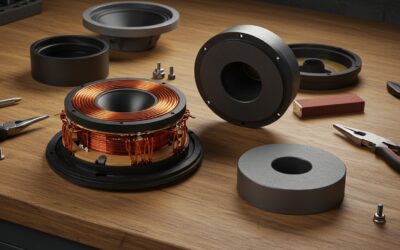
In my workshop, I’ve torn down dozens of these units. Inside, you’ll find a phenolic or plastic diaphragm rather than the silk or aluminum domes found in home speakers. This material is chosen because it won’t shatter under the extreme air pressure required to generate 120+ decibels.
The “speaker” is just the motor. The horn housing (the plastic or metal bell) acts as an acoustic transformer. It matches the high pressure at the diaphragm to the low pressure of the outside air, allowing the sound to “throw” much further than a standard tweeter ever could.
| Feature | Standard Tweeter | Police Siren Speaker |
|---|---|---|
| Primary Use | High-fidelity music | Public safety & Sirens |
| Driver Type | Voice coil/Dome | Compression Driver |
| Frequency Range | 2kHz – 20kHz | 300Hz – 10kHz |
| Decibel Output | ~85-95 dB | 120 – 130 dB |
| Typical Impedance | 4 or 8 Ohms | 11 Ohms |
| Material | Silk, Kevlar, Aluminum | Phenolic, Neodymium |
How Police Speakers Work: Beyond the Tweeter Comparison
To understand why are police speakers tweeters is a “yes and no” question, we have to look at the physics of sound. A tweeter moves back and forth to create waves. A police compression driver works by squeezing sound through a very small opening (the throat) before it expands into the horn.
Neodymium vs. Ferrite Magnets
Modern police speakers, like the Federal Signal DynaMax, use neodymium magnets. These are much smaller and lighter than the old-school ferrite magnets but are significantly more powerful.
When we install these in modern cruisers like the Ford Explorer (PIU), space is at a premium. A neodymium driver allows for a slim profile that fits behind the grille while still delivering the legally required SAE J1849 sound pressure levels.
The Role of Impedance (The 11-Ohm Standard)
This is the most critical technical difference. Most car audio speakers are 4-ohm. If you try to wire a police speaker to a standard car amp, you won’t get much volume because the 11-ohm impedance creates high resistance. Conversely, if you wire a 4-ohm tweeter to a police siren box, you will likely blow the amp or fry the tweeter because the resistance is too low.
Step-by-Step: How to Install and Test a Police Speaker
If you are a volunteer firefighter or a technician installing a new 100W siren speaker, follow these professional steps to ensure the system doesn’t fail when it’s needed most.
Step 1: Choosing the Mounting Location
The goal is “unobstructed projection.” Do not hide the speaker behind a solid bumper.
- Best: Behind the center of the grille.
- Alternative: On a “push bumper” or “bull bar.”
- Avoid: Facing the ground or tucked behind the wheel well, as this muffles the high-frequency tones.
Step 2: Orienting the Horn
Most siren speakers have a “drain” or a specific orientation.
- Pro-Tip: Always ensure the “mouth” of the speaker is slightly angled downward.
- Why?: This prevents rainwater from pooling on the diaphragm, which would cause the speaker to sound “gurgly” or eventually fail due to corrosion.
Step 3: Wiring for 100W vs. 200W Systems
Most standard sirens are 100W. However, many “dual tone” systems use two speakers for 200W of power.
- Parallel Wiring: Connecting two 11-ohm speakers in parallel results in roughly 5.5 ohms. Ensure your siren amplifier is rated for this load.
- Wire Gauge: Use at least 16 AWG marine-grade copper wire. Avoid CCA (Copper Clad Aluminum) as it corrodes rapidly in the salt spray behind a vehicle’s grille.
Step 4: Testing with a Multi-meter
Before connecting to the expensive siren brain, I always perform a “continuity test.”
- Set your multimeter to Ohms (Ω).
- Touch the leads to the two speaker wires.
- You should see a reading between 10 and 12 ohms.
- If it reads 0 (Short) or Infinite (Open), the driver is defective.
Practical Advice: Can You Use Police Speakers for Music?
I often get asked if these can be used as super tweeters for a loud car audio system. While you can, you probably shouldn’t without significant modification.
- The Sound Quality Problem: Because they are designed for sirens, they lack “top end.” They sound “nasal” and harsh. Anything above 10kHz is rolled off significantly.
- The Crossover Requirement: If you do use one, you must use a High Pass Filter (HPF). Sending bass frequencies to a compression driver will shatter the phenolic diaphragm instantly.
- The Efficiency Issue: These speakers are so efficient that they will be 10x louder than your door speakers. You would need an L-pad or gain control to keep them from over-powering the music.
Maintaining Your Siren Speaker for Longevity
Emergency vehicle equipment lives in a harsh environment. In my experience, 90% of “blown” speakers are actually just corroded wires or debris in the horn.
- Quarterly Inspection: Check the mounting bolts. Vibration is the number one killer of siren brackets.
- Debris Removal: Check for leaves, mud, or “road gunk” inside the horn bell.
- Connection Check: Use heat-shrink butt connectors and a dab of dielectric grease. Open-air crimps will fail within one winter season.
Expert Insight: Why Drivers “Blow”
Contrary to popular belief, it’s rarely “too much volume” that kills a police speaker. It is usually DC Offset from a failing amplifier or moisture ingress. When water sits on the diaphragm, it adds weight. When the siren activates, the diaphragm tries to move but the water’s weight causes the voice coil to overheat and melt.
Frequently Asked Questions
Are police speakers tweeters waterproof?
Most are weather-resistant, not fully waterproof. They are designed to handle rain and spray while driving, but they cannot be submerged. The neodymium drivers are usually sealed with gaskets to prevent internal corrosion.
Why are police speakers so loud compared to my car speakers?
Efficiency. A standard car speaker is about 1% efficient (most energy is lost as heat). A horn-loaded compression driver is upwards of 20-30% efficient. This allows them to produce 120+ decibels using only 100 watts of power.
Can I replace the “innards” of a police speaker?
Yes! Most professional brands like Whelen (SA315P) or Federal Signal sell replacement driver kits. You can unscrew the back of the housing and swap the magnet/diaphragm assembly for about half the cost of a new speaker.
What is the difference between a siren driver and a PA speaker?
Functionally, they are the same. However, a “PA Speaker” often has a wider horn to disperse the voice more naturally, whereas a “Siren Speaker” is more focused to project sound directly down the road to clear traffic.
Do all police cars use the same speakers?
No, but they all follow the same 100W / 11-Ohm standard. While the brands vary (Code 3, Feniex, Whelen), the technical specs are standardized so that any brand of siren amp can work with any brand of speaker.