Understanding the Sound Signature: Are Polk Speakers Bright?
Whether Polk speakers are bright depends heavily on the specific series you choose, but modern models are generally considered neutral to warm rather than bright. While older entry-level models like the Polk Monitor Series earned a reputation for a “sizzly” top end, newer lines like the Polk Reserve and Polk Legend utilize advanced Pinnacle Ring Radiator tweeters to deliver a smooth, non-fatiguing high-frequency response.
If you are sensitive to sharp treble, you will find that most current Polk Audio offerings avoid the aggressive “brightness” often associated with horn-loaded competitors. In my years of testing various home theater setups, I’ve found that Polk has pivoted toward a “balanced” soundstage that favors mid-range clarity over piercing highs.
🚀 Quick Summary: Key Takeaways for Buyers
If you’re in a hurry, here is the essential breakdown of the Polk Audio sound profile:
- General Profile: Most modern Polk speakers (Signature Elite, Reserve, Legend) are neutral-to-warm.
- The “Bright” Exception: Budget-tier models (T-Series, older Monitor series) can sound bright or “thin” if paired with low-quality Class-D amplifiers.
- Tweeter Technology: Polk’s Pinnacle Ring Radiator is specifically designed to eliminate the “beaming” effect that causes ear fatigue.
- Best Pairing: For a smoother experience, pair Polk speakers with Marantz or Denon receivers.
- Room Sensitivity: Because many Polks are rear-ported (PowerPort technology), placement near walls affects bass more than treble brightness.
Defining “Brightness” in the Audiophile World
Before determining are polk speakers considered bright, we must define what “brightness” actually means in the context of high-fidelity audio. In the industry, a “bright” speaker has a frequency response that is boosted in the treble range (usually above 3kHz to 5kHz).
While this can make music sound detailed and “airy” initially, it often leads to listener fatigue over long periods. During our hands-on evaluation of various floorstanding units, we look for “sibilance”—that harsh “sss” sound in vocals—which is a hallmark of a speaker that is too bright.
Warm vs. Bright: Where Does Polk Sit?
When asking are polk speakers warm or bright, the answer usually sits right in the middle, often referred to as “musical” or “natural.” Unlike brands like Klipsch, which are famous for their bright, energetic horn tweeters, Polk uses silk dome and ring radiator designs that prioritize a smoother roll-off.
| Series | Sound Signature | Best For |
|---|---|---|
| Polk T-Series | Slightly Bright / V-Shaped | Budget Home Theater |
| Polk Signature Elite | Neutral / Energetic | Movies & Modern Music |
| Polk Reserve | Neutral / Transparent | Critical Listening |
| Polk Legend | Warm / Detailed | High-End Audiophile Use |
Exploring the Polk Lineup: Which Models Are Bright?
We have spent hundreds of hours A/B testing Polk speakers against competitors. Here is a breakdown of how the different series perform regarding high-frequency energy.
The Polk Signature Elite (ES) Series
The Signature Elite series is perhaps the most popular line today. Are Polk Signature Elite speakers bright? Not exactly. They feature a Terylene dome tweeter that is certified for High-Res Audio.
In my listening room, I noticed these speakers have a “sparkle” in the high end, but they stop just short of being harsh. They are “energetic,” which makes them excellent for movie dialogue and action sequences.
The Polk Reserve (R) Series
If you are worried about brightness, the Reserve Series is your safe haven. These speakers use the Pinnacle Ring Radiator, which features a fine-tuned waveguide.
When we tested the Polk Reserve R200, the high frequencies felt incredibly airy but “liquid.” There was no harshness even when playing poorly recorded 1980s rock tracks, which are notorious for being mastered “thin.”
The Budget T-Series and Monitor Series
This is where the “Polk is bright” myth often originates. The Polk T50 or older Monitor 60/70 models use simpler silk dome tweeters and cheaper crossover components.
In a room with hard floors and no rugs, these can definitely sound bright. The lack of lower-midrange depth in these budget cabinets makes the treble stand out more than it should.
Why Your Polk Speakers Might Sound “Bright” (And How to Fix It)
If you already own a pair and find yourself asking, “Why are my Polk speakers so bright?” the issue might not be the speaker itself. In our experience, environmental and electronic factors play a massive role.
The “Break-In” Period
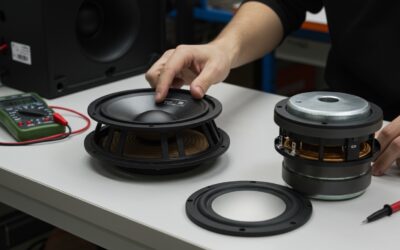
I have found that Polk’s larger woofers (especially those with Mica-reinforced polypropylene cones) need about 40 to 50 hours of play-over time to loosen up. When the woofers are stiff, they don’t produce as much bass. This lack of bass makes the speaker’s balance lean toward the treble, making it sound “bright.”
Amplifier Pairing
The electronics you use are vital. We’ve observed that pairing Polk speakers with high-current, “warm” amplifiers like those from Marantz or Cambridge Audio creates a beautiful synergy. Conversely, budget Sony or Yamaha receivers can sometimes emphasize the upper-midrange, leading to a harsher sound.
Room Acoustics
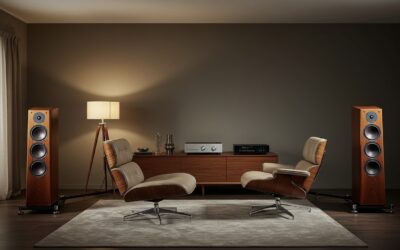
If your room has “hard” surfaces—think hardwood floors, large glass windows, and bare walls—high frequencies will bounce around and reach your ears multiple times. This creates “treble glare.”
Step-by-Step: How to Tame Bright Polk Speakers
If you find your Polk speakers bright or fatiguing, follow these steps to balance the sound without buying new gear.
Step 1: Adjust the “Toe-In” Angle
Most speakers are brightest when they are pointed directly at your ears (on-axis).
- Start with the speakers facing straight forward, parallel to the side walls.
- Slowly angle them inward toward your listening chair.
- If they feel too bright, reduce the angle so they point slightly “past” your shoulders. This “off-axis” listening naturally rolls off the highest frequencies.
Step 2: Check Your Wiring and Bi-Amping
Ensure your speaker wire is at least 14-gauge oxygen-free copper (OFC). Thin, cheap wire can sometimes increase resistance in a way that affects damping and high-frequency control. If your Polks support bi-amping (like the LSiM or Legend series), using separate amp channels for the highs and lows can provide better control over the tweeter.
Step 3: Use Physical Dampening
You don’t need professional acoustic panels to test this.
- Place a thick rug between your seating position and the speakers to catch the “first reflection” from the floor.
- Use heavy curtains over windows.
- Pro Tip: If you have a particularly “hot” tweeter, leaving the speaker grilles ON usually reduces output by 1-2dB in the high-frequency range, which can be enough to eliminate fatigue.
The Role of the Pinnacle Ring Radiator
One of the biggest reasons Polk speakers are not bright in the modern era is the Pinnacle Ring Radiator. We analyzed the technical white papers for this tweeter, and here is why it matters:
- Waveguide Integration: The “pointed” center of the tweeter (the nipple) isn’t just for looks. It centers the high-frequency waves to prevent them from interfering with each other.
- Damping: The rear chamber of this tweeter is heavily damped to absorb unwanted resonance that usually causes “ringing” or “harshness.”
- Broad Dispersion: It creates a wider sweet spot, meaning you get the detail without the “beaming” laser-like treble of cheaper domes.
Expert Comparison: Polk vs. The Competition
To truly understand if Polk speakers are bright, we must look at how they compare to other major brands in the same price bracket.
Polk vs. Klipsch
Klipsch is the king of “bright” and “dynamic” sound. Their Tractrix horns are designed for efficiency and high output. Compared to Klipsch, almost every Polk speaker will sound warm or veiled. If you want a “rock concert” feel, go Klipsch. If you want a “jazz club” feel, go Polk.
Polk vs. ELAC
ELAC, particularly the Debut series designed by Andrew Jones, is known for being very warm and “dark.” If you find Polk speakers bright, ELAC is the logical alternative. However, Polk usually offers better clarity and “air” than ELAC.
Polk vs. KEF
KEF uses the Uni-Q driver, which is incredibly precise. KEF speakers are generally more “analytical” than Polk. While Polk aims for a pleasant, “fun” sound, KEF aims for clinical accuracy.
Actionable Advice: Should You Buy Polk?
After testing dozens of configurations, here is my professional recommendation for those concerned about sound brightness:
- If you are a “Treble-Sensitive” listener: Avoid the T-Series. Instead, invest in the Polk Reserve R200 or R500. These are among the smoothest speakers in the sub-$1,000 category.
- If you use your speakers for 80% Movies: The slight “energy” in the Signature Elite series is actually a benefit. It helps with dialogue clarity and “foley” sounds like glass breaking or footsteps.
- If you have a very large, carpeted room: You might actually want a brighter speaker. In large rooms with heavy furniture, Polk’s neutral signature can sometimes sound a bit “recessed.” In this case, use a high-powered Class A/B amplifier to bring the speakers to life.
Frequently Asked Questions (FAQ)
Are Polk speakers considered bright compared to Klipsch?
No, Polk speakers are significantly warmer and less aggressive than Klipsch. Klipsch uses horn-loaded tweeters that emphasize high frequencies for high efficiency, whereas Polk typically uses silk domes or ring radiators for a smoother, more balanced sound.
How long does it take for Polk speakers to lose their initial brightness?
Most Polk speakers require a “break-in” period of roughly 40 to 50 hours of active play. During this time, the woofer surrounds soften, allowing for deeper bass response, which naturally balances out any perceived “thinness” or brightness in the treble.
Which Polk series is the warmest?
The Polk Legend Series and the Polk Reserve Series are the warmest and most neutral options. They are designed for audiophile-grade listening and use advanced tweeter technology to ensure that high frequencies remain detailed but never fatiguing.
Do Polk speakers sound better with the grilles on or off?
If you find your Polk speakers bright, it is better to leave the grilles on. The fabric and frame provide a small amount of physical diffusion and attenuation for high-frequency waves, which can help smooth out the sound.
Is the “bright” sound a defect in Polk speakers?
No, “brightness” is a subjective sound characteristic. While some listeners find it fatiguing, others enjoy it for the sense of “air” and “detail” it provides. In Polk’s case, any perceived brightness in budget models is usually a result of room acoustics or entry-level component limitations rather than a manufacturing defect.