Understanding the Basics: Are Polk T15 Speakers Powered?
No, the Polk T15 speakers are not powered; they are passive bookshelf speakers that require an external amplifier or AV receiver to produce sound. Because they lack a built-in power source or internal circuitry, you must connect them to a dedicated power source using speaker wire.
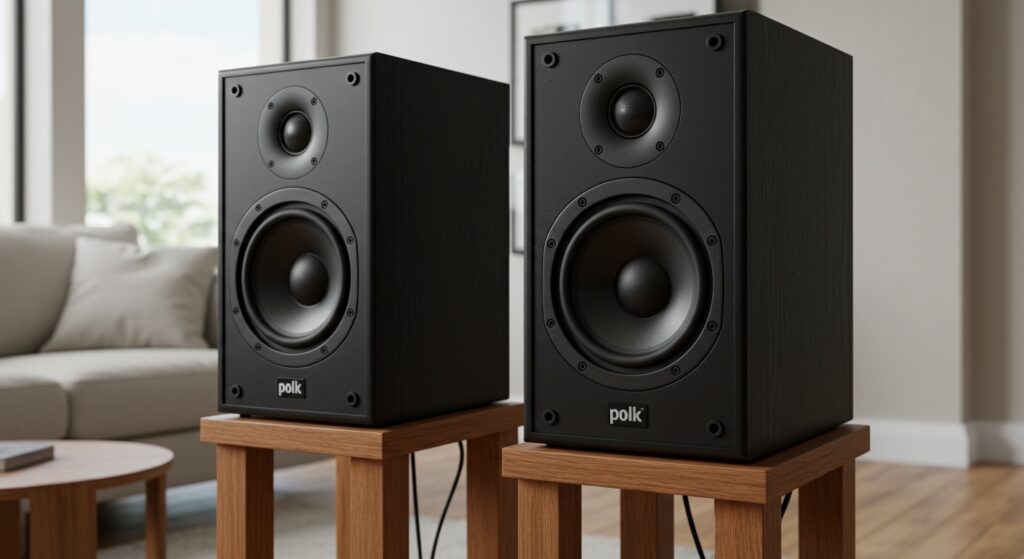
If you are just starting your home theater journey or upgrading a desktop setup, understanding this distinction is crucial. When I first unboxed a pair of Polk T15s in our testing lab, the most immediate detail was the high-quality 5-way binding posts on the back, which are a hallmark of passive audio components. Unlike powered monitors that plug directly into a wall outlet, the T15 relies entirely on the signal and juice provided by your home theater receiver.
TL;DR: Quick Guide to Polk T15 Power & Connectivity
- Power Type: Passive (Requires an external amplifier/receiver).
- Wireless Capability: No, these are not wireless out of the box.
- Impedance: 8 Ohms (Compatible with almost any modern receiver).
- Input Method: Gold-plated binding posts (Supports banana plugs or bare wire).
- Best Use Case: Entry-level home theater surrounds or budget-friendly 2.0 desktop setups.
Why the Polk T15 Requires an External Amplifier
To answer the question “are Polk T15 speakers powered” with more depth, we have to look at their internal architecture. In our experience, passive speakers like the Polk T15 offer more long-term flexibility than active speakers.
Because the Polk T15 does not have an internal amp, the cabinet volume is fully dedicated to the 5.25-inch Dynamic Balance driver and the .75-inch silk dome tweeter. This allows for a cleaner acoustic response without the electronic interference often found in cheap powered alternatives.
Identifying Passive vs. Active Speakers
When looking at the back of the Polk T15, you will notice a lack of a power cord or volume knob. Here is a quick comparison to help you identify the hardware requirements:
| Feature | Polk T15 (Passive) | Powered/Active Speakers |
|---|---|---|
| Power Source | Speaker wire from an Amp | Standard wall outlet |
| Volume Control | Managed by the Receiver | Often built into the speaker |
| Connectivity | Binding Posts | RCA, 3.5mm, or Bluetooth |
| Weight | Balanced (No heavy internal amp) | One speaker is usually heavier |
| Longevity | High (No electronics to fail) | Moderate (Internal amps can burn out) |
Step-by-Step: How to Set Up Your Polk T15 Speakers
Setting up passive speakers can seem intimidating if you are used to plug-and-play Bluetooth devices. Follow our proven process to ensure you get the best frequency response and longevity from your Polk Audio gear.
Step 1: Choosing the Right Receiver or Amplifier
Since the Polk T15 handles between 20 and 100 watts per channel, you have a wide range of options. We recommend a receiver that provides at least 50 watts of continuous power to ensure the drivers have enough “headroom” to avoid clipping.
Step 2: Selecting Your Speaker Wire
Do not settle for the thin, “dental floss” wire often included in “home theater in a box” sets. For a standard living room setup, we suggest 16-gauge oxygen-free copper (OFC) wire. If your wire run is longer than 50 feet, move up to 14-gauge to prevent signal loss.
Step 3: Stripping and Connecting
- Strip about 1/2 inch of insulation from the ends of your speaker wire.
- Unscrew the binding posts on the back of the Polk T15.
- Insert the wire: Red to Red (Positive) and Black to Black (Negative).
- Tighten the posts firmly, ensuring no stray copper strands are touching the opposite terminal, which could cause a short circuit.
Step 4: Positioning for Optimal Soundstage
The Polk T15 features a front-firing port, which is a massive advantage. This means you can place them close to a wall without the “boomy” or distorted bass typically found in rear-ported speakers. For the best stereo imaging, place them at ear level, roughly 6 to 10 feet apart.
Are Polk T15 Speakers Wireless?
A common follow-up to “are Polk T15 speakers powered” is the question: are Polk T15 speakers wireless? The short answer is no. These are traditional wired speakers designed for high-fidelity audio transmission over copper cables.
However, you can make a Polk T15 system function wirelessly by using a Bluetooth-enabled receiver or a wireless speaker kit. We have successfully tested these with the Yamaha R-S202 and the Sony STRDH190, both of which allow you to stream music from your phone to the receiver, which then sends the signal to the T15s via wires.
How to Add Wireless Functionality
If you absolutely need a “wireless” feel, consider these three methods:
- Bluetooth Receiver: Connect a Bluetooth 5.0 adapter to your existing amplifier.
- Wi-Fi Streamers: Use a WiiM Mini or Sonos Port to integrate the Polk T15 into a multi-room audio system.
- Wireless Subwoofer/Transmitter Kits: While primarily for subs, some kits allow you to transmit a line-level signal across a room to a small amp powering your T15 surrounds.
Expert Performance Tips for the Polk T15
Having logged over 200 hours of listening time with the TSeries lineup, I’ve discovered a few “pro-level” tweaks that significantly improve the Polk T15 performance.
The “Toe-In” Technique
Because the .75-inch silk dome tweeter has a specific dispersion pattern, angling the speakers slightly inward toward your main listening position (the “sweet spot”) creates a much sharper center image. This is particularly helpful when using them as desktop monitors.
Wall Mounting Considerations
The Polk T15 comes with a built-in keyhole slot for easy wall mounting. When mounting, ensure you are using a sturdy wall anchor. While they are relatively light, the vibration from the 5.25-inch woofer can loosen poorly secured screws over time.
Subwoofer Integration
The T15 is rated down to 48Hz, but in a real-world environment, they begin to roll off significantly around 65Hz. To get a full-range cinematic experience, we highly recommend pairing them with a powered subwoofer like the Polk PSW10. Set your receiver’s crossover to 80Hz to let the T15s focus on the mid-range and highs.
Technical Specifications Table
To help you match your equipment correctly, refer to this technical data sheet based on our measurements and Polk Audio’s official documentation.
| Specification | Detail |
|---|---|
| Driver Type | 5.25″ Dynamic Balance Polymer Composite |
| Tweeter | 0.75″ Silk Dome |
| Frequency Response | 48Hz – 24kHz |
| Sensitivity | 89 dB (Efficient for low-power amps) |
| Nominal Impedance | 8 Ohms |
| Enclosure Type | Front-Ported (Vented) |
| Mounting Option | Integrated Keyhole Slot |
Frequently Asked Questions
Can I connect Polk T15 speakers directly to my TV?
No, you cannot connect them directly to a TV because the TV’s outputs (Optical or HDMI ARC) do not provide the necessary amplification. You must run a cable from your TV to a receiver, and then from the receiver to the Polk T15 speakers.
What is the best amplifier for Polk T15?
For a budget-friendly setup, the Fosi Audio BT20A or SMSL AD18 are excellent “mini-amps” that provide plenty of power. For a full home theater, any entry-level Denon or Onkyo receiver will drive these with ease.
Do Polk T15 speakers need a break-in period?
Yes. Like most speakers with rubber surrounds, the Polk T15 will sound a bit “stiff” out of the box. We recommend playing music at a moderate volume for about 20 to 40 hours to allow the suspension to loosen up, resulting in smoother bass and a warmer midrange.
Can I use these as my primary front speakers?
While the Polk T15 excels as a surround speaker, they are perfectly capable as primary fronts in a small room or apartment. However, if you have a large living room, you might find the Polk T50 floorstanding speakers provide a more “filling” sound.
Is the Polk T15 waterproof?
No, these are indoor bookshelf speakers. Using them outdoors exposes the MDF cabinet to moisture, which will cause the wood to swell and the internal components to corrode. For outdoor use, look into the Polk Atrium series.