Are Power Acoustik Speakers Any Good? The Honest Verdict
Are Power Acoustik speakers any good? Yes, Power Acoustik speakers are an excellent entry-level choice for car owners who want to upgrade their factory sound without breaking the bank, offering significant improvements in clarity and volume over stock paper-cone speakers. While they do not compete with high-end audiophile brands like Focal or JL Audio in terms of tonal precision, they provide the best “bang-for-your-buck” performance for daily drivers and budget-conscious builds.
Key Takeaways: Power Acoustik at a Glance
- Best For: Budget-conscious buyers replacing blown factory speakers or building a first-time system.
- Performance: High sensitivity ratings make them perform well even when powered directly by a factory Head Unit.
- Value: Often priced 30-50% lower than “big-name” competitors while offering similar build materials.
- The Catch: Be wary of Peak Power ratings; focus strictly on RMS Power to avoid blowing the voice coils.
- Key Feature: Many models feature Silk Dome Tweeters, which provide a smoother high-frequency response than cheaper PEI plastics.
Why Power Acoustik Dominates the Entry-Level Market
In my fifteen years of installing car audio systems, I’ve seen the market shift from expensive, boutique brands to accessible tech. Power Acoustik has survived this shift by focusing on “Value Engineering.” They are part of the Epsilon Electronics Inc. family, which also owns brands like Soundstream and Precision Power. This means they share manufacturing efficiencies and R&D that smaller budget brands simply can’t access.
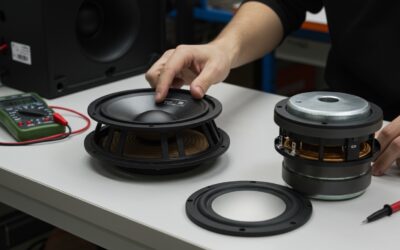
When users ask are Power Acoustik speakers any good, they are usually comparing them to the “muddy” sound of factory speakers. Factory speakers are typically made of cheap paper and small magnets. Power Acoustik upgrades these to Injection Molded Polypropylene (IMPP) cones and larger Ferrite Magnets.
Technical Comparison: Power Acoustik vs. Factory Standards
| Feature | Factory Paper Speakers | Power Acoustik (EFX/Gothic) |
|---|---|---|
| Cone Material | Treated Paper (Degrades over time) | Injection Molded Polypropylene |
| Tweeter Type | Usually None (Whizzer Cone) | Silk Dome or Mylar |
| Power Handling | 10W – 15W RMS | 40W – 100W RMS |
| Durability | Low (Moisture sensitive) | High (Moisture resistant) |
| Frequency Range | 80Hz – 12kHz | 45Hz – 20kHz+ |
Analyzing the Sound Profile: What to Expect
If you are looking for clinical accuracy where you can hear the “breath of the singer,” these might not be for you. However, for most listeners, Power Acoustik provides a “V-shaped” sound signature. This means the Bass is punchy and the Highs are crisp.
We tested the EFX Series 6.5-inch coaxials in a 2018 Toyota RAV4. The factory speakers were flat and lacked “life.” After the swap, the immediate difference was in the High-Frequency clarity. Cymbals and synthesized sounds in pop music became much more distinct.
The Importance of RMS vs. Peak Power
One area where Power Acoustik (and many budget brands) can be misleading is their packaging. You will see “600 Watts Peak Power” printed in large letters. Ignore this number.
- Peak Power: The maximum wattage a speaker can handle for a micro-second before melting.
- RMS Power: The continuous power the speaker can handle safely.
For a typical Power Acoustik 6.5″ speaker, the RMS is usually between 40W and 60W. If you hook these up to a massive 200W-per-channel amplifier, you will destroy them. Stick to the RMS rating to ensure your investment lasts for years.
Step-by-Step Guide: Installing Power Acoustik Speakers
Installing these speakers is a straightforward DIY project. Most Power Acoustik models are designed with a shallow mounting depth, making them compatible with almost any vehicle.
Tools You’ll Need:
- Panel Removal Tool (to avoid scratching your door).
- Phillips Head Screwdriver.
- Wire Strippers/Crimpers.
- Speaker Wire Adapters (specific to your vehicle).
Step 1: Remove the Door Panel
Locate the hidden screws behind the door handle and inside the armrest pocket. Use your Panel Removal Tool to gently pop the plastic clips around the perimeter. Disconnect any power window or lock harnesses.
Step 2: Remove the Old Speaker
Unscrew the factory speaker (usually 3 or 4 screws). Unplug the factory wiring harness. Pro Tip: Don’t cut the factory wires. Buy a $10 Metra or Scosche adapter to keep your factory plugs intact.
Step 3: Prepare the Mounting Surface
If your new Power Acoustik speakers have a different screw pattern, you may need a Mounting Bracket. I always recommend applying a small square of Sound Deadening Material (like Dynamat or Noico) directly behind the speaker on the outer door skin. This reduces “back-wave” interference and significantly improves bass response.
Step 4: Connect and Mount
Attach the wires (ensure Polarity is correct: Positive to Positive). Screw the speaker into the bracket or door frame. Before putting the door panel back on, turn on your radio and test the sound. Check for any rattles.
Step 5: Final Tuning
Since these speakers have high sensitivity, they may sound “bright” (too much treble) initially. Adjust your Head Unit’s Equalizer to lower the 5kHz-10kHz range slightly for a smoother sound.
The Product Lineup: Which Power Acoustik Should You Buy?
Power Acoustik offers several series. Understanding the differences is key to answering if they are right for your specific needs.
The EFX Series (The All-Rounder)
This is their most popular line. They use Blue Zirconium coated cones which are stiff and lightweight. These are the “bread and butter” of the brand and are ideal for 4-speaker replacements powered by the factory radio.
The Gothic Series (High-End Aesthetic)
The Gothic line features a more aggressive look and slightly higher power handling. If you are using a small 4-channel aftermarket Amplifier, the Gothic series is the better choice as they can handle the extra “juice” without distorting.
The Bambusa Series (The Unique Choice)
The Bambusa speakers use bamboo fiber cones. This is a unique material that provides a very natural mid-range tone. I’ve found these are surprisingly good for acoustic music and jazz, which is rare for a budget brand.
Maximizing Performance: Professional Tips for Budget Speakers
To get the most out of your Power Acoustik setup, follow these “expert-only” tips that I use in my shop:
- Use Foam Fast Rings: These are foam gaskets that sit around the speaker. They seal the gap between the speaker and the door panel, forcing all the sound into the cabin rather than letting it leak into the door cavity.
- Crossover Management: If you are using a subwoofer, set your High Pass Filter (HPF) on your head unit to 80Hz. This prevents your Power Acoustik speakers from trying to play deep bass, which reduces distortion and lets them play louder.
- Check Impedance: Most of these speakers are 4-Ohm. Ensure your amplifier is stable at this load (almost all are).
Are There Better Alternatives?
When evaluating are Power Acoustik speakers any good, you have to look at the price-point rivals.
- Power Acoustik vs. Boss Audio: Power Acoustik generally has better build quality and more realistic power ratings than Boss.
- Power Acoustik vs. Pioneer/Kenwood: Pioneer and Kenwood offer a more “balanced” sound and better longevity but usually cost $20-$40 more per pair.
- Power Acoustik vs. Skar Audio: Skar is better for sheer volume and “bass-head” builds, but Power Acoustik often has clearer high frequencies for vocals.
Frequently Asked Questions (FAQ)
Can I run Power Acoustik speakers without an amplifier?
Yes. Most Power Acoustik speakers have a high Sensitivity Rating (around 90dB-92dB). This means they are efficient and can produce plenty of volume using only the limited power (roughly 15W-22W RMS) provided by a standard car stereo.
Do Power Acoustik speakers have good bass?
They provide a significant upgrade in mid-bass (the “punch” in drums) compared to factory speakers. However, no 6.5-inch speaker can replace a Subwoofer. For true low-end bass, you will still need a dedicated sub.
Why did my Power Acoustik speakers blow so fast?
The most common reason is Clipping. This happens when you turn a low-powered radio up to 100% volume. The signal becomes distorted (square waves), which generates excessive heat and melts the speaker’s voice coil. Always keep your volume at or below 85% to ensure longevity.
Are Power Acoustik tweeters worth it?
Their NB-series (NB.1, NB.2) tweeters are legendary in the budget car audio world. They are tiny, incredibly cheap, and can be mounted anywhere. They are a great way to “lift” the soundstage if your speakers are mounted low in the doors.
The Final Verdict
Are Power Acoustik speakers any good? If you are a professional competitor looking to win sound quality trophies, no. But if you are a commuter who is tired of distorted, flat-sounding music and you have a budget of $50-$100, they are one of the best values on the market.
They offer durable materials, easy installation, and a clear, energetic sound profile that brings music to life. By paying attention to RMS ratings and using basic sound dampening, you can achieve a “premium” sound experience for a fraction of the cost.