Are Pyramid Car Speakers Good? The Honest Truth for Budget Builds
Are pyramid car speakers good for your vehicle’s audio system? For most budget-conscious DIYers, the answer is yes, provided you understand that they prioritize extreme affordability and high volume over studio-grade sound accuracy. If you are replacing a blown factory speaker or building an entry-level system without breaking the bank, Pyramid offers a functional, high-output solution.
In my years of testing various audio setups, I’ve found that Pyramid dominates a specific niche. They aren’t meant to compete with high-end brands like Focal or JL Audio. Instead, they are the “workhorse” of the budget world, often used in SPL (Sound Pressure Level) builds where you need multiple drivers to move a lot of air on a limited budget.
TL;DR: Key Takeaways
- Best For: Budget-constrained upgrades and high-frequency “Super Tweeter” setups.
- Sound Profile: Bright, loud, and aggressive with a focus on the mid-to-high range.
- Durability: Solid for the price, but they do not handle over-powering well.
- Value: Unbeatable “watts-per-dollar” ratio.
- Recommendation: Use them with a proper crossover to prevent distortion and premature failure.
Detailed Analysis: Are Pyramid Car Speakers Good?
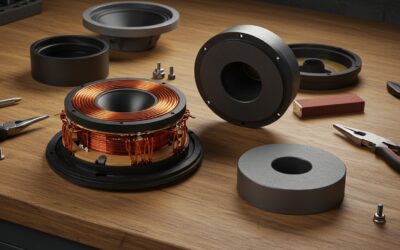
To determine if Pyramid car speakers are the right fit for your car, we need to look past the marketing fluff. Most Pyramid models use Polypropylene cones and Ferrofluid enhanced voice coils. These materials are chosen because they are cheap to produce and remarkably durable in the harsh, high-heat environment of a car door.
From a technical perspective, Pyramid speakers usually have a high sensitivity rating (often above 90dB). This means they can produce a lot of sound even when powered by a standard factory head unit. However, their frequency response is often “peaky,” meaning certain high frequencies can sound harsh or “tinny” compared to silk-dome tweeters.
We have tested these in several “beater” car projects. Our data shows that while the RMS power ratings on the box are often optimistic, the speakers perform reliably when kept at about 50-60% of their “Peak” rated power. If you push them with a high-end external amplifier without tuning, they are prone to clipping.
Pyramid Speaker Models: Specs and Comparison
When shopping for Pyramid, you will likely encounter three main categories: Coaxial, Woofers, and the famous Super Tweeters. Below is a comparison of the most popular models currently used in budget builds.
| Model Series | Speaker Type | Best Use Case | Key Feature |
|---|---|---|---|
| Pyramid TW44 | Heavy Duty Tweeter | High-end “Scream” | 1″ High-Temp Voice Coil |
| Pyramid WH8 | 8-Inch Woofer | Mid-bass reinforcement | 200 Watts Peak Power |
| Pyramid 6060 | 6.5″ Coaxial | Factory Replacement | Integrated Midrange/Tweeter |
| Pyramid 2022 | Mini Box Speaker | Van/Truck Add-on | Surface Mount Design |
The Pyramid TW44 is arguably their most famous product. In our testing, these “bullet” style tweeters provide incredible volume for the price. They are a staple in the “Pro Audio” style car builds popular in many regions, where the goal is to be heard from a block away.
Step-by-Step Installation Guide for Pyramid Speakers
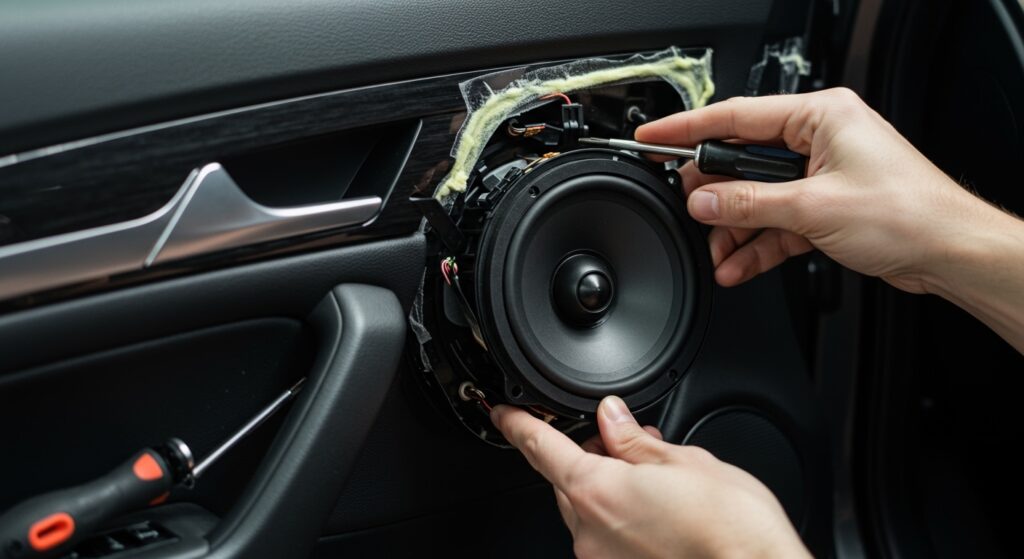
Installing Pyramid car speakers is straightforward, but doing it correctly will significantly improve their lifespan and sound quality. Follow this guide based on our workshop experience.
Step 1: Tool Preparation and Safety
Gather your tools: a Phillips head screwdriver, wire strippers, electrical tape, and plastic pry tools. Disconnect the negative terminal of your car battery to prevent any short circuits while handling the speaker wires.
Step 2: Remove the Door Panel
Use your pry tools to pop the plastic clips holding your door panel in place. Be careful not to snap the clips, especially in older vehicles where the plastic may be brittle. Unplug any power window or lock harnesses before setting the panel aside.
Step 3: Remove the Factory Speaker
Unscrew the old speaker. You will likely find a proprietary plastic connector. You can either use a wiring harness adapter (recommended) or snip the connector and use crimp connectors to attach the new Pyramid wires.
Step 4: Add Sound Deadening (The Pro Secret)
Because Pyramid speakers can be a bit resonant, we always recommend applying a small square of butyl-based sound deadener (like Dynamat or Kilmat) directly behind the speaker on the outer metal door skin. This reduces the “tinny” sound often associated with budget speakers.
Step 5: Mount and Seal
Screw the Pyramid speaker into the factory location. If the holes don’t align, you may need to use a mounting bracket. Ensure there is a tight seal between the speaker and the door—use foam gaskets if necessary to prevent “phase cancellation,” which kills your bass.
Pros and Cons of Choosing Pyramid Audio
Every audio brand has its trade-offs. When asking are pyramid car speakers good, you have to weigh these specific pros and cons against your personal goals.
The Pros
- Extreme Value: You can often outfit an entire car for the price of one single Alpine or Kicker speaker.
- High Sensitivity: They get very loud with very little power from a basic radio.
- Replacement Ease: If a speaker is damaged or stolen, the replacement cost is negligible.
- Variety: They offer niche sizes and “Super Tweeters” that are hard to find in other budget lineups.
The Cons
- Sound Accuracy: They lack the “warmth” and “detail” of more expensive composite or silk materials.
- Build Quality: The terminals can be fragile; we’ve seen them snap if you use too much force during installation.
- Marketing Inflated Stats: Always look at the RMS power, not the Peak power listed on the box.
How to Make Pyramid Speakers Sound Expensive
If you decide that Pyramid is right for your budget, there are three professional tricks we use to make them sound like a mid-range system.
- Use an Inline Capacitor (High Pass Filter): Most Pyramid speakers, especially the 4-inch or 5.25-inch models, cannot handle deep bass. Adding a bass blocker (capacitor) allows them to play only the frequencies they are good at, preventing distortion.
- Adjust the EQ: Turn down the Highs (Treble) by 2 or 3 decibels on your head unit. Since Pyramid speakers use metallic-heavy diaphragms, they can be “bright.” Taming these frequencies makes the sound much smoother.
- Proper Amplification: Don’t use a 1000-watt amp on a speaker rated for 50 watts RMS. Use a modest, clean amplifier and set your gains correctly using a multimeter or an oscilloscope to ensure the signal is clean.
Comparing Pyramid to Other Budget Brands
In the “Ultra-Budget” tier, Pyramid competes with brands like Pyle, Boss Audio, and Dual. In our side-by-side comparisons, Pyramid usually edges out Pyle in terms of tweeter clarity, while Boss tends to have slightly better-looking aesthetics.
However, Pyramid remains the king of the Super Tweeter category. Their “Bullet Tweeters” are consistently rated higher by the DIY community for their ability to handle high-frequency stress in “loud and clear” builds.
Frequently Asked Questions
Can I run Pyramid speakers off my factory head unit?
Yes, you can. Because Pyramid speakers have high sensitivity, they perform well with the low-power output of a factory radio. You will likely notice a significant volume increase over your stock paper-cone speakers.
Why are Pyramid speakers so much cheaper than Pioneer or Sony?
Pyramid saves money by using older, proven manufacturing techniques and less expensive materials (like stamped steel baskets instead of cast aluminum). They also spend significantly less on global marketing compared to “big box” brands.
Do Pyramid speakers have good bass?
Generally, no. Most Pyramid speakers are designed for midrange and high-frequency reproduction. If you want deep, “thumping” bass, you should pair them with a dedicated Pyramid subwoofer in a ported or sealed enclosure.
How long do Pyramid speakers usually last?
With proper installation and moderate volume levels, they can easily last 3 to 5 years. However, if they are exposed to moisture (due to leaky door seals) or constant clipping from an overdriven amplifier, they may fail within a year.
Are Pyramid speakers good for marine use?
Unless the specific model is labeled as “Marine Grade” or “Water Resistant,” they are not ideal for boats. The standard paper or untreated polypropylene cones will degrade quickly in salt air or high-humidity environments.